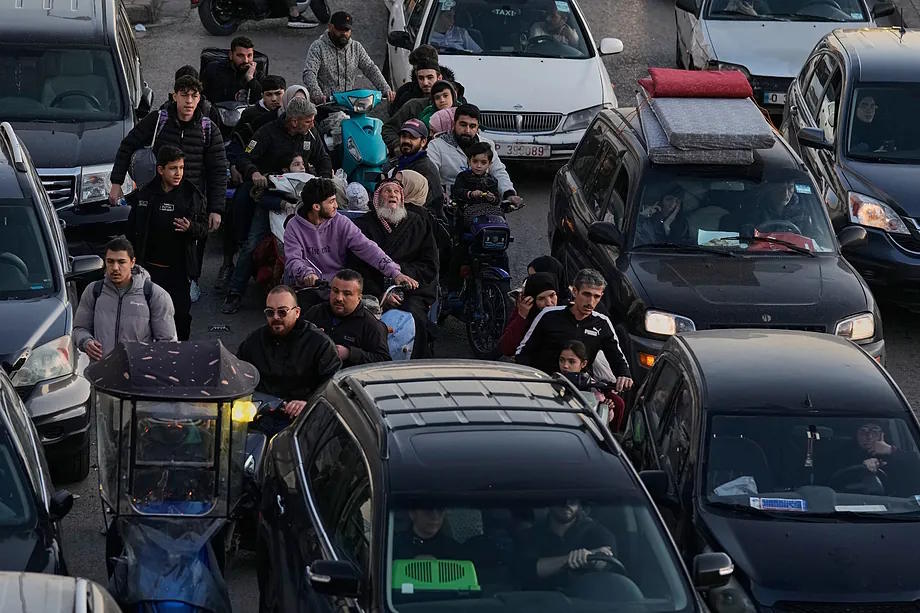
The forced displacement of the civilian population is a war crime stipulated by regulations such as the Geneva Convention or the Rome Statute. However, this Thursday, Israel publicly announced its intention to once again disregard such guidelines by demanding that the approximately 700,000 people living in the southern neighborhoods of Beirut evacuate their homes under the threat of losing their lives.
Shortly after 2:30 in the afternoon, residents of these districts - where the Shiite Muslim community is the majority - received an "urgent" notice on their social networks or even through SMS on their phones with a threatening message in Arabic: "Save your lives and evacuate your homes immediately!" "Head north, to Tripoli, towards the mountains. It is forbidden to go south. That would endanger your lives. We will inform you when you can return to your homes."
The notice, bearing the stamp of the Israeli army, marked large areas of the capital in "red." Not only Dahiya, where besides the civilian population, numerous Hezbollah facilities are also located, the paramilitary organization opposed to Israel, but also Hadath, a predominantly Christian neighborhood.
The order did not allow for discussion. It made no distinction between civilians or militants. It was explicit. It was addressed to "all residents" of those locations.
The news immediately caused absolute chaos in the main Lebanese city. The citizens of the Arab country know that such Israeli threats are followed by devastating bombings hours later.
In case anyone had any doubts, one of the Israeli ministers, the fundamentalist Bezalel Smotrich, released a video in which he anticipated the armed action and said: "Dahiya will soon resemble Jan Yunis." He was referring to the Palestinian town of Gaza, which was literally crushed during the genocide committed by the Israeli army in that territory.
Smotrich's words coincided with reports leaked by several Israeli media outlets such as Channel 14 of their television, which indicated that the Israeli air force was preparing to demolish dozens of apartment blocks in Beirut.
Aware of the impending tragedy, a veritable human tide began to overflow in all directions. The accumulation of vehicles for hours clogged the main avenues of the city.
The shouts of the drivers mingled with the honking of their cars in a hellish traffic jam. The lines of vehicles tried to leave the city in a hurry.
Many ended up blocked. Jalil al-Haj ended up parking his car on the beach in Beirut, not knowing where to go. The 55-year-old Lebanese man had already been displaced for 6 months when the Israelis forced him to flee Dahiya in 2024. "We have nothing to do with this war, but we are the ones who pay the price," he declared.
Jalil was peacefully at home when everything turned into utter confusion. The Israeli announcement mobilized all his neighbors. The building's stairs were filled with people in a panic.
"In a second, all the children were crying, and the women were screaming," he recalled in the afternoon, while still waiting for the Israeli bombs to determine their fate.
"We know that the Israelis do not lie. Whenever they send us such a warning and mark something in red, they raze it to the ground," Jalil added.
Thousands of families were around him, on the coast. Others gathered in the city center. The displaced tried to group around locations they considered safe: congregated around churches, mosques, parks, or hospitals.
In a city that does not forget the boundaries of each neighborhood marked during the years of the last century's civil war, the streets bordering the town's racetrack, the "border" that gives access to Dahiya, were filled with hundreds of fleeing cars trying to decide where to continue their journey.
The Tayouneh square, one of the entry points to the southern neighborhoods, was the scene of a rush of people fleeing, carrying plastic bags. Dozens of mothers pushed their baby strollers and gathered around ambulances, thinking that would protect them.
Another large crowd fled the Palestinian refugee camp of Bourj al Burujneh, also located in southern Beirut.
"How can we live like this, lying on the street?" complained Abdel al-Hassan, 80, who sat on the asphalt not knowing where to go.
Mohamed Ali Zaeb had parked his car on the curb, after being blocked by those driving in the opposite direction, spurred by fear.
Two days ago, he fled Nabatiyeh in the south of the country when Israeli bombings approached his home. He thought Beirut was safer. Big mistake.
"I moved into my brother's house, but I haven't been able to rent any apartment. They refuse to rent it to me if my wife wears a veil. Everyone is against us (referring to the Shiite community)," he said, expressing his displeasure.
Zaeb is not the first to denounce the growing social divide that the new war is generating in this country. Israeli pressure and Hezbollah's actions are reopening the cracks that have always existed between the different confessions.
The decision of the government led by Nawaf Salam to declare illegal the armed wing of the so-called Party of God has exacerbated the crisis between the Iran-aligned paramilitaries and the central power.
Hezbollah's Secretary-General, Naim Qassem, already warned on Wednesday in a televised speech that they do not intend to dismantle their militias and criticized the government.
"The Lebanese government, instead of condemning the Israeli-American aggression and seeking ways to confront it, turned against the resistance (referring to Hezbollah) to complete its mistake and align with Israeli demands," he said, confirming the serious internal political clash facing the country.
Lebanese authorities, starting with President Joseph Aoun, tried to mobilize their diplomatic contacts to prevent Israel's aerial offensive against Beirut. The head of state indicated through social media that he had requested "the intervention of French President Emmanuel Macron."
Aoun's mediation did not seem to have much success. Shortly before 11:00 p.m., Dahiyeh began to be shaken by explosions. Missiles illuminated the night and raised huge columns of smoke into the sky.
"We are attacking forcefully and advancing into Lebanon. I have ordered the army to advance along the border," declared the Israeli Chief of Staff, Eyal Zamir, almost at the same time.
The 136 evacuation orders issued by Israel during the 2024 war - similar to those of this day - affected 25 percent of Lebanese territory and forced nearly 1.4 million people to move from one place to another, as denounced at the time by the NGO Oxfam. "They could constitute a campaign of forced displacement and are a serious violation of International Humanitarian Law," the humanitarian organization stated in its investigation.
Threats against Beirut were intertwined with Israeli bombings in the south of the country, where their troops continue to expand the areas they have occupied since 2024.
According to Lebanese authorities, the fighting has left more than a hundred dead and over 600 injured. Tel Aviv has acknowledged that several of its soldiers have been injured in clashes with Hezbollah militants, who have also responded by launching hundreds of rockets into the northern neighboring country.