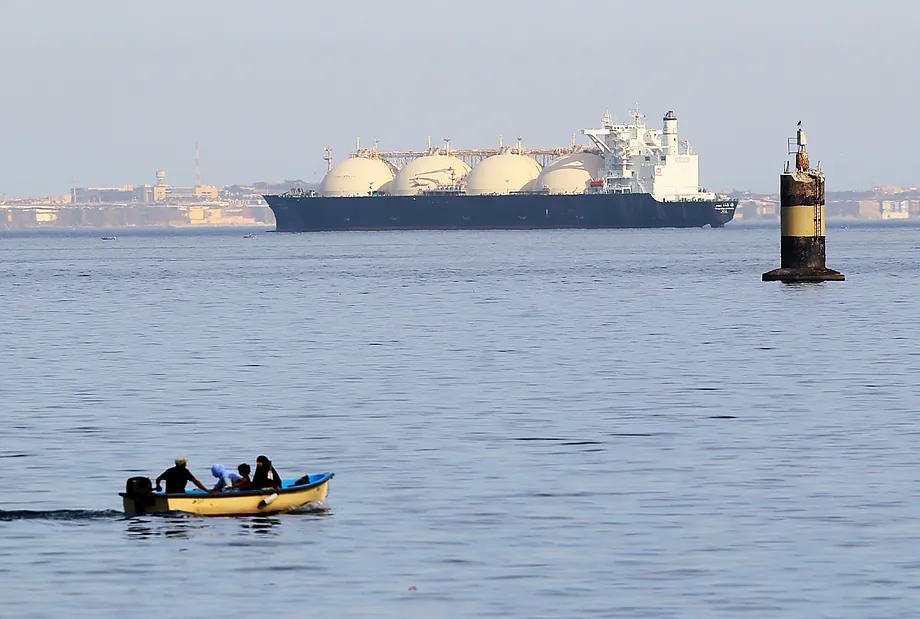
It has already begun. A trickle of liquefied natural gas (LNG) loaded tankers has changed course in recent days while en route to Europe. Their new destination is Asia, a continent desperate to secure its supply at all costs due to the blockade of the Strait of Hormuz, the bottleneck through which the vast majority of the fuel that powers the economies of China, India, Japan, or South Korea flows.
One of these ships was carrying Nigerian gas to France. Midway through the journey, before reaching the French coast, it revised its route and set course for the Asian continent. Kepler monitors, a leading platform in commodity market intelligence, have detected this dynamic in three vessels since the start of the war in the Middle East. "Since Monday, we have monitored three ships diverted from Europe to Asia, two American and one African," confirm industry sources to EL MUNDO, warning that there could be more as diversions are not always visible.
Although the number may seem insignificant, it is important to note that the European Union as a whole usually imports between four and five ships daily. The three diverted ships carried around 536,000 cubic meters of liquefied natural gas. That volume of fuel would be enough to fill 215 Olympic pools or to heat about 2.5 million European homes for a month.
This phenomenon, where one region steals ships from another, is known as lifting. Its appearance in the midst of a global energy shock worries European gas infrastructure managers, who are already monitoring the situation.
Almost all of the gas volume from the Persian Gulf was destined for China, Japan, and other Asian economies. This region has been heavily impacted by the suspension of gas production from Qatar, concentrated in the industrial complex of Ras Laffan. Even if traffic through Hormuz were to resume, it would take at least four weeks to operate normally, warn industry sources. In other words, regardless of how the war evolves, two months of Qatari supply are considered lost.
For the European Union, Qatar represents less than 4% of its gas imports. In Asia's case, the dependency is maximum. The alternative is to buy LNG from other suppliers, from North Africa to the United States. The issue is that, since the Russian divorce, European governments also rely on a huge volume of LNG to fill their reserves before each winter. The result? A frenzied and desperate competition among top buyers from Asia and Europe to secure the same available shipments and vessels.
"China, Japan, and Southeast Asia end up paying a fortune for LNG, especially from Nigeria, a country that doesn't hesitate to break contracts to deliver liquefied gas to those territories capable of paying prices high enough to offset the current high costs of maritime transport," assures another industry source, recalling that Nigeria did the same to Galp during the Ukraine war "and it seems they are going to do it again."
Paradoxically, in 2022, the situation was the opposite: ships destined for Asia changed course towards a Europe desperate to replace Russian fuel. Now, ships carrying European gas for winter are turning midway to place their cargoes in Asia at more attractive prices. In times of war, this financial logic is redirecting maritime routes, altering the physical supply flows in real-time.
Geopolitical circumstances have driven up maritime transport costs, which curiously favors Europe, as it is containing the diversion of shipments to Asia.
"Without Qatar's production, many Asian buyers need LNG, which can come from the United States. But Qatar is not offering the ships it cannot use, so today there are fewer ships available, and they are needed for longer routes. All of this has driven up charter rates [what needs to be paid to ship owners per day to rent them], which have multiplied by ten," explain knowledgeable sources, insisting that given the current situation, no one dares to charter ships at levels of $300,000 per day.
There is a second factor that could limit ship diversions: "Asian buyers facing gas price hikes may stop using gas and switch to coal." The market is already starting to anticipate that the most affected countries, from China and India to Pakistan or Bangladesh, will eventually relax their restrictions on coal use to compensate for the natural gas shortage.
Gas prices in Europe hovered around 50 euros/MWh yesterday, compared to 35 before the war. They are still far from the levels reached during the invasion of Ukraine, when they exceeded 300 euros. However, the cost escalation and its impact on electricity bills, which increase due to gas, will depend on a fundamental variable: the duration of the conflict in the Middle East.
For the Twenty-Seven, the next energy window is the filling of their gas storage facilities, which usually begins in April. Everything indicates that this race will be more costly and also riskier this year, as the Old Continent could be forced to compete with half the world for the same floating shipments if the blockade in the Strait of Hormuz persists.