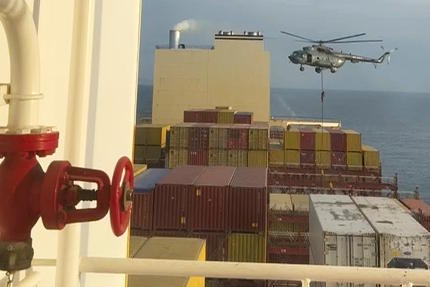
China, Japan, South Korea, Taiwan, Thailand, India, and Pakistan are watching the closure of the Strait of Hormuz with the anxiety of someone contemplating their own carotid artery. The escalating war around Iran is not just a regional conflict: it is a direct threat to the energy heart of Asia. Up to 20 million barrels of oil pass through the strait every day, and most of it is destined for the largest economies in the eastern part of the continent.
Following coordinated attacks by the United States and Israel on Iranian infrastructure and Tehran's response, the strategic focus has shifted to a tiny point on the map but gigantic in its strategic implications: the corridor through which nearly a fifth of the world's oil and a significant proportion of liquefied natural gas from the Gulf transit. That flow that is now blocked is vital for Asian economies above all.
Asia consumes over 60% of global oil and depends on the Middle East for approximately 60% of its imports. Maritime traffic has already been affected: shipping companies suspending voyages and oil tankers anchored awaiting minimal security guarantees. Maritime tracking data shows that transit volumes in early March plummeted by over 80% compared to the annual average.
Japan imports around 95% of its oil from the Middle East, with most passing through Hormuz. Over 40 vessels linked to Japanese companies remain stranded in the Persian Gulf. Tokyo is reviewing its strategic reserves, sufficient for several months but not for a prolonged interruption. On Tuesday, Japan's Foreign Minister Toshimitsu Motegi called on Iran to ensure security in Hormuz. South Korea and Taiwan share similar vulnerabilities: industrial economies with scarce resources of their own and almost total dependence on maritime transport.
India, the world's third-largest oil importer, is watching the crisis with concern. Following Russia's invasion of Ukraine, New Delhi ramped up purchases of discounted Russian oil, taking advantage of Western sanctions. However, at the beginning of the year, under renewed pressures from Washington and facing trade threats from Donald Trump, the Indian government reduced these acquisitions to avoid further friction with its main strategic partner.
Now, India, like other Asian neighbors, is forced to redraw its energy map: longer routes, more expensive insurance, and fierce competition for alternative shipments from West Africa or Latin America, in a market where every available barrel will have more and more suitors.
South Korea announced yesterday that it has seven oil tankers trapped in the Strait of Hormuz. On Wednesday, the South Korean stock market suffered its biggest drop in history due to the conflict. A senior South Korean official also warned that the situation in the Middle East threatens to disrupt shipments of critical materials used in semiconductor production, a key industry in this Asian country. Seoul is a powerhouse in chip manufacturing, representing a significant portion of the global supply and producing almost 75% of the world's DRAM memory chips.
Another delicate case is China. Energy security is a pillar of its political stability. More than half of the oil it transports by sea comes from the Middle East, and a significant portion - around a quarter of those purchases - is of Iranian origin.
Without the supply from Tehran, Beijing would have to turn to the open market at a time of rising prices, further pressuring an economy already experiencing slowdown, a real estate crisis, and persistent deflation. China's strategic reserves, estimated at around 115 days, provide a temporary cushion, and pipelines from Russia and Kazakhstan mitigate some of the risk. But no land pipeline can replace the volume that passes through Hormuz.
Bloomberg reported that senior executives of Chinese energy companies are pressuring Iranian officials to avoid actions that disrupt the exports of Qatari oil and gas passing through the strait. Tehran promised to attack any ship attempting to cross Hormuz. "If anyone tries to pass, the heroes of the Revolutionary Guard and the regular navy will set fire to those ships," Iranian authorities warned.
On Thursday, Chinese authorities instructed their major refineries to suspend diesel and gasoline exports. "If the conflict persists, China does not have the capacity to cushion the impact," says Muyu Xu, a senior crude oil analyst based in Singapore for Kpler, a market research firm. "It would be catastrophic not only for China but for the global market," Xu added. The Chinese Foreign Ministry has described Hormuz as a "crucial international trade route" and has called for an immediate cessation of hostilities.
From Pakistan, where they are also embroiled in their own war against neighboring Afghanistan, they report having several tankers immobilized in Hormuz and are studying contingency plans, including the possibility of redirecting purchases to suppliers using alternative routes through the Red Sea. However, only Saudi Arabia and the United Arab Emirates have pipelines that bypass the strait, and their combined capacity covers only a fraction of the daily barrels that normally cross that passage.
The impact is not limited to oil. Qatar, one of the world's largest exporters of liquefied natural gas, sends a good portion of its shipments to East Asia through the same waters.
"Thailand, India, Korea, and the Philippines are the most vulnerable to rising oil prices due to their high dependence on imports, while Malaysia would be a relative beneficiary as an energy exporter," Nomura stated in a note. "South Asia would face the most severe disruption, particularly regarding LNG supply. Qatar and the United Arab Emirates account for 99% of Pakistan's LNG imports, 72% of Bangladesh's, and 53% of India's."