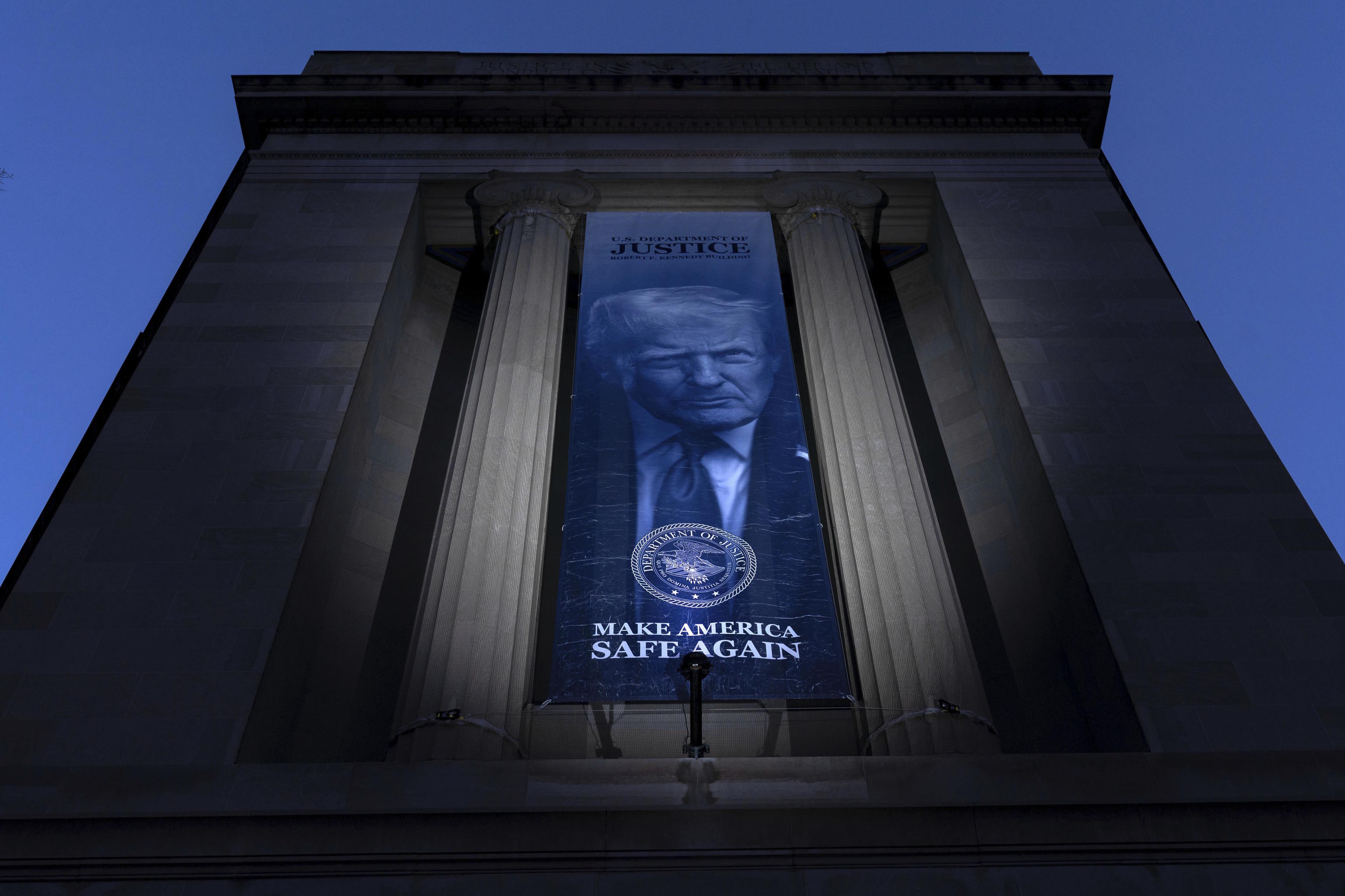
The United States has a long history of interventions to subdue or overthrow foreign leaders. From Commodore Perry's shots in Japan in 1853 to the Monarchy in Hawaii in 1893. From Nicaragua in 1908 to Jacobo Arbenz in Guatemala in 1954, due to the interests of the United Fruit Company. From Mosaddegh's Iran in 1953 to Vietnam. From Granada to Iraq, Afghanistan, or Libya. Sometimes supporting revolutions or coups, sometimes instigating them, sometimes simply invading or threatening to do so.
Donald Trump came to power with an anti-war discourse, stating that wars were over, that the focus should be on America First, domestic issues. That the U.S. would be strong and monitor its backyard, but would never fall into the mistake of nation-building again. But in just a year, the president has transformed into a puppeteer, increasingly pulling the strings on the global stage. Bombing seven countries, capturing or assassinating leaders, imposing puppet governments, threatening and sanctioning judges, parliaments, or presidents who oppose his interests and preferences.
Nothing seems enough for him. On Thursday, in just a few hours, he claimed that he personally had to choose the next Iranian president. "They are wasting their time. Jamenei's son is insignificant. I have to participate in the appointment, like with Delcy [Rodríguez] in Venezuela," he said in several interviews. "Jamenei's son seems unacceptable to me." Hours later, he insisted, saying that his concern is not whether there is democracy in Iran or not, stating that he found it "great" that Iranian Kurdish militias entered by force or that an unelected ayatollah continued to lead. "No, I say there must be a leader who is fair and just. Who does a great job. Who treats the United States and Israel well, and treats other countries in the Middle East well; they are all our partners" (...) "It will work very easily. It will work like in Venezuela. We have a wonderful leader there. She is doing a fantastic job," he assured. It is not a novelty, from Franklin D. Roosevelt onwards, many presidents and advisors have relied on a form of foreign policy summarized in the brutal formula: "he is a son of a bitch, but he is our son of a bitch."
But the president seeks more. That is why he has warned that Havana will be next. "Cuba will also fall. (...) We cut off all the oil, all the money, we cut off everything that comes from Venezuela, which was the only source. And they want to reach an agreement." When asked if the United States was playing a role in the fall of the Cuban government, Trump replied: "Well, what do you think? For 50 years.... that's the icing on the cake," he gloated, stating that his Secretary of State, son of Cubans, Marco Rubio, is in contact with communist authorities.
But there is much more. In recent days, Trump has threatened Spain with an "embargo" and breaking "all ties" commercial for the decision not to authorize the use of the Rota and Morón bases for operations in Iran. He has insulted and threatened the United Kingdom for basically the same reason. And he has pointed fingers at the President of Israel, his great ally, pressuring heavily for a pardon for Benjamin Netanyahu, accused of corruption. "Tell him I'm exposing him," he said in an interview. "It's a disgrace (...) I don't want anything to distract Bibi except the war with Iran. (...) He promised me five times that he would pardon him. I told him I wouldn't meet with him (if he didn't). He's been dealing with that for a year, over Bibi's head," said Trump, who during the judicial process had his ambassador go to court to personally pressure the judges handling the cases.
There is little resemblance to the image cultivated over the years, the promises to and from the MAGA world. Trump is immersed in an interventionist wave, thrilled by the success of the bombing of Iran's nuclear facilities in the summer of 2025 and the capture of Maduro, which he followed as if it were a movie. He believes he is on a winning streak, unstoppable. That if Roosevelt defeated the Nazis and Reagan the communists, he will go down in history as the one who annihilated the ayatollahs' regime. While demanding the Nobel Peace Prize.
The latest cover of The New Yorker portrays the president as a general, like Patton or probably MacArthur, the one who managed Japan after 1945, based on the type of pipe in the caricature. A general president who launches into war in the Middle East from his Florida golf course, renamed War-a-Lago, alongside his caddie, Secretary of War, Pete Hegseth.
The Wall Street Journal, using a direct quote from a senior State Department official, has dubbed the Administration's policy as "Decapitate and delegate." The military removes a hostile leadership and the president leaves the management to those remaining, as long as they comply with the White House's orders. In Venezuela, there were casualties among soldiers, but in Tehran, the attack on Jamenei also took out all the moderates that the CIA had identified as potential replacements willing to collaborate. Without a clear plan, decisions are improvised based on the leader's mood, his humor. Venezuela turned out as desired. Iran, clearly, did not.
That is why Trump has repeatedly encouraged Iranians in recent days to risk their lives by taking to the streets to seize a unique opportunity and take power. Just as George W. H. Bush did with Iraqis in the Gulf War.
On Tuesday, he shared twice on his social media an opinion article from the Washington Post signed by Marc A. Thiessen, former spokesperson for George W. Bush, stating that he has not started a war but is ending one that has been ongoing for 47 years. According to the author, the Trump doctrine implies that there is no need to send soldiers because others will do the job. "In other words, there is no need for a U.S. invasion force. The Iranian people are on the ground, and the country's fate is in their hands. And if things do not go as expected, and a government emerges that resumes its hostile stance towards the United States and its pursuit of nuclear weapons, Trump can also eliminate it," he concluded. Trial and error, trial and assassination, until finding the right one. Senator Lindsey Graham, the hawk who pressured Trump the most for the attack, defends exactly the same.
During his first term, Trump began to weave a network of alliances, largely guided by his then-chief guru, Steve Bannon, who traveled through Europe and the world finding like-minded movements, think tanks, groups to finance and teach the methods that had allowed the creation of the MAGA universe and turned Trump into their leader. With the goal of helping them reach power. In this second term, the approach is very different, less subtle or indirect.
On one hand, the president expressly supports leaders he considers close. Viktor Orban, the Japanese Sanae Takaichi, the Honduran Nasry Asfura, the Salvadoran Nayib Bukele. Javier Milei. He is in the process of funding their foundations and study centers and asserts, convinced, that they have won because of him, as they were lagging behind and his official support changed everything. But besides that, he has started to offer his support in the form of blackmail. In October 2025, when meeting Milei in Washington before the Argentine elections, he conditioned his support for the country on his ally winning: "Our approval depends on who wins the election (...) If the president doesn't win... I know the person he would compete against, I believe, probably, that person is extremely left-wing and has a philosophy that led Argentina to this problem in the first place, so we wouldn't be generous with Argentina if that happens. If he loses, we won't be generous with Argentina," he warned about the rescue package signed between them.
As if that weren't enough, he also does the opposite. During that same period, the Treasury Department sanctioned the Colombian president, Gustavo Petro, his family, and collaborators. And after Maduro's capture, he hinted that Petro could be next. "He has been quite hostile to the United States. (...) I hope he is listening to me. He will be next," he warned. Brazil and South Africa have faced brutal pressures. In July, Trump sent a very aggressive letter to President Lula da SilvaJair Bolsonaro be dropped, and imposed 50% tariffs on Brazilian imports, despite the country having a trade deficit with the US and not a surplus. He also imposed sanctions on Supreme Court Justice Alexandre de Moraes, the case's instructor, to try to prevent Bolsonaro from going to prison. Just as he did with the judges of The Hague, who are not allowed to have bank accounts or operate on the internet, for attempting to prosecute Netanyahu for the Gaza war.
In the South African case, not only did he threaten with sanctions and organize a small meeting at the White House with its president, Cyril Ramaphosa, but he also boycotted G-20 meetings and approved emergency visas for the white population, repeatedly claiming that a genocide process is underway.
"Illiberal Hegemony"
In the latest issue of Foreign Affairs, political scientist Stephen M. Walt points out that we have not yet been able to find a completely accurate label to describe Trump's approach to foreign relations. Terms like 'illiberal hegemony' have been used, as well as the more classic schools, from realist to nationalist, traditional mercantilist or imperialist, in addition to isolationist. "Each of these terms captures some aspects of his approach, but the main strategy of his second presidential term may be best described as 'predatory hegemony'," says Walt. "His main goal is to use Washington's privileged position to obtain concessions, tributes, and displays of deference from both allies and adversaries, seeking short-term gains in what he sees as a zero-sum world."
The thesis is that unlike his predecessors, Trump does not believe that it is always good for his allies to do well, that the system that emerged from World War II has generated prosperity. And that there is no Trump Doctrine per se, only its effects. "The United States has become a predatory hegemonic power. This strategy is not a coherent or well-thought-out response to the return of multipolarity; in fact, it is precisely the wrong way to act in a world with several great powers. It is, instead, a direct reflection of Trump's transactional approach in all relationships and his belief that the United States has enormous and lasting influence over almost every country in the world."
This time, Trump does not have more experienced advisors, but rather enthusiastic and loyal ones who do not question, and that is why, according to the political scientist, "his desire to exploit the vulnerabilities of other states has been given free rein, driven by a group of people appointed for their personal loyalty and by Trump's growing, albeit unfounded, confidence in his own knowledge of international affairs."
All major powers have committed and continue to commit acts of predation, of abuse. However, what distinguishes 'predatory hegemony' "is the willingness of a state to obtain asymmetrical concessions and benefits from both its allies and its adversaries." This is not the case with this Administration, as it has shown time and time again, and was seen again on Saturday in Miami, when it welcomed like-minded Latin American leaders. "A benign hegemonic power imposes unfair burdens on its allies only when necessary because it believes that its security and wealth increase when its partners prosper. It recognizes the value of norms and institutions that facilitate mutually beneficial cooperation, are perceived as legitimate by others, and are durable enough for states to safely assume that such norms will not change too frequently or without prior notice. A benevolent hegemonic power welcomes positive-sum alliances with states that share similar interests, such as keeping a common enemy at bay, and may even allow others to gain disproportionate benefits if it benefits all participants," writes Walt. This is what economist Arnold Wolfers called 'environmental objectives': shaping the international environment so that the overt exercise of power is less necessary. Trump, clearly, is not in that mindset.