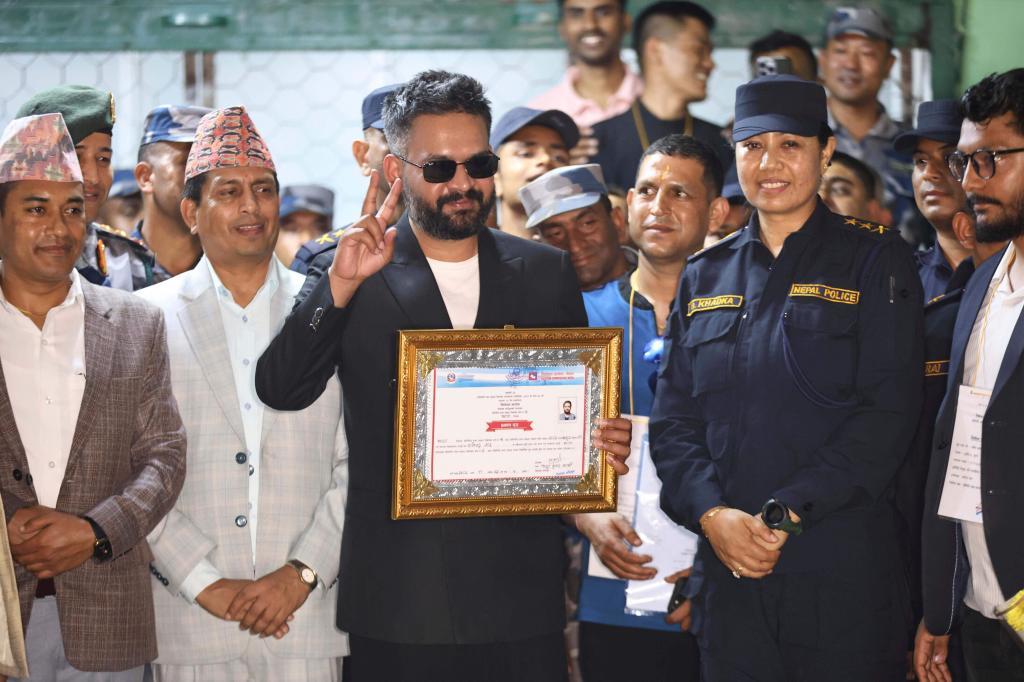
In the dusty streets of Kathmandu, where electric cables hang like vines over ancient temples, rap has become a form of political protest. During months of public unrest, a song played on mobile phones, portable speakers, and student demonstrations: Nepal Haseko (Smiling Nepal), a track with over ten million views on YouTube, with a chorus of children singing the longing of a whole generation: "I want to see Nepal smiling; I want to see Nepalis living happily."
Behind that soundtrack is Balendra Shah, known to his followers as Balen, a rapper with a sharp beard and rectangular black glasses who, at 35, has gone from improvising rhymes in hip-hop competitions to challenging the establishment of the Himalayan nation as a politician. Shah, leading the centrist party Rastriya Swatantra (RSP), is likely to be the new prime minister of Nepal. His party, according to official results, is heading towards a landslide victory having won 122 out of the 165 directly elected seats in the general elections held last Thursday.
Just before the elections, in front of thousands of supporters at one of his rallies, the rapper raised his dark glasses slightly, looked at the crowd, and uttered a simple phrase: "I love you." The response shout was deafening. In a country where politics is usually dominated by septuagenarian leaders and bureaucratic speeches, Shah's emotional connection with the youth has been almost revolutionary.
Just over a decade ago, his name was not part of any political calculations. In 2013, he burst onto the Nepali music scene after winning a popular rap battle called Raw Barz. That night, Shah not only won the duel but became a cultural phenomenon. "More than a rapper, he was a poet," one of the contest organizers would later recall. His songs denounced corruption, ridiculed traditional parties, and spoke of the sacrifices of migrant workers who sustain the country's economy.
Nepal, a nation of 30 million people sandwiched between India and China, had been trapped in decades of unstable coalition politics, clientelism, corruption scandals, and recurrent economic crises. Over 40% of its population is under 35, yet power remained in the hands of much older leaders. In that context, Shah managed to channel the generational discontent.
His entry into politics came in 2022. As an independent candidate, without the support of major party machinery, he unexpectedly won the mayoralty of the capital, Kathmandu. That victory was seen as more than a personal triumph: it was the first sign that urban youth was ready to challenge the old guard.
In September 2025, a wave of protests led largely by students and Generation Z youth shook Nepal. It all started with what seemed like a minor decision - a temporary ban on social media - but quickly turned into an uprising against corruption, inflation, and economic stagnation. The demonstrations ended with at least 77 dead and government buildings set on fire, forcing the resignation of then-Prime Minister KP Sharma Oli.
During those chaotic days, Shah's name began to be mentioned as a possible interim leader. Many Generation Z activists saw him as the face of the revolt. And now he has risen to the top by defeating former leader Oli in the elections, the same leader whose fall was celebrated by millions of voters months earlier.
Analysts point out that Shah's political style will be as unpredictable as his rhymes. He has publicly insulted traditional parties, criticized India, China, and the United States - the three major players influencing Nepali geopolitics - and even threatened to burn political symbols. His detractors accuse him of being a populist and question whether a rapper is prepared to govern a country.
His success undoubtedly lies in the magnetism he has achieved among the youth. On Facebook, he has over 3.5 million followers, one million on Instagram, and nearly another million on YouTube, figures that give him a digital audience uncommon in traditional Nepal. He rarely grants interviews to traditional media, preferring podcasts, television shows where he acts as a judge, and casual videos on his social networks.
His campaign focused on presenting himself as a scourge of corruption, a narrative not without contradictions. Those expecting a more austere lifestyle from him do not view positively that Shah goes everywhere in a Land Rover Defender valued at around $275,000. The vehicle, it was later revealed, had been a gift from a businessman for his campaign, sparking a debate on transparency and political financing.
Before pursuing music, Shah studied civil engineering in his country and then pursued a postgraduate degree in India. This technical background, combined with his communication skills and rap appeal, has fueled the image of an outsider capable of speaking the language of the streets without giving up on governance. His followers see him as proof that Nepali politics can reinvent itself. His critics, however, fear that his confrontational style may worsen the already fragile institutional stability of the country.