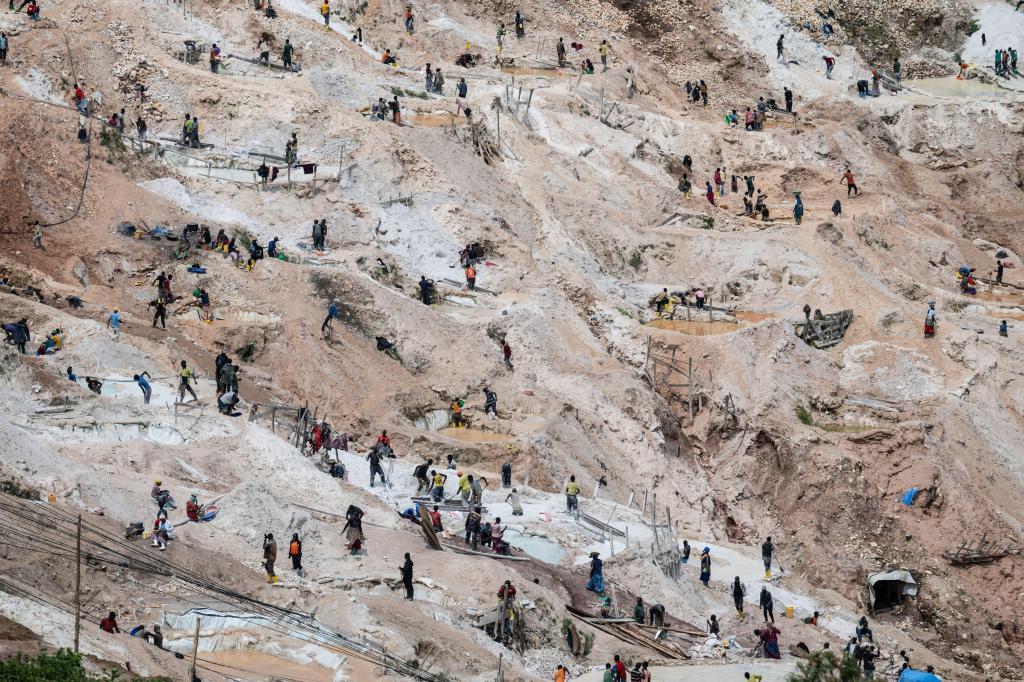
At least 300 people have died in a new collapse that occurred in the mining area of Rubaya, in northeastern Democratic Republic of Congo (DRC), as reported to Efe by a local civil society leader on Sunday.
The landslide occurred on Saturday due to the rain that fell on the Gakombe mining operation, affecting not only artisanal miners working in that deposit, but also families living in the surrounding areas, stated Telesphore Nitendike, coordinator of the civil society in Masisi (where Rubaya is located), to Efe.
"We can estimate more than 300 (fatal) victims, mainly among the surrounding households and also among the miners themselves, many of whom lost their lives," explained Nitendike over the phone, clarifying that this is a provisional count.
"More than 40 families," he specified, "were swept away by these landslides, including the miners themselves. It is tragic what happened (...), especially because the rescue efforts were not organized by specialists." The civil society leader deplored the lack of organization in the mining area of Rubaya, located in the North Kivu province and controlled by the rebel group March 23 Movement (M23), which operates in that territory with impunity, fostering chaos according to Nitendike.
The incident on Saturday occurred after over 200 people, including about 70 children, died in a collapse that took place on March 3 in a coltan mine in Rubaya, as confirmed by the Congolese government last week.
"Another problem is that the search for the latest landslide has not ended. The bodies are still buried under the rubble. That is another tragedy," Nitendike recalled.
The same mining area of Rubaya was the scene of another collapse caused by rain on January 28, which resulted in the death of around 460 people, as confirmed at the time by the coordinator of the civil society in Masisi to Efe, although the Congolese government only estimated 200 fatalities.
The Congolese government then denounced an "organized system of looting and illegal exploitation" of natural resources by the M23, emphasizing that national authorities had imposed "a ban on all exploitation activities" in the area for security reasons before the rebels took control of this territory.
The conflict in eastern Congo worsened at the end of January 2025 when the M23 took control of Goma, the capital of North Kivu, and weeks later, of Bukavu, the capital of the neighboring South Kivu province, after clashes with the Congolese army.
This area is rich in minerals such as coltan, essential for the technology industry in the manufacturing of mobile phones. Meanwhile, mining accidents are common in the country, where many mines are operated in an artisanal manner without following necessary safety regulations and measures, and in many cases, are run by armed groups.