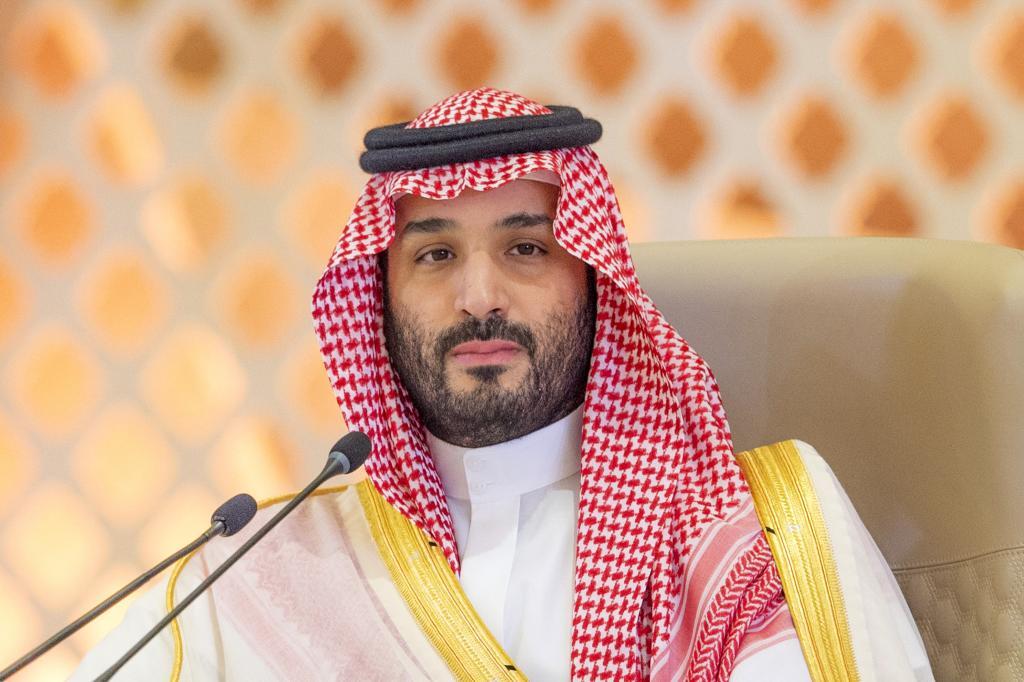
It is not difficult to imagine the powerful and ruthless Saudi prince, Mohammed bin Salman (MBS), sipping some fruit juice as a toast when he was informed that the great Iranian ayatollah Ali Jamanei had been taken down. After all, the Shiite cleric was the main antagonist of the strongman of Riyadh in the volatile powder keg of the Middle East. Today, the echoes of the Heir's words in The New York Times in 2017 resonate, when he referred to Khomeini's successor as the region's "new Hitler." And not even the fact that in recent years there had been a political and economic rapprochement between Iran and Saudi Arabia could hide the old rivalry between the two Gulf powers to extend their conflicting interests beyond their respective borders.
This helps to understand the double game that, according to all the information that has been revealed in recent days, the Desert Kingdom would have maintained in the face of the attacks by the United States and Israel on Iran, which have triggered the regionalization of a war with unpredictable consequences and that threatens once again to blow up the fragile political status quo in the region. And it is that, while in public Riyadh called for negotiation and advocated for a diplomatic solution to the conflict, urging Washington to avoid bombs, revelations from different diplomatic actors lead to the conclusion that, at the very least in recent weeks, it would have pushed Trump to act to crush the ayatollah regime.
The Saudi Minister of Defense, Khalid bin Salman, brother of MBS and one of his main foreign policy advisors, held different meetings earlier this year with both the president's inner circle of President Trump and with diplomats and top-notch think tanks in the US, to whom, as revealed by The Washington Post and other media outlets, he would have warned that if military action was not taken against Tehran immediately, their regime would become much "more emboldened". The spokesman for the Saudi embassy in the American capital, Fahad Nazer, came out to deny it -what else could he do-. But Riyadh's movements suggest that it was more than aligned with the plans of the US and Israel, despite the fact that until the eve of the outbreak of the Epic Fury operation it maintained the public narrative that it would not provide space for any attack.
The situation represents a delicate crossroads for Saudi Arabia. With its public containment strategy, it sought to avoid possible retaliation from Tehran once the war broke out, but behind the scenes, it is evident that it savors the historic opportunity to see its great rival definitively brought to its knees and to establish itself as the sole bulwark of the Gulf. It has been Riyadh's dream since the triumph of the revolution in Iran in 1979, which turned the Islamic Republic and the Petro-monarchy into almost irreconcilable enemies. And for the astute and ambitious MBS - who de facto runs the country, given that his father, King Salman, at 90 years old is in very delicate health, almost on the sidelines of government decisions for a decade - a tempting opportunity has arisen that he could hardly let slip away, even though in the medium term it could be a double-edged sword, as Israel's absolute dominance in the entire new Middle East sooner or later will also clash with Riyadh's interests.
For now, the reprisals of the wounded animal that is today the ayatollah regime have reached all neighboring Monarchies, including Saudi Arabia, which is suffering blows to some of its critical infrastructures, such as the Ras Tanura refinery, operated by Saudi Aramco, which forced operations to be temporarily suspended earlier this week. Iranian President, Masoud Pezeshkian, apologized yesterday to his Arab neighbors, although he later clarified that they will continue to attack US bases and targets in all countries in the region.
The Desert Kingdom has always sheltered under the American security umbrella, but this time it feels that its strategy has flaws. The worst thing that could happen to Riyadh and its allies in the Gulf Cooperation Council is a completely uncontrolled escalation of the conflict, without a clear timetable or objective from Washington and Tel Aviv, which could seriously damage the region's economic interests and threaten the fragile security architecture of these countries. A prolongation of the conflict leading to a long asymmetric war of resistance and attrition will also escalate internal tensions in some of these kingdoms that are like pressure cookers.
Saudi Arabia itself, with a regime that exercises repression as fierce as Iran's, has 15% of Shia population - the branch of Islam of which Tehran is the world's great beacon - always subjugated and very sensitive to what is happening. Or, for example, in the small Bahrain, a state that survives through its umbilical cord with Riyadh, the majority of the population is also Shia, despite its Monarchy and all the ruling elite being Sunni, and there are already riots and clashes between the population and the police, fearing a repetition of an uprising as serious as the one in 2011 that put the Al Khalifa dynasty on the ropes.
Saudi Arabia activated its first Thaad air defense system last year to shoot down ballistic missiles - of American military technology - and the development of three more was planned throughout 2026. During the 12-day war between the US and Israel against Iran last June, Riyadh refrained from providing interceptors to help Tel Aviv, among other reasons to avoid retaliation from the ayatollahs, this time the war in the region leads to considerations of actions by the Desert Kingdom that were previously unthinkable, which many of its citizens consider a betrayal of the umma - the global community of Muslim believers - by the authorities guarding the most sacred places of Islam.
Saudi Arabia and Iran resumed their diplomatic relations in March 2023, after seven years of cold war with hardly any channels of dialogue, in a crucial gesture of geopolitical thaw sponsored by China. There were many reasons that led Mohammed bin Salman to approach the Khomeini regime. On the one hand, the Saudi Heir did not feel entirely secure, given that the policy then driven from Washington by the Biden Administration generated enormous distrust among the Gulf Petro-monarchies, who felt -contrary to what Trump promised upon his return, whom they welcomed with open arms- that US support was not going to be unconditional. But, beyond that, Bin Salman shook hands with his enemy after some monumental failures such as the military operation in Yemen, which, after eight years of a costly war, left thousands dead but a humiliating inability for Riyadh to crush the Houthi rebels - supported by Tehran. Although Saudi censorship prevented criticism of MBS, that showed that the future king's impetus is not always linked, by any means, to making the most sensible decisions for his nation.
But that Riyadh-Tehran rapprochement was never entirely sincere. Bin Salman did not hide his concern -exactly like Israel- about the advances of the Iranian nuclear program. In his explosive statements in 2017, he not only compared Jamenei to Hitler but emphasized that they had "learned from Europe that appeasement does not work" to demand more assertiveness from the West against the ayatollahs. And in 2023, while with one hand he shook hands with the Iranian government, with the other he waved the red flag and warned that if his neighbor advanced towards acquiring the atomic bomb, Riyadh considered itself urged to do the same.