The missile impact left a huge crater in the center of Nabi Chit. A hole so immense that it made the devastated houses around it seem small. In one of them, a red Mercedes could be seen, with its wheels pointing to the sky, perched on the third floor of the building, whose facade had disappeared.
"There were some members of the Party (Hezbollah) inside but they managed to run out before the explosion. The car flew up there," explained Ali Al Musawi, amidst the ruins that now surrounded the restaurant he opened 26 years ago.
Despite the destruction surrounding him, 69-year-old Ali spoke calmly, as if normalizing the horror. For him, this is just another chapter in the bloody and endless struggle that began in 1948 when the Arab nation found itself facing the newly created Israel on its borders.
"We have been bombed 32 times since October 2023 and we have 132 martyrs (referring to the dead)," he said in a monotonous tone, as if talking about the weather or any other triviality.
Musawi's defiant tone was shared by the rest of the residents of this small Lebanese town, located in the Bekaa Valley, about 80 kilometers from Beirut, despite the high cost in lives of the latest clash.
According to the Lebanese Ministry of Health, at least 41 people died and many more were injured during the assault carried out by the Israeli military against Nabi Chit during the early hours of Friday to Saturday.
The operation, so far the bloodiest of this ongoing conflict, was organized with a singular objective: the Israelis intended to find the remains of pilot Ron Arad, who was captured in 1986 during another of Tel Aviv's cyclical attacks on Lebanese territory. Arad was captured by a local armed group and disappeared since that date.
The search for Ron Arad has taken on an almost mythical character in Israel, which has never stopped looking for his remains.
The Israeli army spokesperson, Avichay Adree, confirmed the intervention of his country's troops and its failure. "As part of the activities of the Israeli army in Lebanon, special forces carried out an operation to find clues related to the missing pilot Ron Arad. We have not found any leads," he said, denying that the commando had suffered any casualties.
The Israeli action could be part of a movie script, although the casualties are real.
Muflaj Shukar lives next to the cemetery of Nabi Chit, where the skirmish began. The Israelis had started bombing the surrounding areas of the town after nightfall. Nabi Chit had been included, along with two other nearby villages, in the list of locations that Tel Aviv demanded be evacuated by its residents.
According to his account, four Israeli helicopters transported the soldiers to the nearby mountains, from where they headed to Nabi Chit in several vehicles.
"A group of women noticed something strange when they saw the Israelis near the cemetery. They were dressed in Lebanese army uniforms and were using three ambulances. They started shouting, and immediately the neighbors grabbed their weapons (possession of machine guns is an ancestral tradition in the Bekaa) and started shooting at the Israelis," Shukar recounted.
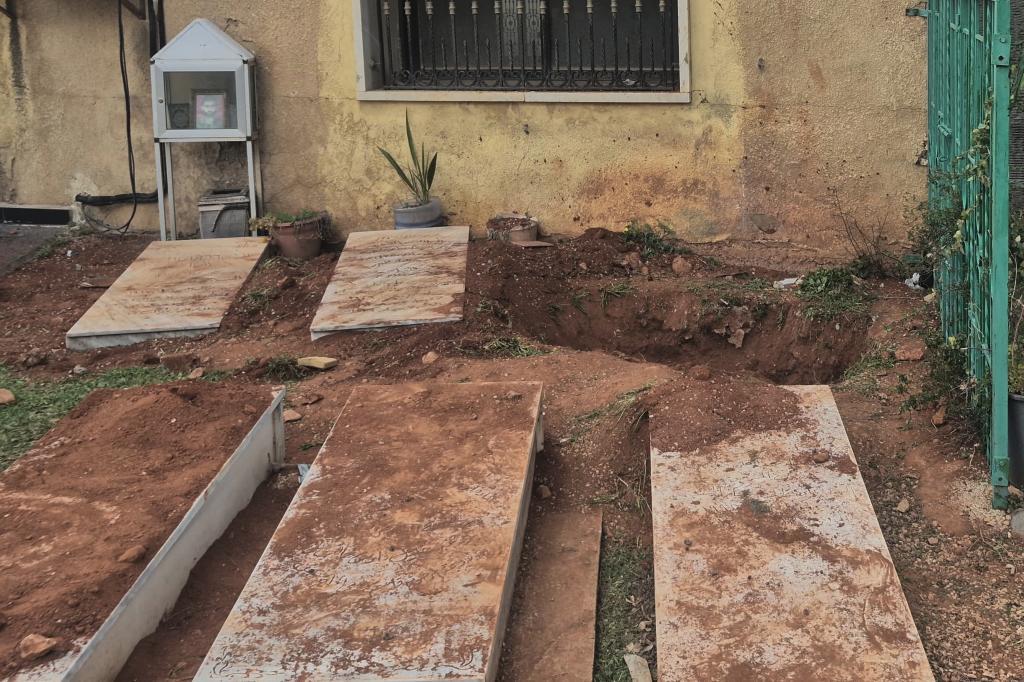
The Lebanese man spoke among the tombstones. A few meters from the hole left by the Israelis, who had dug in a corner.
At the entrance of the cemetery, there was a four-wheel drive vehicle riddled with bullets. One of its passengers, whoever it was, left a trail of blood on the vehicle's seat and then on the asphalt of the road.
The brutal confrontation began before midnight and lasted for hours. Survivors described a night dominated by absolute horror. The videos they showed revealed how the sky lit up with flares or bursts as they tried to reach the Israeli aircraft.
"The Israelis called us shortly after 11:00 pm and told us to leave. They started bombing 15 minutes later. It felt like a continuous earthquake. I had to cover my ears to bear the noise of the explosions," narrated 40-year-old Munira al Musawi, who remained hidden in her house with a dozen other family members, including eight children, who kept "crying and screaming."
Debris from destroyed buildings at the site of an Israeli airstrike on the Haret Hreik neighborhood in the southern suburbs of Beirut.AFP
Outside, Israeli planes, drones, and helicopters were trying to clear a path for their commandos to escape from Nabi Chit.
"The whole village was covered in smoke. It looked like fog," added Ali Al Musawi. "There are bodies we haven't found yet. They must be under the rocks."
Signs of the spectacular battle that took place in the village were evident in its streets. The entrance was almost blocked. Another rocket had blown up part of the road, swallowing a jeep that got trapped in the hole.
Several streets were littered with shattered glass on the ground, alongside debris and electricity cables torn by the explosions. Dozens of businesses and homes were damaged by shrapnel.
The mayor of the village, Hani al-Musawi, specified that it was the "residents themselves" who confronted the soldiers. "Here, everyone supports Hezbollah, but it was the people, not Hezbollah, who fought the Israelis," he added.
Among the casualties were the nine members of the same family. Another addition to those erased by the horror of this war.
As was the case during the conflicts of 2023 and 2024, Nabi Chit is far from being an exceptional case. Tragic events are a constant in the entire Bekaa region, as well as in the rest of the country.
Near the city of Zahle - on the road that connects Beirut with the Bekaa - 30-year-old Jumaa Jeddo recalled how he came across the "jumble of human pieces" he found on Thursday in front of his small café when another Israeli drone attacked a car, killing two people. Among the victims was a member of the Lebanese police.
"The first missile killed them. The car kept moving, and the second one left them in pieces. Everything was covered in blood."
The victims are not only Lebanese. Two soldiers from the United Nations forces deployed in the south of the country were seriously injured on Friday when their position was hit by a projectile. The images of the incident showed the UN facilities engulfed in flames.
The two soldiers were from Ghana, a country that stated that the attack represented "a violation of international law equivalent to a war crime." Lebanese President Joseph Aoun accused Israel of being responsible for the action against foreign forces.
On Saturday, Israeli Defense Minister Israel Katz once again threatened Lebanon, stating that the entire country - not just Hezbollah - "will pay the price" if the local government does not disarm the paramilitaries.
The Israeli demand is an impossible hypothesis since the Lebanese army has been facing a de facto embargo by Western countries for decades, preventing it from acquiring military means to confront the irregular forces led by Naim Qassem.
Katz's words suggest an escalation of the conflict in Lebanon, which has already spread to numerous regions. Beirut authorities estimate that the five days of conflict have already claimed the lives of about 300 people and left over a thousand injured.
Tel Aviv once again demanded during the day that all residents of the southern country flee their homes, adding this imposition to the one already dictated over a significant area of Beirut.
Evacuation of 8% of the country
According to calculations by local newspaper L'Orient Le Jour, Israel has demanded the evacuation of 8% of the country, including 10 neighbourhoods in the capital, Beirut.
The newspaper reported that the maps drawn up by Israel to delimit the area that civilians must leave in Beirut included predominantly Christian neighbourhoods such as Hadath and even Baabda, home to the Presidential Palace and the Spanish embassy.
The NGO Norwegian Refugee Council estimated on Friday that Israeli warnings and bombings have already caused at least 300,000 Lebanese to flee. The forced displacement of the civilian population is a war crime under regulations such as the Geneva Convention and the Rome Statute.
In the middle of the afternoon in Nabi Chit, many residents appeared to be packing their belongings to leave the village, which is still among the locations Israel plans to attack again.
The Israeli operation may be just a continuation of Tel Aviv's endless search for Arad. Last December, the Lebanese media reported the possible kidnapping of former captain Ahmed Shukur.
The former member of General Security disappeared on 17 December last year while on his way to sell a plot of land near the aforementioned village of Zahle. A person detained by the Lebanese security forces admitted to receiving payment of $100,000 by Israeli intelligence services to organise Shukur's abduction.
The cemetery targeted by the Israeli commando unit on Friday belonged to the Shukur clan, one of the four major families living in Nabi Chit.
Located in the hills bordering Syria, at an altitude of about 1,200 metres, Nabi Chit occupies a prominent place in the history of Hezbollah. One of its most distinguished founders, its second secretary general, Abbas al-Musawi, was born here and was assassinated along with his wife and son by Israel in 1992. The mausoleum where his remains rest is located in the same town.
The streets of Nabi Chit are adorned with portraits of residents who have died in armed clashes with Israel. There are also photos of the late Hasan Nasrallah, who succeeded Musavi. The latest additions to the roads of the Bekaa are posters paying tribute to Iranian Ayatollah Ali Khamenei, who was the spiritual leader of Hezbollah.
'Your sound is gone. But your echo still fills the distance,' read one of the banners placed along the roads, next to the portrait of the cleric.
Unlike other regions of the country, in the Bekaa it is difficult to find anyone who doubts the relevance of involving Lebanon in the war unleashed by Israel and the US when they assassinated Khamenei.
'Here we are all part of the resistance. Our families were here before Israel existed and will still be here when it disappears,' Munira al-Musawi proclaimed in the face of the desolation that surrounded her.