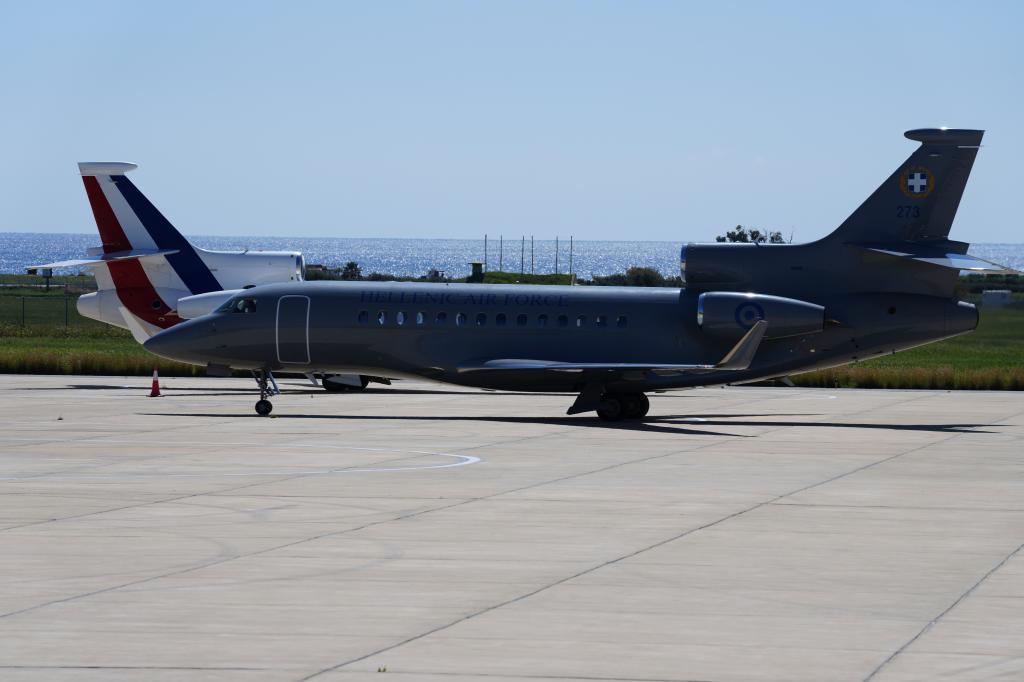
Emmanuel Macron will travel to Cyprus on Monday to express "the solidarity of France and the EU" following Iranian attacks and with the mission to "strengthen security in the Eastern Mediterranean," with the imminent arrival of the aircraft carrier Charles de Gaulle. The visit of the French president has been preceded by demonstrations on the island against the British military presence at the Akrotiri base and harsh criticism against Prime Minister Keir Starmer for his delayed response.
France sent the frigate Languedoc to Cyprus last week, shortly after Greece announced the dispatch of two warships. Spain has also sent the frigate Cristóbal Colón, and Italy and the Netherlands have committed to providing naval assistance to the island in the coming days.
British Prime Minister Keir Starmer, on his part, announced the dispatch of the warship HMS Dragon to Cyprus, as well as helicopters with anti-drone capabilities. However, the Cypriot ambassador to the UK, Kyriacos Kouros, stated that his country is "disappointed" by the lack of information and the delayed response from London following the Iranian drone attack on the Akrotiri base of the Royal Air Force.
Emmanuel Macron will meet on Monday in Paphos, on the southwest coast of Cyprus, with President Nikos Christodoulides and Greek Prime Minister Kyriakos Mitsotakis. According to a statement from the Elysée, the objective of the visit is to coordinate the defense of the Eastern Mediterranean against possible attacks and "contribute to deterrence in the region."
The "reinforcements" will begin to consolidate on Tuesday, with the expected arrival of the frigates Languedoc and Cristóbal Colón. The arrival of Charles de Gaulle is expected by mid-week, which moved after maneuvers in the North Atlantic and entered the Mediterranean on Friday, accompanied by its entire naval unit consisting of two frigates, an escort ship, a tanker, and a submarine.
The Charles de Gaulle is equipped with 40 aircraft, including Rafale combat jets, surveillance and early warning aircraft, and Caiman Marine helicopters. The 260-meter aircraft carrier has a crew of 1,900 sailors, and its mission will be to protect France's allies in the region, in addition to strengthening the security of Cyprus as a member of the EU.
"France must ensure its own security, that of its citizens and its bases, as well as those of its allies in the region," emphasized Macron in his televised speech last Tuesday. "We have defense agreements with Qatar, Kuwait, and United Arab Emirates," reiterated the French president, who has also offered himself as a "mediator" to prevent Lebanon from "being dragged into war."
"Our deterrent force is robust and effective, and anyone daring to attack France knows the unsustainable price they would pay," warned the French president, who nevertheless stated that the missions of the deployed military force will be "strictly defensive."
"Our presence in the Mediterranean Sea is based on a defensive logic to defend our interests," declared Air Force Deputy Minister Alice Rufo to BFMTV. "The arrival of the aircraft carrier Charles de Gaulle will allow us to have additional air resources. It is about acting in a more active, efficient, and faster way."
Alice Rufo also pointed out that the presence of Charles de Gaulle in the area also has a symbolic dimension of "demonstrating power": "It means that we defend our interests, that we are here."
The American aircraft carrier Gerald Ford and the destroyer USS Bainbridge - part of its naval unit - entered the Red Sea on Thursday and joined the aircraft carrier USS Abraham Lincoln, operational in the Arabian Sea. President Trump criticized British Prime Minister Keir Starmer last Sunday for considering sending two British aircraft carriers to the Middle East at this point: "We no longer need them. We do not need people to join wars that we have already won!"