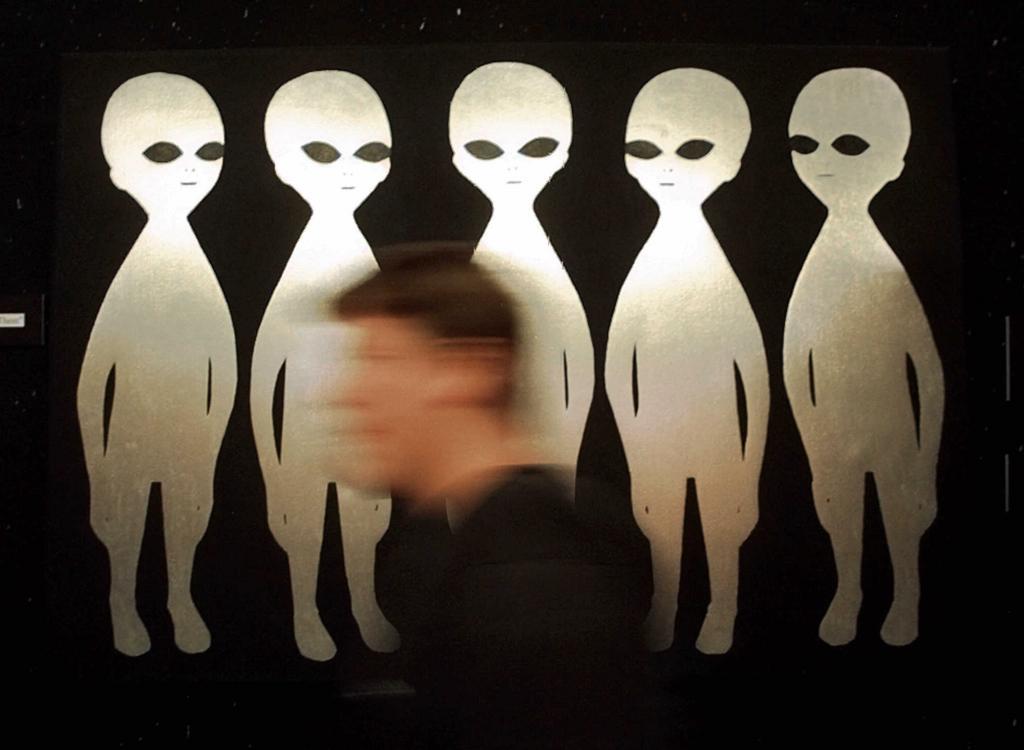
If no extraterrestrial has contacted you, it is likely because you drink too much coffee. It is also not advisable to consume alcohol as it can deactivate the satellite function of your DNA. Simply sleeping eight hours is not enough. The ideal way to become a receiver of information sent by non-human intelligence is to practice the ni-ni rule. Sleep eight hours, wake up for a while, and then sleep for one more hour.
"In summary, I believe, and there is evidence to support it, that our DNA functions both as a receiver and as a transmitter. It does so at a specific frequency, which interestingly is the same one we use to communicate with our satellites in deep space. In a way, humans are like satellites. That's why it's important to tune the body and DNA correctly. Coffee completely cancels the signal."
This recipe comes from Tyler, a pseudonym for an American scientist. He started working in his country's space program at 18. Involved in most launches, the Challenger shuttle accident on January 26, 1986, changed his life. He left NASA. Now, inspired by information falling from somewhere in outer space, he develops biotechnology. The first sign of his transformation into a conduit for the human race came when a U.S. Army general wanted to present a project to Tyler. He interrupted him. He already knew the experiment would work. "Don't ask me how I knew. I just did," he said. The general believed in Tyler. And it worked.
It was a milestone in his scientific career.
Tyler confided his secret to Diana Walsh Pasulka, a historian of religions and director of the Department of Philosophy and Religion at the University of North Carolina. Pasulka has captured this in The Believers (Errata Naturae), an essay that organizes the evidence of the emergence of a new religion based on UFOs, which have become symbols of hope, fear, salvation, and meaning in these hyper-technological times.
"I never believed in UFOs," clarifies the professor in a video call. She is also a specialist in the relationships between spirituality, technology, and popular culture. "While writing my book on purgatory, I found many records in Catholic historical archives. In Europe in the 13th, 14th, and 18th centuries, there were people who saw things in the sky. They described them in religious terms: souls from purgatory, the house of the Virgin Mary floating in the sky, things like that... I started keeping a record of all cases. Then something happened: a friend suggested I attend a conference where people had seen UFOs. I recognized a pattern. They all interpreted it in an almost religious way. They had that attitude of 'This changed my life.' So I thought: this seems like a new form of religion. Even a new form of religion caused by screens. That's how it all started. I thought it would be easy to gather information about people's beliefs through ethnography, that is, by talking to them. But what happened next was not what I expected."
A few days ago, former U.S. President Barack Obama spoke on a podcast about the existence of UFOs with total naturalness. Trump intends to declassify government information on extraterrestrial life. In July 2023, some U.S. military personnel testified in Congress to having interacted with "non-human remnants," opening the door to intergalactic events. And the National Geographic documentary UFOs seems to have demonstrated the existence of some physical evolution in the brains of those contacted. Or could it be an implant after undergoing an alien examination? The Believers lays the groundwork to approach a conclusion: there is something that exists.
Diana Walsh Pasulka is as surprised as anyone. "Yes, it is a physical phenomenon. I met many contactees. Some didn't even know each other. But they were all seeking data to understand what they were seeing and dealing with." Most had been contacted as children. Like James, another scientist investigating the phenomenon who openly declares himself an "experiencer." When he was five or six years old, small beings began appearing in his bedroom. Paralyzed, he could see the glowing dwarfs observing him by the bed. As a teenager, one night while delivering newspapers, he passed through the forest. "Everything was out of place there. A formation of lights about six meters wide was slowly and silently flying over the treetops. He felt time distorting. He was enveloped in a white light, almost solar, with no apparent source."
As an adult, he again hosted another presence in his room. "It was translucent, like mist. A voice inside his head said, 'Sleep.' And he did."
"I realized that my book was much more challenging than I thought," comments the author. "To be honest, I had to include this group of people and what they believe in my book. It's not just a religion. There are people within the government who believe this. I had to write about it. My editor didn't like it at all. And I would reply, 'I wish I didn't have to say it.' But it's exactly what they are telling me. So I will put it in the book saying that I don't know if it's true." Deep down, she knew she wasn't dealing with misinformation. "They were not misinformers because I had known them for a long time."
The Believers proposes a journey through the common areas of religions. When the professor addresses the dogmatic, there is an inversion of a key factor. Common sense, replaced in most beliefs by faith, applies here. Scott, founder of In the field (the special bodies that fight against fraud and manipulation of UFO photographs or videos that appear on the internet), warns: "Above all, we encourage common sense."
Scott disappeared from home at three years old. He was found by his parents in the field. He claimed to have spoken with cows: they were horses. He then experienced strange, slightly eerie dreams, featuring a giant praying mantis spying on him through the window. "Common sense involves maintaining an agnostic stance. It doesn't make sense to say it comes from Andromeda. We shouldn't rush," clarifies Walsh Pasulka.
"It's not a normal faith. It's an intention. It's the motto 'I want to believe.' It would be fun or nice to believe in the possibility of UFOs existing."
The research led the professor to meet some agents dedicated to investigating celestial appearances. There is a B league of scientists who prefer to seek answers without publicity. In reality, they contacted her as her work became more popular. Everyone wanted to know what she was up to. The text keeps alive another myth: why does it seem that UFOs only visit Americans? "When I started this study, I also thought that this belief system existed only in my country. But no. I discovered that people from all over the world share it. It's just that the United States tends to think it's quite special."
For Diana, the UFO religion maintains a faith in waiting. Everything seems to be connected in some way to fiction, which has, as she explains, contributed to changing the worldview of millions of people. Validating the stories of The X-Files as if the plot had been constructed by picking up a lost thread from official government documents, or confusing Star Wars with reality by channeling the obsession with George Lucas' films on the internet, has built a potential faith. Unlike Catholics who receive faith as a gift, here people don't believe: they want to believe. "It's the motto I want to believe. It's not a normal faith. It's an intention. Saying I believe would be admitting that you believe in UFOs. It's a conditional admission. It would be fun or nice to believe in the possibility of UFOs existing."
What's inside? 'Some believe that the ship itself is conscious. Others describe small beings. Other scientists talk about the hypothesis that it is ourselves from another dimension who are visiting us, which is why interactions are very limited. So as not to change anything in the present.'
On her first foray into the unknown, Diana Walsh Pasulka was blindfolded. Tyler drove her through the New Mexico desert. They were going to recover the remains of a ship that crashed in 1974. Shortly after arriving, the metal detector revealed the location of a piece of the artefact. It was stuck at the bottom of a hole between two rocks. They soon found another one. Tyler believes they belong to the ship's hull. 'Talking about non-human intelligence takes us back to religion. Religion is the interface that each culture has developed organically to deal with non-human intelligences. Fifteen years ago, it would have seemed crazy to me to be there,' looking for aliens.