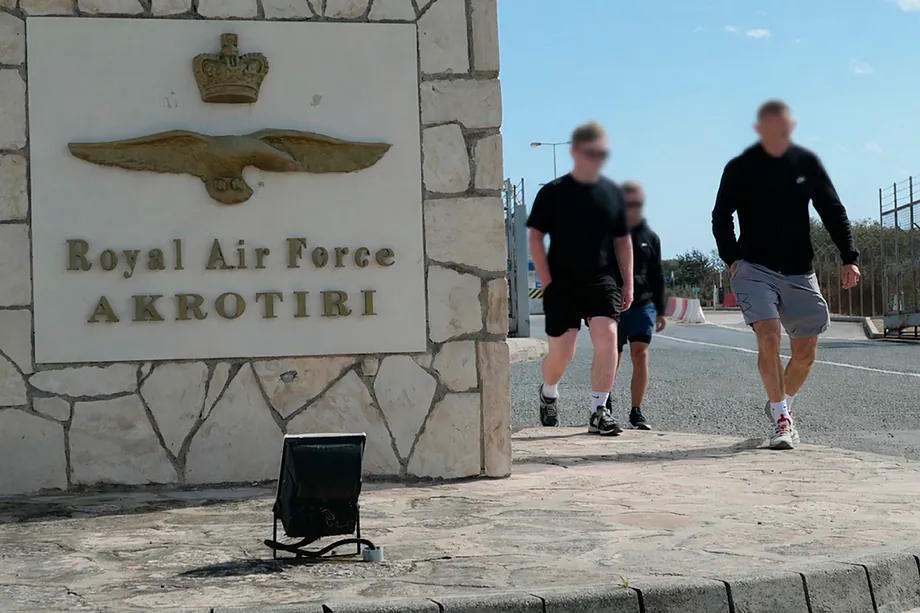
The wetlands of Akrotiri shine turquoise and reflect the shadows of fighter jets and migratory birds. Flamingos coexist with them. There are even radars to detect flocks. It used to be the great dilemma of this strategic military base, where patrols warned of their presence to prevent them from colliding with rotors and engines. Until the early hours of March 2, when a kamikaze drone, similar to the Iranian Shahed-136, arrived. Witnesses heard its characteristic buzz. And fire broke out in one of the most guarded territories in the world. The smell of burning reached the peaceful village it coexists with. From the outside, one assumes that the Royal Air Force stronghold is seemingly impregnable. With fences, cameras, about 1,500 RAF military personnel prepared for combat and espionage inside and outside its facilities. The English boasted that it is one of the safest military outposts. Here everything is geostrategic and historical. The huge outpost is British sovereign territory. Crossing its double barbed wire fences with concertina wire at the top, it is Cyprus, a country that is part of the European Union, although geographically it is in Asia. In turn, the northern part of the island is territory occupied by Turkey since 1974. A wound that still hurts in the European village. "Like in '74," the elders repeated when they were evacuated after the kamikaze drone incursion.
On the Cypriot side, walking its streets at first gave the impression of being a guest in a chapter of The Walking Dead. The elementary school locked during school hours. Tables set up... But it's just a first impression. After the explosion, the inhabitants of Akrotiri were invited to leave. Those who couldn't find accommodation were sent to hotels in Limassol, a tourist enclave and financial pillar of Cyprus. They are gradually returning. We find Nicole, a professional firefighter, hanging her clothes to dry. She is one of the first to return. —"Back?" we ask her. —"One must live," she responds naturally. She has a pronounced tan, a result of the sun and her work. She is used, through her job, to remain calm in risky situations. Due to her family history, to know that the possibility of a war conflict is part of living in this territory... The Akrotiri peninsula has been inhabited since the late Bronze Age. Since then, it has been a desired location. It was a Greek polis. Annexed by Rome. Part of the Byzantine Empire. Cyprus was conquered by Richard the Lionheart in the Third Crusade, in 1191... Its salt and strategic position made it important for the Ottoman Empire. Until in 1878 the entire country became a British colony. After independence in 1960, the United Kingdom chose to keep Akrotiri as a Western sovereign base, and Dhekelia as an Eastern sovereign base. Until in 1974 Turkey took over northern Cyprus. The displaced people arrived in Akrotiri. Like Nicole's grandparents. Who have a lot to say...
"I'm always on alert," she says as she continues to tidy her yard. It is a modest house, contrasting with the luxurious buildings just a few blocks away. It is a miniature Cyprus, a magnet for the wealthy and a peaceful place with tireless workers. It is worth noting that Cyprus's economic growth has led to a GDP per capita higher than that of Spain. And Limassol, its stellar resort, just 20 kilometers from here — more Malaga than Ibiza — is its economic engine. And Akrotiri, despite the English influence, remains as it was before. Resistant to losing its roots. Proud, perhaps of the spirit inherited from being part of the polis of Kourion. Still hurt by the Turkish affront. And expectant of the consequences of the drone attack, one that hit the target and an undetermined number that were intercepted. The origin of the one that hit the target is still uncertain. Initially, Iran was pointed to. The Government of Níkos Christodoulídis, who also leads the presidency of the European Council, attributes it to the terrorists of Hezbollah, funded for decades by the ayatollahs' regime.
The attack was not random. Since the outbreak of the open war between Israel, Trump's United States, and Iran —and the activation of Tehran's allied militias in the region—, Western bases in the eastern Mediterranean have been on high alert. The European Union and the United Kingdom fear that Iranian-made drones will expand the front to military installations outside the direct battlefield. Cyprus is at a crossroads. "They are not bombing us," Nicole confidently points out. "I'm not afraid that they will start doing it as in other places. I don't think we are really involved." She tries to regain her routine. She does not speak with drama or feigned heroism. Pure caution. "I try to be neutral". In an island accustomed to living in close proximity to external conflicts, prudence is also a way to maintain balance. She acknowledges that neighbors have little real information about what happened. "We don't know anything. They give us the information they want to give us," she complains. Uncertainty creeps into every conversation. Most of her neighbors choose silence. Nicole is not afraid to give her name or be photographed... In Akrotiri, everyone knows they live in a strategic location. By the way, that word comes from the Greek strategikós, derived from strategós, or army general... "If you look at the map, Cyprus is called the naval world's navel. It's like a point in the middle of everything. We are close to many conflicts." It is absolutely true. Syria is 200 kilometers away. Israel, 300 km. The Suez Canal, 400 km. The Persian Gulf, 2,000 km. Turkey, 109 km. Lebanon, 250 km. Planes from here have an operational range covering the Middle East, North Africa, and the Black Sea.
For Nicole, the drone that appeared near the British base could have been more of a message. "I think it was a warning to the British bases. If they had wanted to harm us for real, they would have sent more drones or something much larger." According to various estimates, since the start of the war, Iran and Hezbollah have launched over 500 missiles and nearly 2,000 drones. As she explains, she acknowledges that the current atmosphere is strange. "It's not something that happens once, where you put out the fire and it's over. It's a situation that can drag on."
WAITING FOR THE SPANISH FRIGATE CRISTÓBAL COLÓN
Cypriots are reassured by the announcement that European powers are sending ships to the area to protect them. "Military ships are arriving to protect the area." The most mentioned is the frigate Cristóbal Colón. Its resonant name has made an impact here. It is the most repeated name. Even above the aircraft carrier Charles de Gaulle which will also protect the third largest island in the Mediterranean.
The comparison is ideal to see the effect of storytelling in modern warfare. The Charles de Gaulle is a nuclear aircraft carrier, the only one of its kind in Europe, with a length of 261 meters. There is more military personnel on board than at the Akrotiri base itself. It carries around thirty combat aircraft, including Rafale fighters. Our most advanced ship, on the other hand, has a length of 147 meters and will essentially protect the superb French vessel, after a first stop at the NATO naval base in Crete (Greece). But even in the news, the arrival of the Cristóbal Colón is talked about more. It is anticipated that if its sailors set foot on land, they will receive a pop star welcome. Likewise, after many years of cohabitation, the presence of military bases in their territory is being questioned.
Some historians also recall the two faces of the RAF detachment at Akrotiri. How they remained neutral during the Turkish invasion. By acting, Erdogan's homeland would never have been able to annex the north. Others gratefully remember that, on the contrary, they helped refugees arriving with nothing. Nicole's family history is marked by that 1974. Her parents were born in the northern area of the island, now under Turkish control, although its inclusion is not recognized by any country except the invader.
"My parents lived through the war. They lost their home, the place where they were born, their village, everything." Like thousands of northern Cypriots, they had to flee and live as refugees. "They have told me many stories of how they lived in tents, how they had to evacuate their city... We have the DNA of war. When we hear the sirens, we remember those stories of escaping, of leaving a place. They came here as refugees".
Each year, it comes back to her memory with the sirens sounding on the anniversary of the invasion. "I never thought something like that would come close again," confesses the returned Nicole. The alarms have sounded again after the drone attack on the base.
However, she insists that they still consider themselves fortunate. "We are close, yes, but we are still lucky. We are not in that situation. We are well protected". After the explosion, Nicole stayed at a friend's house for a few days. But she has decided to return. "I needed my space. I got tired of staying at a friend's house." A car stops next to her. More neighbors returning.
She returns to what it means to hear the cautionary warnings again. Everyone knows that the Middle East war is no longer limited to the battlefields. Iran's and its allies' revenge also targets the infrastructures that support Western military defense: bases, ports, radars. And Akrotiri, located in the center of that chessboard, once again reminds why its position has been coveted since ancient times.
SAVING LIVES
"I try not to panic every time I hear a siren. But I'm not in a 'nothing happens' mood either". She knows what she's talking about, Nicole works saving lives, so if something major were to happen, she would have to stay at her post. "If something bigger happens, I will have to go to work anyway. It's part of my job to help other people." Although she does it in Paphos.
Akrotiri also experiences a political peculiarity: the village itself is also within the sovereignty zone of the United Kingdom. It is, for different purposes, an administration. "This village is under British control. They have their own police, their own court, and their own fire department." It is almost like a small state within Cyprus. "If you are stopped by the police here, it's the police of the sovereign base. And you go to their court, not Cyprus's." The airbase is just a couple of kilometers away. "Many neighbors work within the facilities and need special permits to enter".
As she says goodbye, Nicole summarizes what it means to live in this corner of the Mediterranean. A peaceful, even idyllic place, but located right in the middle of too many wars. "Since ancient times, our position has been important. We are in the middle of everything".
And in Akrotiri, when the world stirs, that "everything" feels too close again. On the road, cars return incessantly. To the base, to the village. Heavy trucks come and go. Soldiers rush to run errands and shop in the village. The waiter of a shop puts up a sign written in chalk. "We are open," reads next to Makis' restaurant. From its windows, the wetlands, their serene whiteness, can be seen. Billy Joel plays in an empty venue. But that's another story...