The regional war unleashed by United States and Israel attacking Iran is increasingly threatening to destabilize neighboring Iraq, with the increase in attacks by Tehran's allied groups against installations linked to US forces and the economic turmoil the country is facing due to reduced oil exports.
The absence of a plan to replace the Iranian regime, aside from repeated airstrikes - something that has never won a war in history - became evident in recent days when US President Donald Trump expressed support for an invasion of Iran by Iranian Kurdish factions based in Iraqi Kurdistan, only to retract his statement later.
On Saturday, the US head of state opposed the same intervention he had publicly endorsed shortly before: "We do not want to make the war more complex than it already is."
Turkey, which views the intervention of Kurdish groups and the support given to the Iranian opposition by Israel with great suspicion, warned on the same day - without naming Tel Aviv - about those seeking a regime change by trying to "incite a civil war in Iran and ethnic or religious divisions."
Despite the media frenzy generated by Israel regarding the Kurdish issue, over the weekend several of the six groups of this Iranian ethnicity included in an alliance denied immediate plans to attack Tehran-controlled territory.
A spokesperson for the Kurdistan Freedom Party (PAK), Khalil Nadiri, stated that their militants would only intervene accompanying a US-led invasion, something that Trump has never considered.
"The Kurds should not be the spearhead of the attack," Nadiri pointed out, reflecting the distrust of militants who have not forgotten that Washington abandoned them a few months ago in Syria when they came under attack by the Damascus army.
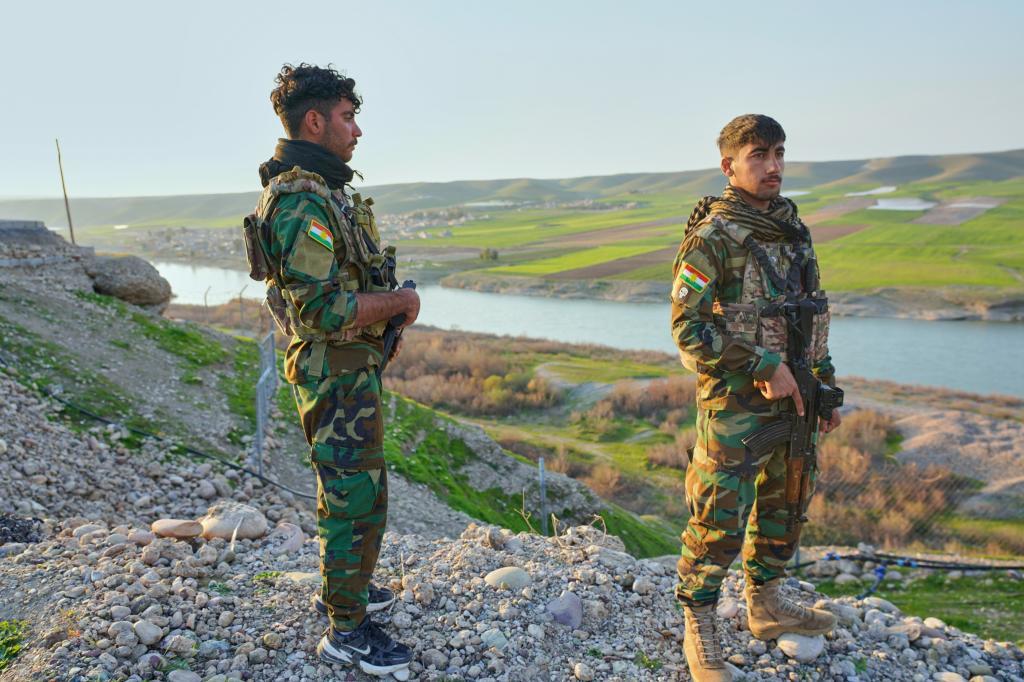
However, the hypothetical intervention of irregular Kurdish forces based in Iraqi Kurdistan has drawn retaliatory rocket and drone attacks from Iran, which have targeted that region nearly 200 times since the war began, according to the count by the NGO, Community Reconciliation Teams.
Dozens of these airstrikes have been directed at factions like PAK but also at the Erbil airport - where US military personnel are stationed - and luxury hotels in that same city and Suleimaniya.
The repeated strikes against Kurdistan prompted the angry response on Sunday from the main Kurdish leader of the autonomy, Masoud Barzani, who warned that "restraint has its limits."
"If they impose war on us, we will defend ourselves. The continuation of these hostilities will lead to serious consequences," he added, emphasizing the ethnic tension spiral in which the country is embroiled.
Erbil - the Kurdish capital in the north - attributes many of these armed actions to pro-Iranian Shia militias grouped around the so-called Islamic Resistance of Iraq.
The escalation of violence that has spread to the Arab state intensified on Saturday with a series of acts throughout Iraqi territory such as the rocket attack on the US embassy in Baghdad, against US soldiers' positions at the Baghdad airport, oil wells in Basra, or the aerial bombardment of militia bases near Mosul and in the Anbar province. On that day alone, the Islamic Resistance of Iraq claimed responsibility for more than twenty attacks.
The newspaper Arab al Jadeed reported that Washington has informed Baghdad that it has decided to bomb the paramilitaries' facilities from now on.
Last Wednesday, a missile killed three fighters - including a prominent commander - from Kataeb Hezbollah, one of the most influential Iran-associated groups in Iraq.
Like in Lebanon, the social and political division between Tehran supporters, those who seek to stay out of the conflict, and factions that have been relying on Washington's influence and assistance for years, is exacerbating the cracks in a country that has not yet rid itself of the legacy of the brutal civil war it suffered after the illegal US invasion in 2003.
The acting Prime Minister, Mohammed Shia al-Sudani, one of those trying to navigate between two sides, has called on security forces to arrest those responsible for the attack on the diplomatic delegation.
But at the same time, he has had to speak out against the potential offensive by Iranian Kurdish irregulars from the north, stating that "there will be no tolerance for any attempt to drag Iraq into war."
The internal disagreements have spilled over into the parliament, which convened on Saturday. There, lawmakers aligned with Iran-allied irregular forces began chanting slogans like "Death to America!"
"Death to the mercenaries, Death to Israel, Long live the Resistance!", exclaimed one of the legislators, Mohamed Abu Eis, associated with the Asaib Ahl Al-Haq group.
In addition to their armed presence, groups close to Iran have significant political influence in parliament.
Eis's bloc, for example, has 27 deputies, including the vice president of parliament.
The successive clashes in the Arab nation have already led to a temporary shutdown of several strategic oil fields such as the Rumaila fields or some in Kirkuk.
The closure of the Strait of Hormuz could deprive Iraq of 50 to 60 percent of its daily fuel production, on which more than 90 percent of its budget depends, estimated the Prime Minister's economic advisor, Mazhar Muhammad Saleh, this weekend, a situation that would lead to an economic disaster for the country.