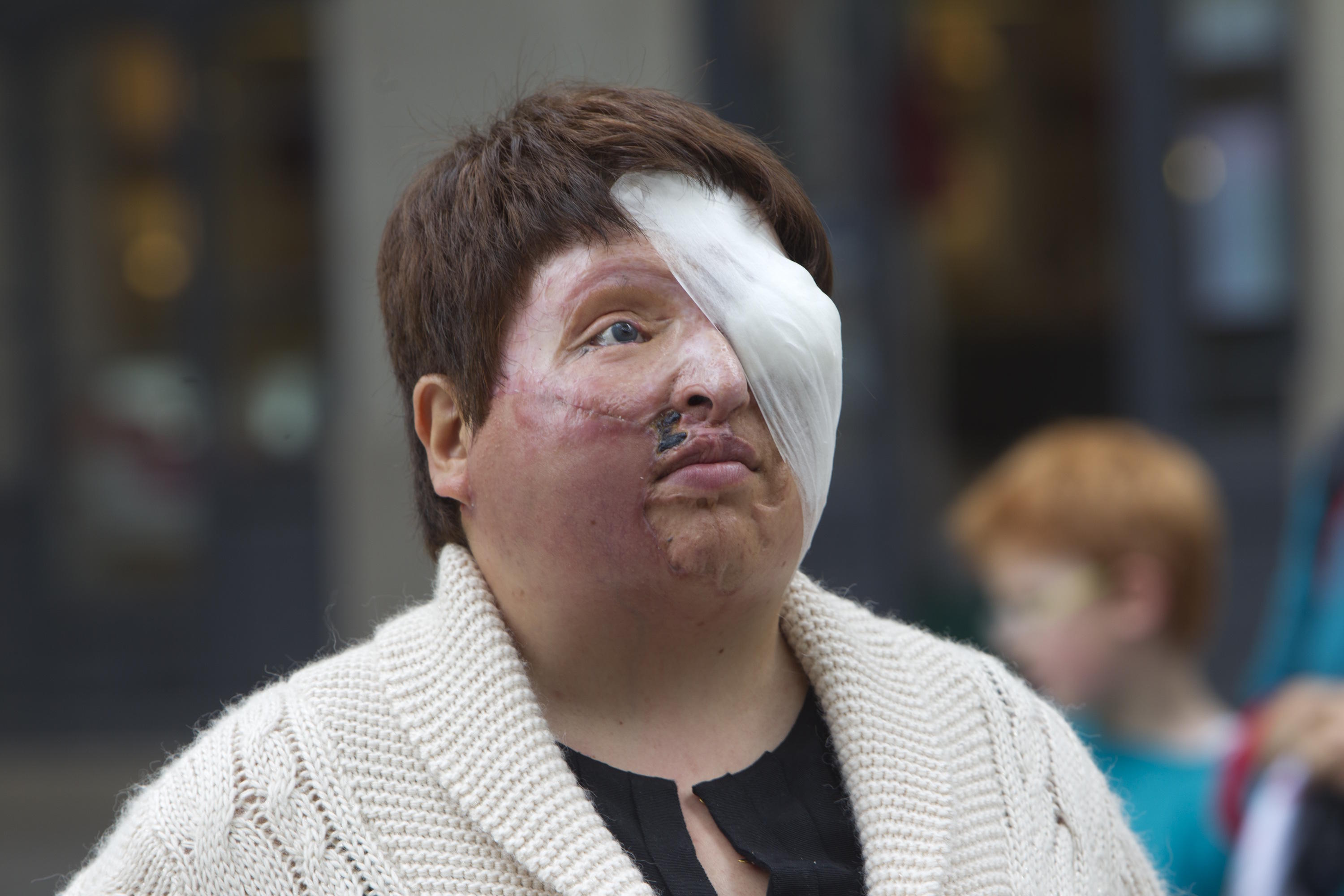
It is eight in the morning on Saturday, March 7th -Iranian time-. Ameneh Bahraminava and her mother wait at the door of the Spanish embassy in Tehran for the departure of the ambassador, Antonio Sánchez-Benedito, and the ten people who will try to leave the country with him. They are the last Spaniards to be evacuated from Iran.
Ameneh Bahraminava was born in Tehran, but she has lived in Barcelona for 21 years and has dual nationality. She came to Spain in search of a miraculous surgery to restore her eyesight, lost since November 2004 - when she was 27 years old - after a suitor she rejected threw acid on her face. Blind and disfigured, her case gained worldwide attention four years later when Majid Movahedi was tried, and Ameneh requested qisas - an eye for an eye - a punishment provided for in Islamic law, which the court granted her. The convict was already in the medical room waiting for Ameneh to blind him by dropping acid in his eyes on July 11, 2011, when she forgave his sight in exchange for financial compensation.
If this war caught her in Tehran and not in Barcelona, it is because he - already released, Jamenei granted it to him - did not fulfill his promise. Ameneh, who needs that money to continue with the reconstruction of her body, traveled to Iran last September to speak with lawyers and file claims in court. "Our house in Tehran is in the center, very close to Jamenei's residence. It's on the 20th floor, and from there we saw the first three bombs fall, the ones that killed the ayatollah. In the last days, we couldn't even sleep because of the noise. Bombs falling day and night, and I was very scared. On Friday [March 6], I called the embassy at eight in the evening: 'I'm very scared, I can't see or go out, can you help me go to Spain with my mom?' An hour later, they called me back: 'The ambassador is returning to Spain tomorrow, and you can go with him. Take a small bag, don't talk to anyone, be at the embassy at nine'," recounts Ameneh, who asserts that even though Iranian television says people are living normally, the streets of the capital, at least those around her house, are deserted: "You only hear a car with music."
There are no taxis available, she says. If they managed to reach the embassy, it was thanks to "a very dear friend" who, with much fear, drove them there. "The ambassador came out to greet us and told us there was no time to enter, we had to leave quickly because the border [with Azerbaijan] was only going to be open for an hour for us to leave."
Ameneh (wearing sunglasses), her mother, the Spanish ambassador, and the student Marjon at the Baku airport.
At ten-thirty in the morning, the Spanish diplomatic delegation closes, and the convoy sets off. According to Ameneh, who sees through her mother's eyes, it consists of four vehicles. Three diplomatic cars serving as escorts plus a fourth carrying the ambassador and four embassy staff members, "two boys and two girls." Ameneh and her mother are in the fifth vehicle, a van where they are accompanied by Marjon, a 19-year-old girl of Pakistani origin with Spanish nationality studying in Granada - Ameneh believes she is studying Medicine: "The ambassador told me she has a bright future. She sits next to me and helps me a lot." The other two seats in the van are occupied by a newlywed couple: he, of Iranian origin with Spanish residency and nationality, traveled to Tehran just to celebrate the wedding and return to Spain with his new wife.
At the first coffee and bathroom break near the Iranian city of Rasht, Ameneh recounts, the diplomatic insignia identifying the vehicles are removed: "They take down the Spanish flag," Ameneh says. At the second stop in the city of Talesh, the ambassador approaches her to talk. "He tells me he is not familiar with my case, and I explain a bit about what happened to me. He has been very kind throughout the journey, taking good care of me and everyone," she appreciates Sánchez-Benedito's treatment.
Shortly after eight in the evening on Saturday, after nine and a half hours of travel, the convoy arrives at the border town of Astara, the gateway to Azerbaijan. "There are people waiting for us, complaining that we are an hour late," Ameneh says. "We hear two bombs falling very close, inside Iran but very close to Azerbaijan," she adds.
The vehicles that brought them there, she explains, wait to see if everyone manages to cross to the other side or if someone is rejected and has to be taken back to Tehran. This is the case for the Iranian who joined the convoy in Rasht and an embassy employee who voluntarily returns. The border control is particularly strict with the Iranian couple, questioning them in separate rooms: "How long have you been married, who are your families, your addresses in Iran and Spain, where are you going...". Ameneh's mother, Shahin, who has a residence permit in Spain but no passport, is also taken aside. "One of the border guards tells me: 'I know your story. Don't worry, you can pass'."
Sánchez-Benedito and the three embassy employees remaining with him, Ameneh and her mother, the newlyweds, and the Medicine student successfully pass through and walk to the Azerbaijani side of Astara. "There we wait for four hours on the street; it's raining and snowing, we are very cold," Ameneh recounts the tough time they had waiting for visas.
Around midnight on Saturday, they all depart in a minibus to Baku, the capital of Azerbaijan, where they arrive at four in the morning. They stay at a hotel for about two hours, just enough time not to miss the plane that will take them to Istanbul. Once in Turkey, on Sunday morning, the group plans to head to Madrid. "But I tell the ambassador that I want to go to Barcelona if possible, as I live there, and he says yes and gives us the tickets. The embassy covers all expenses," Ameneh says. The ambassador and the rest head to Madrid. "And as we are about to board our plane, they tell us: 'You are not Spanish, you are liars, you cannot board the plane'. Thanks to the help of a Turkish Airlines employee who speaks Farsi, they manage to resolve the situation and finally land yesterday, Monday, at El Prat airport.