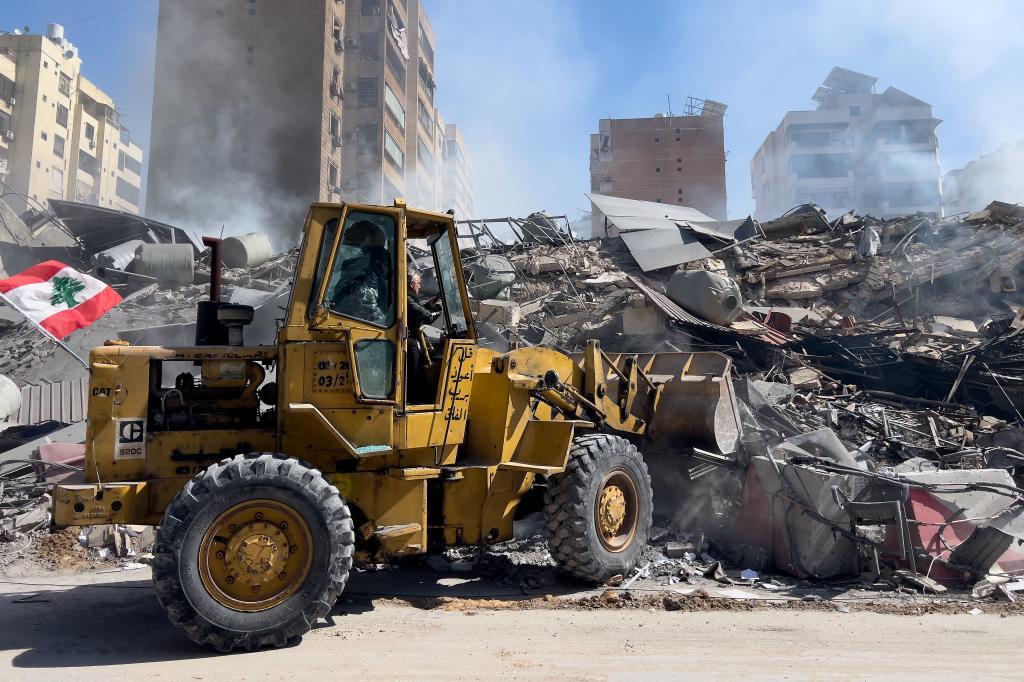
Ali Fares was sitting in Ryad al-Solh Square, in the center of Sidon, waiting for the absurd routine that has been established in Lebanon: residents from different cities in the country wait for hours for the exact moment when Israeli planes bring down several-story towers, which they had previously demanded to evacuate.
Dozens of Lebanese and a crowd of television cameras had been set up since nine in the morning a few hundred meters from the well-known avenue of the southern metropolis. "Yes, it's crazy. We see how they ravage the country and film it live with our phones. It's like a horror movie," added Fares.
For the 45-year-old Lebanese, the Israeli announcement about the future destruction of the offices of Al Qard al Hassan, the organization that acts as Hezbollah's financial arm, surprised him when he thought he had found a safe haven for his family.
A native of the border town of Kfar Kila, Fares had to flee that town in the last war, which was completely devastated by the fighting, and settled further north in Nabatiye.
But when Israel and the United States started the war against Iran, and Lebanon's territory joined the confrontation, Nabatiye also began to be daily hit by Israeli planes. "I had been sleeping in the car with my wife next to the offices of Al Qard al Hassan for days. I thought it was safe," he recounted.
The scene in Sidon was repeated hours earlier in Beirut, where thousands of people gathered around the southern suburbs of the capital to witness the repeated Israeli bombings - around a dozen - that occurred during the day.
Long columns of smoke rose at intervals throughout the day as Israel brought total war to the Arab nation, multiplying its actions in regions like the Bekaa, the capital, or the south of the country.
The small size of this nation allows moving through all these areas in a few hours. The first light of day surprised the residents of the Bekaa Valley under total psychosis, as Hezbollah had reported new armed clashes in the region with troops transported by Israeli helicopters during the night. The news was not confirmed by Israel. "We are on high alert. Don't even think about getting close," was the only communication this newspaper received from a member of the militants led by Naim Qassem.
The National News Agency also confirmed that "violent clashes" occurred during the night not far from the village of Nabi-Chit, the same village in the Bekaa where dozens of people died in another Israeli commando assault last Friday.
The main road in the Bekaa, leading to Baalbek, has been adorned with black posters with Jamenei's face reading: "Your sound is gone, but your echo still fills the distance."
The sounds that woke the residents of the capital, Beirut, were no less distressing than those in the Bekaa. Thousands of people continue to camp on the outskirts of Daiyeh, the southern enclave where Hezbollah has several logistical positions, but where hundreds of thousands of civilians also lived, who had to flee due to threats from Israel.
The surroundings of the nearby Hippodrome now resemble an improvised reception camp, with dozens of tents lined up on the sidewalks. Or characters like Hassan Hassan, a 55-year-old Syrian, who simply dozes on a mattress given to him by a charitable soul days ago. "I came here because in 2024 I also spent 66 days right here, on this same sidewalk," he specified.
The displaced have been blocked in this area for almost a week, unable to return to their homes in Dahiye. From here, they witness the continuous harassment of that suburb.
On Sunday, Israeli violence even reached one of the luxurious hotels in the Al Rouche neighborhood, facing the coast of the Lebanese capital. Room 409 at the Ramada appeared blackened and with shattered glass. The room had been shaken by an explosion around three in the morning.
The Ministry of Health acknowledged that the incident had cost the lives of four people and left a dozen others injured.
Among the latter was a 15-year-old boy, Haydar, whose father, Bilal, explained that the boy was hit in the leg by shrapnel. The family was not among the wealthy clients of the Ramada. On the contrary. Like tens of thousands, Bilal and his clan had been living for several days in an abandoned room. "Where are we going to go?" he asked desolately.
According to Israel, the target of their action was a meeting of members of the Quds Force, the elite units of the Iranian Revolutionary Guard, something Tehran denied.
Information disseminated by the protagonists of this confrontation suggests an even more violent escalation of the war in this country, which has already caused the exodus of 700,000 people, including 200,000 children, according to UNICEF figures.
The same organization estimated that among the several hundred fatalities caused by the Israeli army, 83 were children.
Another humanitarian group, Human Rights Watch, accused Israel of using white phosphorus projectiles days ago in the southern town of Yohmor, which is illegal according to international regulations. Yohmor is one of the over 50 villages in southern Lebanon that Israel has demanded be evacuated by its residents under threat of death.
Israeli analysts like Ron Ben-Yishai, from the newspaper Yediot Aharonot, have acknowledged that their country's military is preparing to withdraw some of the military capabilities being used against Iran to the Lebanese front due to the "increase in casualties" being suffered by the troops in the south.
Israeli media claim that Tel Aviv is already deploying troops from at least five divisions in southern Lebanon, indicating that the assault is far from a limited plan.
Tel Aviv identified on Monday the two soldiers killed on Sunday by a Hezbollah missile, a day when another group of soldiers was injured by a projectile also launched by Lebanese paramilitaries.
Militants have continued to attack Israeli territory with rockets and drones, and on Monday, they injured two people in the country's center.
A senior Hezbollah official, former minister Mahmoud Qamati, stated that his followers are prepared to continue the confrontation indefinitely since the containment of recent months - following the ceasefire signed in November 2024 - did not prevent Tel Aviv from eliminating hundreds of their fighters. "It's about establishing a strong deterrent equation," he stated in an interview with a Russian media outlet.