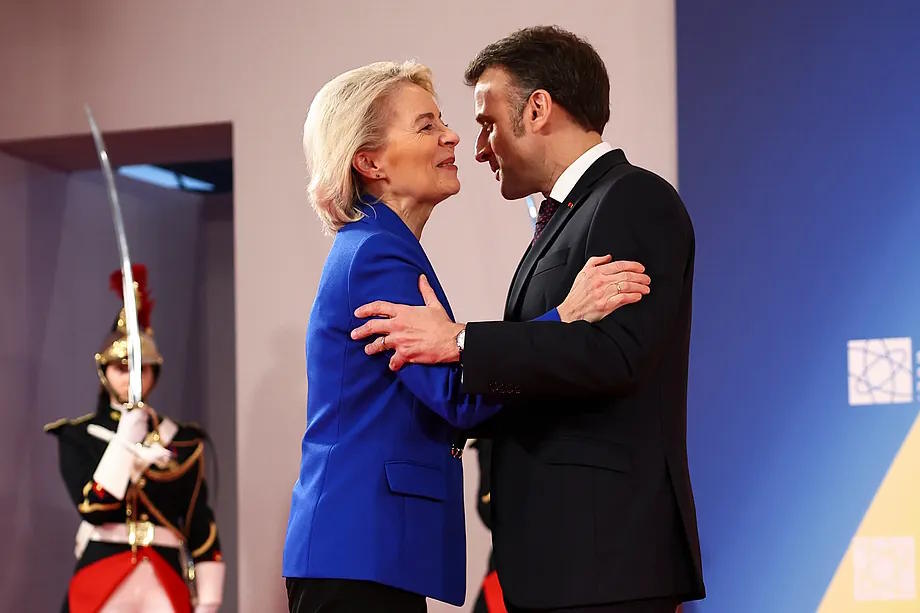
The President of the European Commission, Ursula von der Leyen, announced on Tuesday a new European strategy to develop small modular nuclear reactors and revealed the creation of a €200 million guarantee to mobilize private investment in "innovative nuclear technologies."
"We want this new technology to be operational in Europe by the early 2030s," Von der Leyen stated during an energy summit held in Paris, where she argued that these reactors could play a key role alongside traditional nuclear power plants in a more flexible energy system.
The strategy presented by Brussels will be based on three main lines of action: simplifying the regulatory framework to facilitate the deployment of these technologies, mobilizing new investments, and strengthening cooperation among Member States to develop the sector on a European scale.
"Nuclear energy is profoundly safe," proclaimed Emmanuel Macron at the start of the second international summit on civil nuclear energy, held in Paris coinciding with the 40th anniversary of the Chernobyl disaster and the 15th anniversary of the Fukushima accident.
The French President specifically referred to Fukushima in his opening speech, emphasizing the innovations and safety improvements that have allowed the industry to relaunch on a global scale. "The world has changed, and nuclear energy is now a fundamental piece in the energy transition," Macron declared to representatives from over 40 countries gathered in Boulogne-Billancourt.
Two Greenpeace activists disrupted the summit's opening and confronted the French President, asking, "Why do we buy uranium from Russia?" The procession of authorities on the red carpet was momentarily interrupted by the protest, shedding light on French imports of enriched uranium from Moscow, which reached 112 tons last year.
68% of electricity in France is produced by nuclear energy in the 57 operational reactors in 19 plants across the country. Despite the "made in France" label, the country heavily relies on uranium imports, with a quarter coming from Russia, according to estimates from the AFP agency.
Just a week ago, 20 Greenpeace protesters blocked the port of Dunkirk to prevent the unloading of the Mikhail Dudin vessel, which allegedly carried material destined for French nuclear power plants. Four of them, holding banners saying "Solidarity with Ukraine" and "EDF loves Putin" (referring to the state energy company), were arrested by the police.
The environmental organization denounces how the nuclear industry has escaped sanctions following the war in Ukraine and how the Russian state nuclear company Rosatom continues to export around the equivalent of one billion euros annually to EU countries (according to data from the Bellona Foundation). Greenpeace has demanded transparency from Brussels, which is soon to reveal its strategy for the development of small modular nuclear reactors (SMRs) in Europe. France has already announced its intention to build at least six.
Macron, who predicted the entry into a "new nuclear era" just a week ago, aims to consolidate France's position as a "pioneer in civil nuclear energy" in Europe. The French President is taking over precisely from Brussels, where the first "nuclear club" conference was held last year.
The Paris meeting has been marked by the impact of the war in Iran on the energy sector. G7 ministers will indeed take advantage of the summit to hold a parallel meeting and discuss once again the possibility of collectively activating strategic oil reserves.
Rafael Mariano Grossi, Director-General of the International Atomic Energy Agency (IAEA), made a very clear reference in the summit's opening with his statements to the RFI broadcaster. "The solution remains negotiation," Grossi warned, stating that he had been in contact with Iranian authorities since the beginning of hostilities.
"To my knowledge, the 440 kilograms of enriched uranium that the Iranians had before the war are where they were in June 2025," Grossi added. "There are no radioactive leaks at this time, although the threat of nuclear weapons persists."
The President of the European Commission, Ursula Von der Leyen, also stated that Europe made "a strategic mistake" by reducing its nuclear capacity in recent decades. "This has to end," Von der Leyen proclaimed, defining nuclear energy as "reliable, affordable, and low-emission" and as an ally of renewables in the energy transition.