Inside a regime van, surrounded by women who, like her, had been detained, Farnaz felt that this could not continue. She was experiencing a devastating humiliation just because her jacket was a few centimeters above the knee. Her companions, who were on their way to being registered as criminals, had committed 'crimes' as serious as having a strand of hair peek out from under their veil or wearing clothes that were too bright. Now, exiled in Spain, a member of the Iranian resistance from here, she tells the story of these brave Persian women. Those who want to be heard. In homage to the tens of thousands who have been killed by the ayatollah regime without being given a voice.
"I am an engineer and had a project to present in the morning. I was leaving the metro to go to work and those police officers detained me. Only because my jacket was not below my knees. They treated me like a criminal. I had to wait there until someone from my family arrived with what they considered appropriate clothing. Only then could I leave the police facilities," Farnaz recounts with rawness to Crónica. "Everyone found out that I had been detained because of my clothing... I felt hurt as a woman."
This brave woman's voice trembles. But she continues. "I went home and told my father, 'I don't want to live here anymore.' Although I loved my job, I loved living with my parents, in my country... I couldn't take it anymore. I can't be a woman in this country. And for me, that was the moment I decided to leave." After managing to study for a master's degree in marketing in Spain, now at 34 years old, she tells her story after a hard day's work at the Mobile World Congress. A narrative more reminiscent of the Middle Ages than these times of artificial intelligence. A scene that is everyday for her, the daily life of the girls in her country, summarizes the terror imposed by Ayatollah Ali Jamenei, who fell last week after a deadly attack by the United States and Israel. After his death, the Iranian regime ordered 40 days of mourning and strict black attire as a sign of mourning.
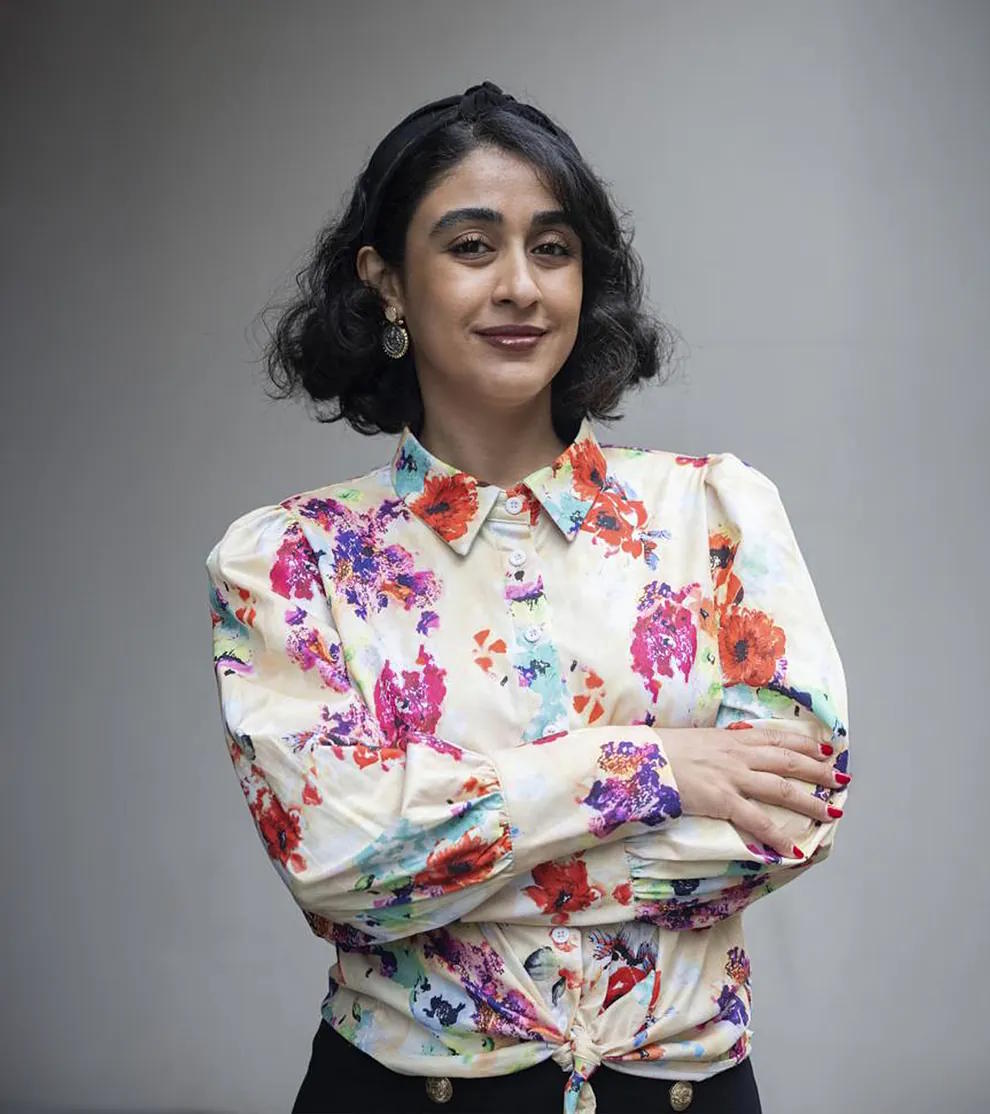
Farnaz poses for Crónica in a colorful printed shirt. She and her friends celebrated in the streets of Barcelona. With their hair down, dancing, singing, smiling... all of which, for Jamenei, was a reason for imprisonment if you were a woman.
Also there was Yani, a 27-year-old literature student. She sports short hair, dressed in white. Just watching the video of her last day at university makes you understand a divided world. You see them, dressed like Westerners. Loose t-shirts, colorful shirts, jeans... In the same scene, they in dark colors, forced to cover up. It's their "The End," as it appears on the screen. She participated in protests for her country to change. Here and there.
"THEY WERE SYSTEMATICALLY KILLING THEM"
She decided to come here solely to survive as a woman. To escape that contemporary slavery that is being a woman in the Iran of the ayatollahs. The frustration of not being heard. That the non-governmental organizations that are supposed to listen to them and report what the regime was hiding remained silent. They were being systematically killed. It was a painful silence.
"I stopped saying that I am a feminist. I prefer to say that I am an Iranian woman, it seems more powerful to me, because feminists abandoned us... Iranian women are showing the true definition of feminism in the world." She wipes away a tear that resisted falling with her left hand.
It's the effect of remembering. All the interviewees in this report emphasize what happened at the beginning of the year, in two grim days. In those 48 hours, everything changed in Iran. The number of those killed has been estimated at 30,000 deaths. "Just on the 8th and 9th of January, according to two senior officials from the Ministry of Health who spoke to Time, indicating a drastic increase in the number of deaths. The Iranian security services killed so many people that Thursday and Friday that they overwhelmed the state's capacity to dispose of the dead. Body bags ran out, as reported by officials, and eighteen-wheelers replaced ambulances," the chronicles say.
MASSACRING A STADIUM EVERY DAY
The same media outlet points out that the figure has even been underestimated. "It does not reflect deaths related to protests of people recorded in military hospitals, whose bodies were directly transferred to morgues, nor those that occurred in places where the investigation did not reach." Annihilating more than the capacity of Rayo Vallecano's stadium every day has few precedents.
"The only parallel offered by online databases occurred during the Holocaust. Outside Kiev, on September 29 and 30, 1941, Nazi death squads shot 33,000 Ukrainian Jews in a ravine known as Babi Yar," concludes Time. Among them is the martyr of the protests Sahba Rashtian, a symbol of Iranian women: an athlete and artist, shot by a sniper.
"How can so many people be killed in such a short time? I don't know any family in Iran that hasn't lost a loved one for protesting," points out Parisa, 38 years old, who came to Alicante to study a master's in Tourism. She holds her long black hair and touches her forehead. She is moved by the number of deaths and those who, faced with so much evil, did not protest in Europe. And who now stand on the side of the theocratic government. Against Tehran's mourning, she poses in turquoise.
"The Spanish left repeats the regime's propaganda. I am very disappointed by that. I am very afraid to see that something so radical, so far from humanity, has been justified by feminist women. They don't care about the life of Iranian women, only to uphold their discourse."
She doesn't forget. She describes with horror the videos of how the massacre occurred. She talks about beheadings, mass rapes, merciless executions...
"There has just been a massacre, tens of thousands dead. They are women and men who have preferred to die rather than live in repression. We suffer murders and rapes just for wanting a normal life: dancing, smiling, having our hair down are acts of rebellion that can lead you to the grave... I will never be the same person after seeing what has happened."
A BULLET TO THE FOREHEAD FOR REMOVING THE VEIL
Every word of hers is accompanied by heartbreaking experiences about the subjugation of women in Jamenei's Iran. The United Nations High Commissioner for Human Rights himself confirms that there is legal and structural discrimination against women: inequality is embedded in the legislation itself.
Unlike those who argue that the veil should be optional, there it is the central axis of control. It functions as a mechanism of social and political discipline, with a direct impact on freedom of movement, expression, employment, and access to public spaces.
"For us, taking off the veil means being ready to receive a bullet between the eyes directly," Parisa points out. She reflects on what is happening in her country today and the help they need. "Just as the world united against the Nazis to defeat them, now we must defeat the ayatollahs to be able to live in freedom. That is what we need."
The Iranian diaspora since 1978 is counted in millions of exiles worldwide. Nina arrived with her parents as a child. Today, at 34, she is a jewelry designer in Madrid. She grew up free from oppression and speaks impeccable Spanish. Her relatives remain in their home country. She poses in intense red.
Nina supports the cause of Persian women from afar. She believes in a truth that is not being told. "There is a lot of talk about geopolitics, about Jamenei, about a lot of data, but there is no talk about the freedoms of women, which I believe is crucial... The death of the ayatollah is the symbol that something terrible for women has ended."