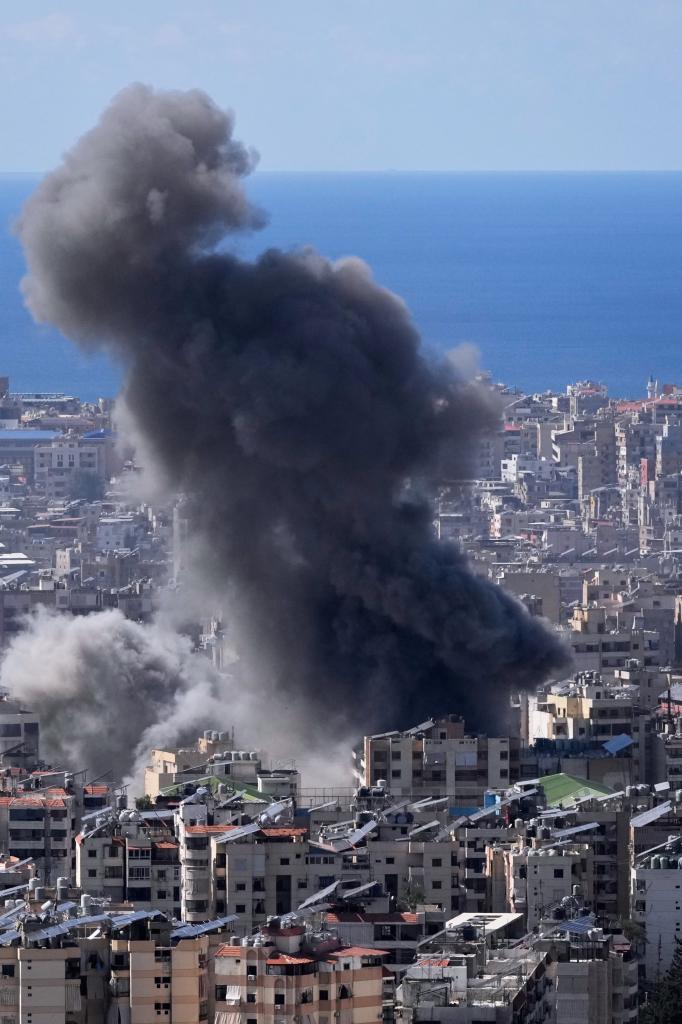
The small Christian community in the city of Tyre remains concentrated in a corner of the old city, next to the port. A stronghold clearly marked with huge posters or statues of the Virgin Mary, and those typical urns hanging on the walls, where they accumulate more effigies of saints, Christs, and other religious paraphernalia. An iconography that contrasts clearly with the huge portraits of Hassan Nasrallah, the late leader of Hezbollah, and other militants of that group or its allies from Amal - another Shia paramilitary group - who dominate the rest of the southern metropolis.
Raimond Baradai is one of the holdouts. He refuses to leave but admits that "90% of the Christians" in the neighborhood have already left as Israeli bombings targeted the largest city in the border region of Lebanon.
"I left during the 2006 war, but I didn't in 2024. I'm fed up. Lebanon has been at war with Israel since it was created in 1948. It didn't start with Hezbollah. Hezbollah didn't exist," he added as he wandered through the narrow alleys that make up the enclave.
Baradai was not surprised by the death of the well-known cleric Pierre al-Rai from the southern village of Qalayaa, who died on Monday in an attack by Israeli military.
"To Israel, it doesn't matter if you are Christian or Muslim. They kill us all the same," commented the 52-year-old Lebanese.
His opinion does not reflect the unanimous feeling of the Christian minority living in Lebanon, but it does reflect his weariness, which combined with the tragic fate of Pierre Al-Rai, has accelerated the exodus of part of the Christian population settled near the border with Israel. The Tel Aviv troops have intensified their advance on the border, where violent clashes with Hezbollah paramilitaries are taking place.
The death of Al-Rai, a very popular cleric in the Arab nation, caused a real shock in the southern area, prompting the immediate escape of the few Christians who remained in the village of Alma al-Shaab, escorted by blue helmets.
This last village also suffered the punishment of the Israeli army in recent days, which ended the life of one of its Christian inhabitants. The victim was watering his garden, as reported by Lebanese media.
"Everyone knew him. He was the brother of the priest. We don't understand anything," acknowledged Vera Makhoul, a Lebanese Christian who remains in Rmeich, one of the southern towns where members of this faith reside.
International forces confirmed that they had escorted about 80 people and that now the population - mostly Christian - has been left empty, as also happened in the 2024 war. "Many are considering leaving," acknowledged a resident of Qlaya, contacted by phone. The events in this last enclave and Alma al-Shaab added to the ultimatum received by the city of Rmeich itself.
One of the officials of the place disseminated the threatening call from an Israeli uniformed person, demanding the expulsion of all displaced Shia Muslims who have taken refuge there. "We know who is there. If there is anyone from Hezbollah, we will attack. The responsibility is yours," the Israeli interlocutor was heard saying.
With more than 5,000 inhabitants, Rmeich is, along with Maryajoun or the aforementioned Qlayaa, one of the few urban centers with a Christian majority in the areas near Israel, where the Muslim Shia population overwhelmingly dominates.
The dozen or so localities where Christians are grouped have tried to stay out of the clashes between Hezbollah and Israel in the repeated wars that the area has experienced in recent years, under the assumption that Tel Aviv makes a distinction between Christian devotees and Muslims.
But this conjecture has been shattered in recent hours, especially after the assassination of Pierre al-Rai. All witnesses consulted by this newspaper agreed that the cleric lost his life to a projectile launched from Israeli positions.
"They first shot at the house of a teacher, a Christian, like everyone in this village. When two ambulances and Father Pierre had already arrived, the Israeli tanks fired again, and that's where the priest died. We don't understand. I don't know what message Israel wanted to send. They said there were Hezbollah militants in that place, but it's not true," recounted B (who did not want to give his name) over the phone.
His statement was corroborated by the mayor of Qlayaa, Hanna Daher. "It's a lie. There were no (Hezbollah) groups. The only ones were the villagers who came to help the wounded," he said. Like B, the Christians in the south share the fear. "This war is not like the one in 2006 or the ones in 2024. Now, no one knows what Israel wants. Maybe they want to kill everyone and occupy the entire southern region," said Vera Makhoul from Rmeich.
Al-Rai had stood out in recent hours for his statements in favor of Christians not leaving the region. Israel has demanded that all residents south of the Litani River leave that area.
"When we defend our lands, we do so as pacifists who only carry the weapons of peace, kindness, love, and prayer," Al Rai proclaimed at a recent public gathering.
The event was even mentioned by Pope Leo XIV, who expressed his "deep sorrow for all the victims of the bombings in the Middle East in recent days, for the numerous innocent people, including many children, and for those who were providing them with help, like Father Pierre El-Rai, a Maronite priest murdered this afternoon in Qlayaa," as reported by the Vatican's Telegram channel.
Pierre al-Rai was a well-known figure to the Spanish troops deployed in that territory. The Spanish Military Archbishopric itself acknowledged on social media "the great friendship" that the deceased cleric had with the Spanish military, whose main base is located near Qlayaa.
The former Spanish ambassador to Lebanon, Jesús Santos, also shared a photo with the religious figure, recalling that Al-Rai "always refused to leave Qlayaa, even in the most difficult moments."
Al-Rai's murder has accentuated the serious social division in the country, as the leader of the Lebanese Forces, Samir Geagea - who was an ally of Israel during the civil war - tried to justify the priest's death by stating that before the attack by Tel Aviv's uniformed personnel, there had been an "infiltration" of Hezbollah militants in the village, which provoked the enemy army's reaction.
The accusations from the far-right party sparked a violent exchange of accusations on social media, another sign of how the current conflict is beginning to fracture the tacit coexistence - the de facto division has always been maintained - that was established in the Arab nation at the end of the civil strife in 1990.
The office of the same organization in Qlayaa lashed out against Hezbollah and lamented that Father Rai died in what it described as "an imported war" and "fought by outlaws," referring to the militants of the so-called Party of God.
Referring to the event, the highest authority of the Maronite Church, Bechara Rai, joined the accusations against Hezbollah for "unilaterally participating" in the conflict, urging that this group be disarmed. The forces under Naim Qassem, whose military potential exceeds that of the local army, have already warned that any plan in that direction will lead the country into a new fratricidal war.