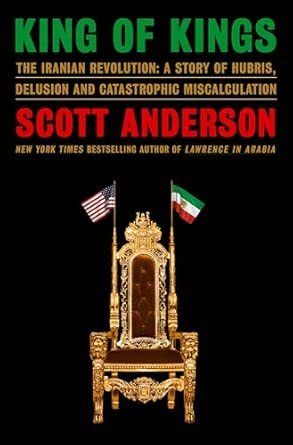
A war correspondent in Lebanon, the Balkans, Sudan, and Libya for publications such as The New York Times Magazine, Esquire, and Vanity Fair, American journalist and writer Scott Anderson—brother of the perhaps better-known John Lee, whom he describes as "a more traditional journalist who interviews the powerful"—has spent decades covering the conflicts and tensions of the Middle East. Obsessed for years with the Iranian Revolution, which he considers "year zero of a new geopolitical era," he has now published King of Kings (Península), a vibrant and human chronicle that reconstructs the fall of Shah Mohammad Reza Pahlavi and the rise of Ruhollah Khomeini through declassified documents, diplomatic archives, global press reports of the time, and, especially, hundreds of interviews with some of the key players.
The book's central thesis is that, rather than an inevitable revolution, the ayatollahs' seizure of power was "a process fraught with historical accidents, miscalculations, and arrogant and catastrophic personal decisions." Nearly half a century later, he argues, "the legacy of the Iranian Revolution continues to shape world politics and helps us understand the current war."
Reza Pahlavi, the Shah's son who has been waiting for his moment for 40 years in Washington: "My dear compatriots, decisive moments await us."
After covering conflicts in the Middle East for decades, what made you think that the Iranian Revolution was a story that still hadn't been fully told?
For a long time, the Iranian Revolution has been seen as an essentially local event. But in reality, it had enormous global consequences. After 1979, we see an explosion of religious nationalism and extremism in all religions: Christian nationalists in the United States, radicalized Jewish settlers, Hindu nationalists attacking Muslims in India... I don't know if the revolution created it, but it certainly accelerated it. If I look at my own life, I would say that the two great world events have been the fall of the Soviet Union and the Iranian Revolution. And in some ways, this last one may have been even more important because of the way it changed the world.
Instead of a purely structural approach, the book revolves around three key figures: the Shah, Ruhollah Khomeini, and Jimmy Carter. Why did you decide to center the story on this triangle of power?
Because I realized something very curious: all three were extraordinarily isolated. If you're the "king of kings," like the Shah, you don't listen much to others. If you're God's representative on Earth, like Khomeini, you don't either. And something similar was happening with Carter: at many of the revolution's decisive moments, he was preoccupied with other matters he considered more urgent. So I decided to reconstruct the story from the perspective of the people who were, so to speak, in the room with them when important decisions were being made. I wanted the revolution to be seen through the human experiences of those who lived through it, not as an abstract narrative.
The book also draws on interviews with key figures and witnesses, including former Empress Farah Pahlavi. What do these voices bring to your narrative?
It completely humanizes the story. I strongly believe in what's called the "great man" approach: individual decisions can change the course of history. We're seeing this today with figures like Trump. With Farah, it was interesting. Older people often have a very fixed narrative about their past, but there was a moment when that shell cracked. We talked about Prime Minister Amir-Abbas Hoveyda, who was executed after the revolution and with whom she had a very close relationship. She was present when his fate was decided. I asked her why she hadn't done more to defend him, and she became very emotional. She told me, "We did it to save ourselves." It was a moment of rare honesty.
The canonical narrative presents the revolution as inevitable, but you suggest the opposite, that it was full of contingencies and historical accidents. Was it all so random?
Yes, there were many moments when things could have taken a different turn. One of the Shah's biggest mistakes was not understanding that the revolution had a strong anti-colonial component. Many people saw him as a lackey of the United States. Every time he promised reforms or elections, the effect was the opposite: many Iranians thought he was simply obeying orders from Washington. And then there were specific events that changed the climate of the country. The fire at the Cinema Rex in Abadan, where hundreds of people died, happened just as the protests were beginning to subside. It was attributed to the regime, although it probably didn't orchestrate it, and it completely changed public opinion.
The other central figure in the book is Khomeini, initially underestimated by everyone. How do you explain his rise?
That was the great enigma for me. Was he simply in the right place at the right time, or was he far more astute than he appeared? I think it was the latter. His writings clearly showed that he wanted to transform Iran into a radical theocracy, with a supreme leader who would be God's representative on Earth. But he managed to keep this program secret. Many of his allies thought he would simply be the spiritual guide of the revolution and then return to his mosque. They completely underestimated him. Moreover, he possessed something the Shah could not: an image of incorruptibility. The Shah's regime functioned largely through favors, bribes, and patronage. Khomeini was in exile and appeared pure, immune to all of that. And for this reason, he attracted a broad range of people, not just religious fundamentalists, but also students, liberals, and the poor. He argues that the revolution changed global politics as much as the French or Russian revolutions.
What is his most important legacy in current global politics?
Undoubtedly, legitimizing religious extremism as a political force, the idea that, in the name of God, almost anything can be justified: a war, an attack, the persecution of another religious group. This phenomenon is not limited to Islam. We see it in religious nationalist movements all over the world. And it also had enormous consequences for the relationship between Iran and the United States. The hostage crisis left the United States with a profound sense of humiliation. In certain circles, there has always been the idea that revenge had to be taken against Iran. I think that sentiment has influenced American politics for decades.
Today, Iran is once again at the center of world politics because of the war. What does this conflict mean for the country and the region?
Logically, it is very difficult to know how it will end, but there is one thing I think can be said with considerable certainty: it will not unfold as the Americans or Trump believe. The Iranians know they cannot confront the United States militarily. So they have opted for another strategy: attacking the economy. The bombings in the region aim to paralyze the oil industry and sectors like tourism. And therein lies the key. The longer the war lasts, the higher oil prices will rise, and the greater Iran's chances of winning. In the United States, the price of gasoline is the great political barometer. If it continues to rise, support for the war will decline. And Trump knows this.
Internally, despite its external image, Iran has been experiencing internal tensions and regional conflicts for years. Do you see parallels between the country's current political climate and the final years of the Shah's regime?
In both cases, widespread social discontent is evident, but there is a fundamental difference. The Shah, despite being an autocrat, repeatedly refused to use mass repression. He said he was not willing to sacrifice his country's youth to save his throne. The current regime has no such limit; it has shown that it is willing to kill tens of thousands of people if necessary. That is why I do not believe the Ayatollahs' regime will fall without external help or the intervention of foreign troops.
After spending years researching this revolution, what is the historical lesson you believe the world still hasn't grasped about Iran?
Simply put, countries don't want others to dictate their destiny or tell them what to do. That was one of the central problems of the Shah's regime; many Iranians saw it as a creation of the United States. Even those who supported its modernization felt a sense of national humiliation due to that dependence. All countries have national pride and want to forge their own path. That's a lesson Washington still needs to learn.