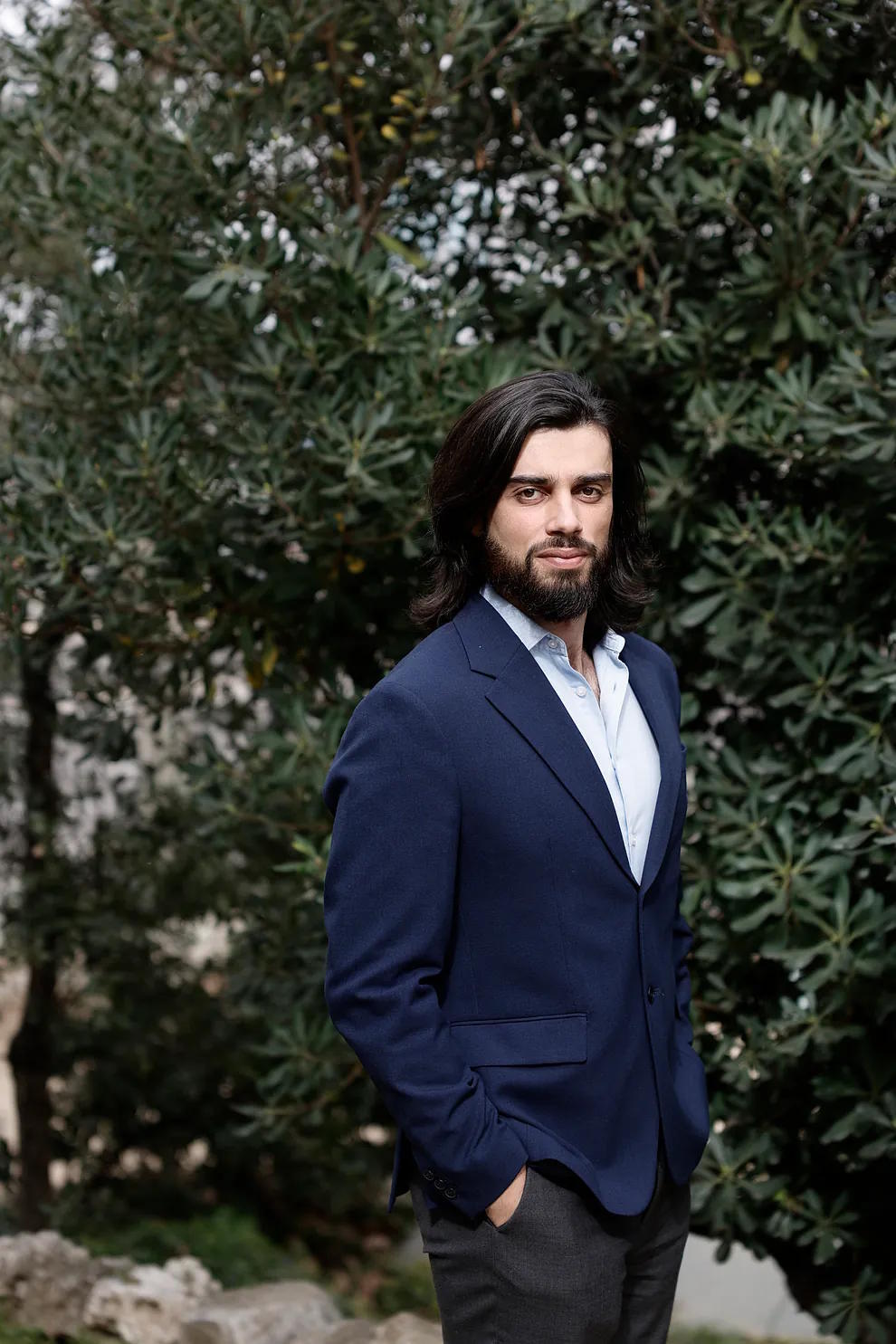
Son of an Iranian and a Spaniard, Daniel Bashandeh (Madrid, 1994) is a consultant and political analyst specializing in contemporary Islamic studies and Middle East geopolitics. His voice represents the young Iranian diaspora calling for the end of the theocracy ruling the country.
Question. What do you think is the biggest misconception in Spain regarding Iran?
Answer. It is crucial to differentiate between Iran as a country and the Islamic Republic as a regime. There are not many examples in the world where such a significant gap exists. The Iranian people are nothing like the regime. During the revolution against the Shah, the people demanded democracy, political openness; it never had to necessarily be an Islamic revolution. However, what the Islamic Republic has done from the beginning is govern for a political and social minority, never for a majority. It has promoted confrontation and division among Iranians, rather than reconciliation, and has pushed for political Islam from the institutions that have hindered the country's development, economically and in other aspects. In any case, when it comes to political terms, trying to draw analogies from Spanish politics to understand Iranian politics is a mistake. This is where many analytical errors are made.
Q. At what point would you say the regime is currently at?
A. It could be described as a point of no return. The younger generations (and many who were part of the revolution) do not identify with the revolutionary values or this political system. Especially under the leadership of Jamenei, Iran has been led to a dead-end. The Islamic Republic cannot be understood without him, as he built a network of loyalties within the system to stay in power. Therefore, his death following the American and Israeli operation was a severe blow to the Islamic Republic. Now the question is whether the system will be able to resolve the leadership problem, if a new balance of power will emerge, and if the 'velayat-e faqih' system (the Supreme Leader's position) has a future. As of today, it is very difficult for that to happen.
Q. What else is yet to be seen?
A. To what extent the regime will maintain its cohesion among the different factions within it. The big question is who will embody this new balance of power. That's why what we are witnessing is a closing of ranks and the portrayal of the conflict as a resistance war. It will also depend on how successful the military operations of the US and Israel are in achieving their goal, which is the demilitarization of Iran. Ultimately, it is not just about the Islamic Republic: it is a power struggle in the regional context.
Q. In what sense?
A. Israel sees Iran as its main regional competitor: in terms of human capital, resources, and territory. Therefore, Israel is interested in a weakened or destabilized Iran. By aligning with Israel, the US is also participating in this struggle for regional hegemony. Even if the US were to reduce its involvement, Israel would likely continue with the attacks.
Q. Washington has made it clear that it does not have a plan for Iran.
A. We do not exactly know what the US wants to achieve from the country. That's why it is so complicated to think that Iran could face a viable transition in the short term. Many analysts discuss possible exits for the regime, but the margin seems to be shrinking. Because war is a Pandora's box and because the regime is not being offered a clear way out. And there is an evident fear: that Trump, just as he unilaterally decided to attack, may also decide to unilaterally withdraw. He prioritizes his own interests: he could sell a political success that may not necessarily reflect reality. Declaring that he has destroyed Iranian nuclear facilities and withdrawing. That would end up frustrating many aspirations within Iran because the Iranian people want democracy and an end to this regime. In any case, since the Islamic revolution, no country has influenced US foreign policy (and its presidents) as much as Iran. There has always been the "Iran objective." The difference now is that Netanyahu has found in Trump the best ally to carry out his plan because he knows that Israel cannot sustain this war without US assistance.
Q. There is talk of the involvement of groups like the Kurds in the conflict.
A. Iran is a demographically complex and diverse country. The regime plays a lot with the idea that within the country, there are groups that could foster destabilization and internal fragmentation. Within this diversity, we are seeing the beginning of a certain unity against the Islamic Republic: there is a broad, majority consensus that the problem is this regime as we know it. Anyone who does not see this does not understand that the regime has lost all its legitimacy with its people. Not only because of the recent repressions but also because of this accumulated period, which has been decisive.
Q. Why?
A. Iran is under international sanctions that deeply affect the daily lives of the population. This impacts the economy, banking transactions, access to medicines, everything. It is an economy under pressure. This has served as a perfect excuse for the regime to maintain political control within the country. It is equally true that this pressure is used by foreign powers to encourage popular discontent. But the main culprit remains the regime itself: it has always prioritized ideology over management and the well-being of the population. People see that within this system, there is no way to change anything, no opportunities. The Islamic Republic has tried to lead Iran into a black-and-white world when Iran is colorful, joyful, and culturally diverse.
Q. This intervention has sparked a debate about the possibility of real change in such a brutal system without external help.
A. Nobody wants to see their country bombed. And history shows that the international context has always influenced Iran's political future. What should have happened a long time ago is that change should have been driven from within, from Iranian institutions themselves. But the power accumulated by Jamenei - and also controlled by the Revolutionary Guards, who dominate much of the economic power - made internal reform impossible. It is a very uncertain situation, but the Islamic Republic, after Jamenei's fall, will find it very difficult to continue exactly as it was. Political reform was impossible with him. I believe that both Trump and Netanyahu were clear that to unlock the situation in Iran, the Supreme Leader had to be eliminated. And yes, they have achieved a tactical objective, but they have not yet completed the structure.
Q. How would you have liked events to unfold?
A. Every Iranian, regardless of age or generation, has always imagined an Iran without Jamenei. But Iranians would have liked that end to come with a public accountability for all the deaths, for all the broken families, for all the repression. Again, Iranians are not like the regime: they are not in favor of death, they are not in favor of a black-and-white Iran.
Q. How do you analyze the attitude of Iran's 'allies'?
A. Iran has never had true allies. It has rather been a political opportunity for different powers. For Russia and China, they see Donald Trump's intervention as a convenient opportunity to advance their own geostrategic interests in their respective spheres of influence and consolidate their regional power spaces: Europe in the case of Russia and Asia in the case of China. The more involved the US is in the Middle East, the more room for maneuver they will have. If Trump is the perfect leader for Netanyahu, he is also for Putin and Xi Jinping. In this global struggle where three major powers are trying to divide their spheres of influence, Russia and China will prioritize pragmatism over Trump's actions.
Q. And that of their 'proxies'?
A. The so-called "Axis of Resistance" has made Iran more vulnerable. It has not fulfilled its function, which was to distance the US and Israel. Since the October 7 attack, Israel has found a pretext to dismantle Iran's regional power. And it has been doing so in stages: Hezbollah, Hamas, the fall of Assad... Now Iran finds itself in a kind of dead-end, and the Islamic Republic is bunkerized. Because while resources, management, and political energy were directed towards this Axis of Resistance, the internal foundations of the Islamic Republic, such as the economic and political development of the population, were neglected. Iran has closed off even more. And all of this served Jamenei to stay in power. In the end, the Iranian regime represents an institutionalized political model that has also tried to be exported throughout the region. I believe that the Revolutionary Guards do not defend so much a religious idea as a political model.
Q. I wanted to finish by asking about the position of the Spanish Government
A. Understanding Iran through Spanish politics is a mistake, I repeat. The issue Spain has regarding Iran is actually a European problem. No EU country foresaw this attack. This raises questions about how much European foreign policy truly understands Donald Trump's leadership, which aims to exercise power rather than defend international law. And we have seen how he identifies within the European Union the countries that can serve him to divide it. In this still disordered puzzle of European politics regarding Iran, the Spanish Government is trying to anticipate an uncertain resolution and also an uncertain stance from Trump. It seems to me that they are trying to position themselves as a potential mediator. However, all this poses a problem: if the European Union does not act as a bloc, it will not be able to respond effectively to the larger political landscape or adapt to Trump's way of acting. Within the European Union, countries like Germany or France, very aware of Iran's strategic importance, have been defining clearer positions. Spain, on the other hand, moves within uncertainty.