"I have never seen anything like this. Never," summarizes a community source with extensive experience the succession of events and attacks that occurred yesterday in the European Union, which showed that political polarization is at levels never seen before in recent history and that this situation has escalated after the start of the Iran war. And, of course, with the President of the Government, Pedro Sánchez, and his No to War as the main spearhead.
The day began with the Vice President of the Commission for Just Transition, Teresa Ribera, going live on Onda Cero to express her displeasure with the President of the Commission, Ursula von der Leyen. "I do not think it is appropriate," she stated as soon as she had the opportunity to criticize the position of the high-ranking German official after she emphasized on Monday that the world has changed; that Europe should not cling to the old order based on rules that "no longer exist"; and that the fall of the Iranian regime does not deserve "a single tear to be shed." Many noticed that the former vice president of the Sánchez government wanted to make these statements on a Spanish radio station, early in the morning, and showing great harmony with what the Spanish Government defended before and after.
Almost immediately, the President of the Council, António Costa, also contradicted his "friend" Ursula. In a more restrained way, undoubtedly, and without direct references. But with a background that contained a notable criticism. It is necessary to "ensure that the world remains a rules-based system" and "defend the principles of the United Nations Charter and international law," said the Portuguese socialist, who is one of the last major allies that Sánchez has in Brussels, although his work has always been very conciliatory and with his own profile.
Almost at the same time, the President of the EPP, Manfred Weber, launched a counteroffensive against Sánchez from Strasbourg. "He is using this debate we are having now at the international level," referring to the Iran war, "for his political profile." The leader of the main party of the European Union thus emphasized the criticisms that Von der Leyen herself has made of the Spanish Prime Minister in private.
As reported by this newspaper also yesterday, the high-ranking official considers that Sánchez is one of the "two problems" she has in the Council. The other is Viktor Orban, and both systematically oppose the proposals that Von der Leyen brings to the meetings of presidents and prime ministers for purely national electoral interests. Another significant reason for the polarization within the EU.
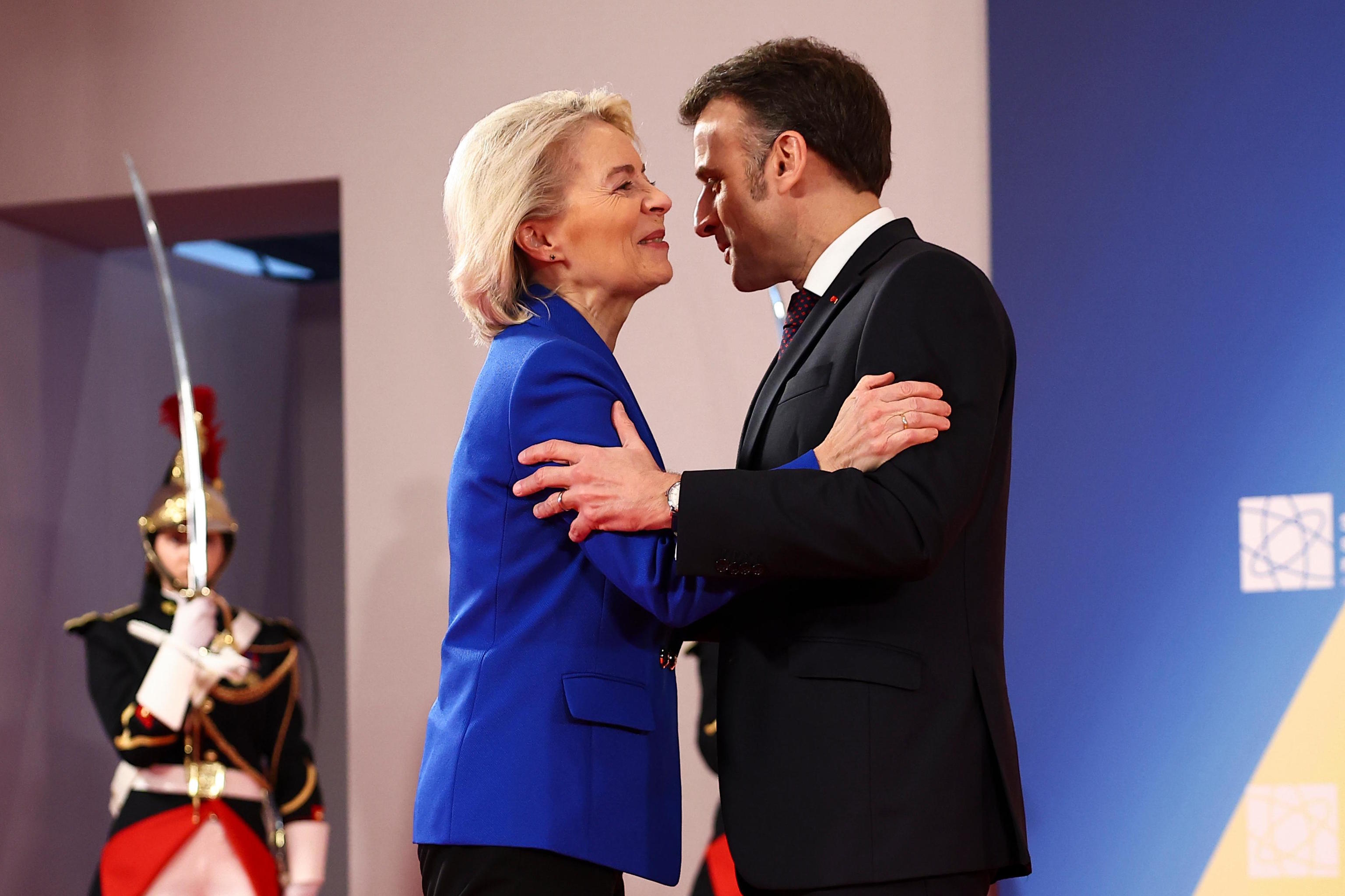
The President of the Commission herself would be the next to speak on that historic and controversial day yesterday, and she did so by launching a double attack on Ribera. Because from Paris, she stated that Europe made a "strategic mistake" by moving away from nuclear energy, and she outlined the keys to a new European strategy to accelerate small modular reactors (SMRs). The first statement goes directly against what the Vice President of Just Transition and, of course, the Spanish Government defends. And with the second, she anticipated the presentation of the new energy investment package that the former Vice President of the national government was to make shortly after from Strasbourg.
Amid the battle between popular and socialists, the two families that have supported the EU for decades and now exchange good intentions with throat-cutting, the Spanish Government wanted to have its share of the spotlight. Not for nothing an essential part of this political turmoil. "Europe has to defend the international order because the alternative is disorder, not order, and there is no opposition between an old order and a new one that would replace it," stated the Minister of Foreign Affairs, José Manuel Albares, in words that closely resembled those spoken the day before by Vice President Yolanda Díaz in Brussels and were directly against Von der Leyen. "The other is barbarism," specifically stated the Minister of Labor.
And there was still one last reply. Again, from Ribera, who far from being intimidated after Von der Leyen stole the spotlight from her, stated that "she cannot intervene in energy policy" and encourage countries to embrace nuclear energy. It was the second time she accused her of overstepping her competencies because at the beginning of the day, she did the same with foreign policy. "Unprecedented," the same community source concludes.