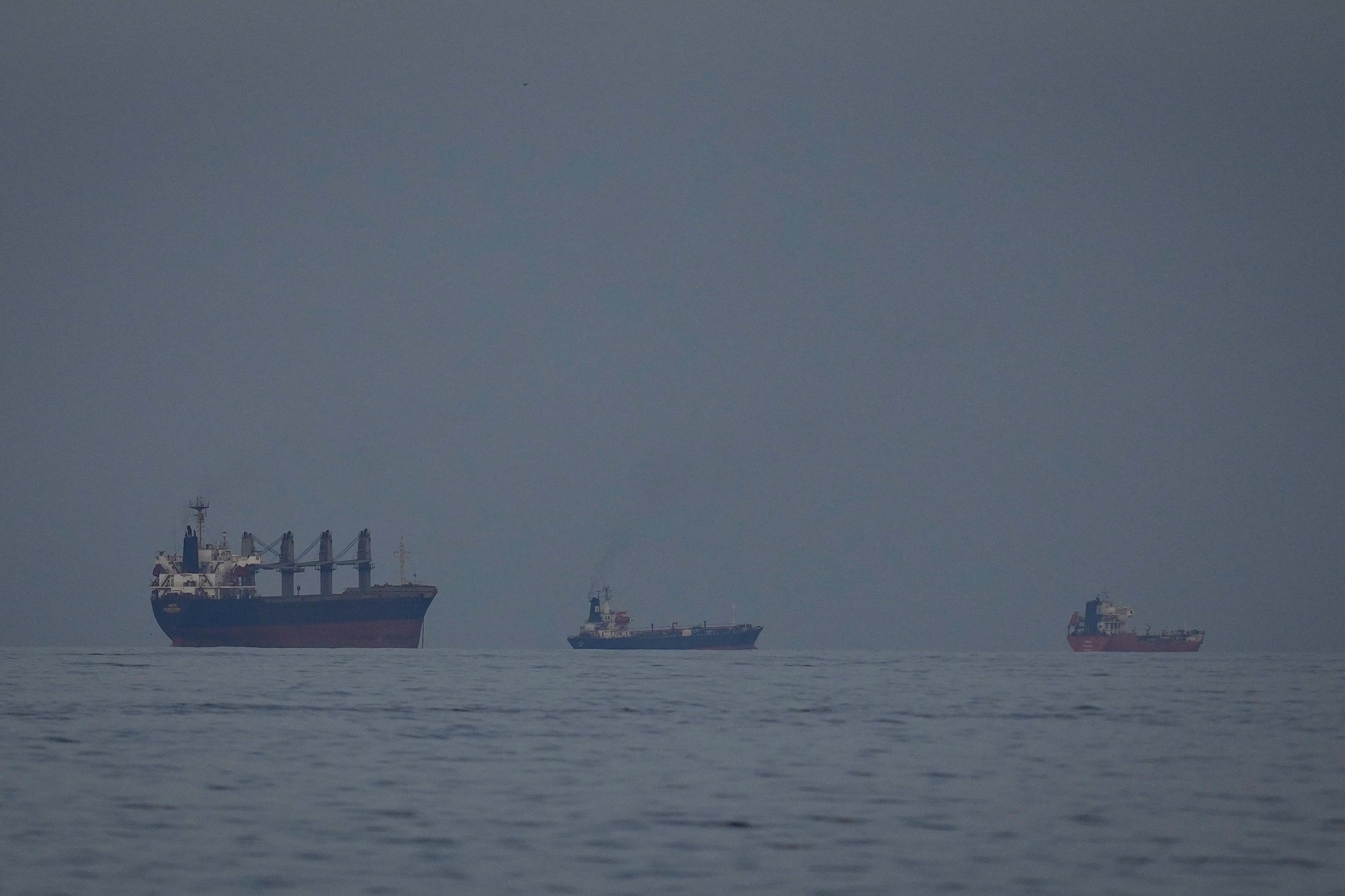
Due to the whims of geography, the Arabian Peninsula is like a rhinoceros head making its way between the Persian Gulf to the east and the Red Sea to the west. At its tip, the horn is born threatening to pierce into Iran's lower abdomen, creating the so-called Strait of Hormuz, a narrow maritime corridor of only 39 kilometers wide that has now become the hottest geopolitical point on the planet. It is in these warm waters where the duration of this war, who wins, who loses, and whether we are heading towards a global economic crisis will be decided in these moments.
In front of that pointed peninsula, with Dubai at its base and Oman at its tip, until a few days ago, 20 million barrels of crude oil and its derivatives (20% of global consumption) passed through, along with 21% of the world's liquefied natural gas (LNG), meaning a fifth of all fossil energy consumed in the world circulates through two maritime highways only three kilometers wide each way.
Iran is using small boats to place mines in its waters instead of large ships that could be sunk instantly. US intelligence sources claim that Iran still retains between 80% and 90% of its small boats and minelayers and is currently using them in Hormuz. Each of them carries two to three mines of Russian manufacture. Meanwhile, Donald Trump stated yesterday that he had dismantled "all the ships in one night."
The Ayatollah regime, emboldened, has grabbed Western countries by their weakest parts and has begun to strangle them. They are already threatening "with a barrel of oil at $200," an unaffordable figure. "We will not allow a single liter of oil to reach the United States and its partners," declared an Iranian military spokesperson.
Western foreign ministries are helplessly witnessing something that everyone knew could happen but no one has been able to prevent: Iran has closed the tap to its vessels and has attacked at least three tankers that were trying to break the blockade. These are the bulk carrier Mayuree Naree with a Thai flag, the container ship ONE Majesty flying the Japanese flag, and the cargo ship Star Gwyneth with the colors of the Marshall Islands, three columns of black smoke over the sea serving as a clear warning to sailors.
However, Iran is allowing cargo ships linked to its own fleet and China to pass through, as reported by The Wall Street Journal. In the maritime tracking pages abundant on the internet, no movement is observed, simply because they have turned off their transponders to go unnoticed. Like jumping onto platform 9 and 3/4 from Harry Potter, these large tankers over 300 meters long sail towards one end and, after mysteriously disappearing for a few hours, reappear on the other side of the strait, in the Arabian Sea, right where the aircraft carrier USS Abraham Lincoln is anchored. Two others are deployed in the area, joined by the French aircraft carrier Charles de Gaulle, a naval force not seen since World War II.
For the past six decades, the US and its allies' plan to keep the Strait of Hormuz open to traffic was to threaten Iran with the use of force. By starting the war alongside Israel, Trump has removed that threat and is now left without leverage to restrain the Tehran regime, which is fighting for its survival. The large pipeline that Saudi Arabia built to connect the Persian Gulf with the Red Sea only buys some time but does not solve the problem.
Shipping companies affected by this scenario have asked the US Navy to escort them through this maritime passage, but the response has been negative. Can the powerful US warships, no matter how technologically advanced they are, stop swarms of hundreds of cheap drones with the real capacity to disable any tanker? Maritime drones have not yet come into play, but Iran has them and they could be the terror of these black gold giants. A miscalculation could cost Donald Trump's war aspirations dearly.
Three teams of Ukrainian advisors are arriving this week in Saudi Arabia, Qatar, and the United Arab Emirates. They are not empty-handed but bring thousands of anti-drone interceptors manufactured in Kiev and tested in the world's bloodiest and most demanding combat, the Donbass front. One wonders why the United States rejected the offer of help from Volodymyr Zelensky last year to share their anti-drone technology and is now desperately seeking a plan to unclog this energy bottleneck.
The Ukrainian advisors will not perform miracles but will show these countries the way to minimize damage, secure their critical infrastructures, and try to shoot down most of these modern V-1s that Hitler launched over London. The Ayatollahs' blitz on the Gulf countries has intensified in recent hours with new missile and drone launches, incorporating Russian technology into their own Shahed 136 model. Two of them fell near Dubai Airport, crowded with people looking for a way out. The refineries in the United Arab Emirates have announced a halt in their operations, just like those in Qatar. If hit by a missile while in full operation, the damage would be much worse. Yesterday, the port depots in Salalah, Oman, were ablaze, attacked by another drone.
Javier de Blas, an analyst at Bloomberg's economic channel, states that the United Arab Emirates is spending approximately $28 on defending its airspace for every dollar Iran spends on attacking it. This is how this new war of salvos unfolds, where the winner will be the one capable of saturating the enemy's batteries and depleting their missiles. If the expensive Patriot arsenals run out, the interceptor used by US allies, Iran will have a free hand to wreak havoc.
Meanwhile, major shipping companies are counting losses in millions of dollars. Maersk has 10 container ships trapped inside the Persian Gulf out of the more than 400 large transport ships inside, with another 200 waiting outside. It represents 10% of the world's traffic of this type of vessels stuck in a bottleneck.
"Any tanker from the US and its allies is a legitimate target for Iran," says the Revolutionary Guard. One of the Iranian army commanders, now acting like a multi-headed hydra, threatened yesterday to attack power centers and banks, advising citizens of the Gulf emirates to stay at least a kilometer away from these buildings. Several international banks are evacuating their employees.
It could get even worse. If Iran activates another of its proxy militias, the Houthi rebels from Yemen, it could also affect traffic in the Gulf of Aden and the Red Sea, as they did in 2023 by hijacking tankers and attacking them with drones, resulting in a 70% decrease in total navigation in those waters for weeks. The alternative for ships to bypass this blockade would be to sail all the way around Africa through the Cape of Good Hope, a ruin in terms of time and money.
Iran has decentralized decision-making, and it is estimated that there are at least 31 commanders launching drones on the northern coast of the Strait of Hormuz without following higher orders, precisely the war scenario Iran has been preparing for decades.