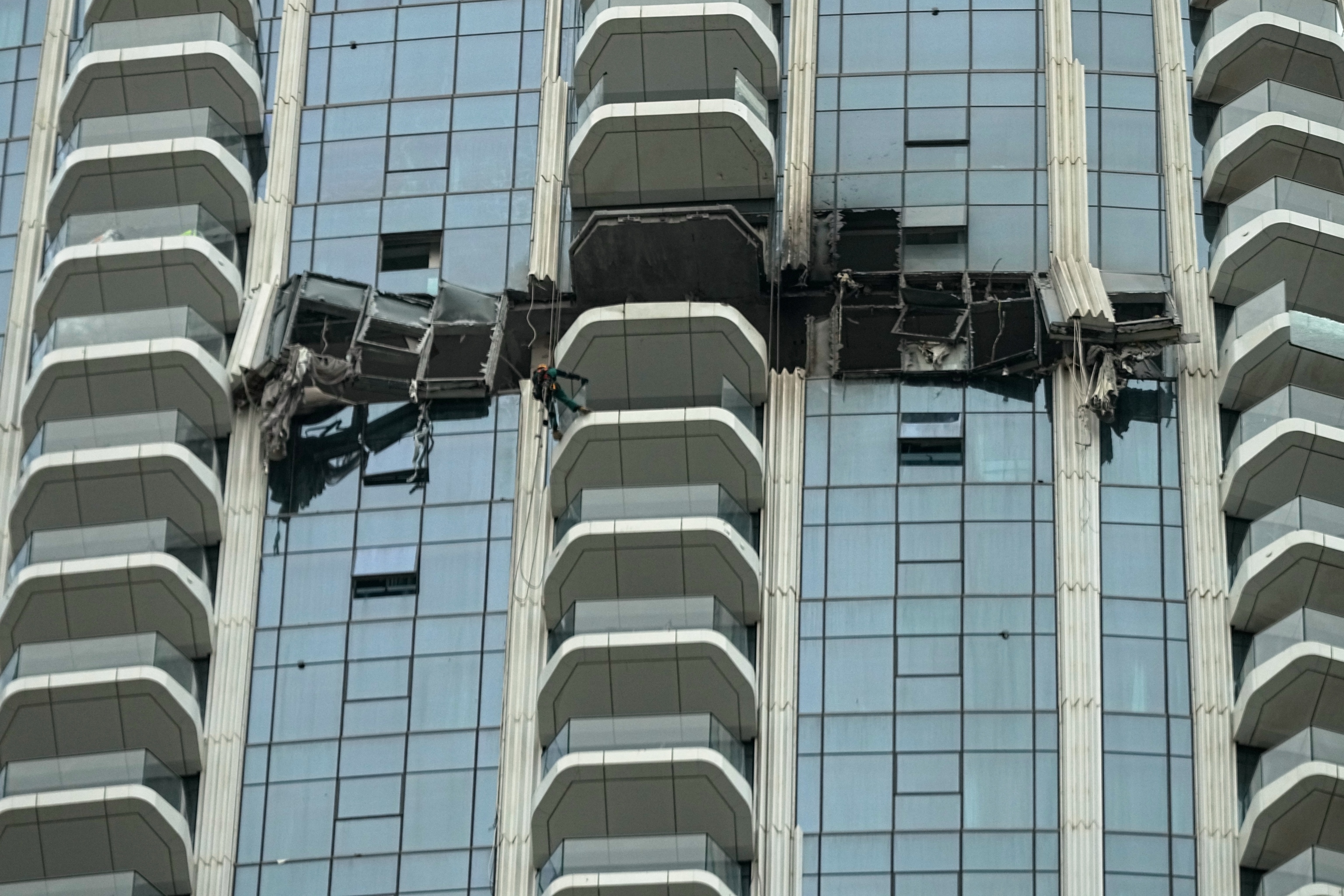
Iran launched a new wave of attacks on the Gulf countries' oil infrastructure on Thursday, leading to a rise in crude oil prices despite the historic release of strategic reserves announced the day before.
This war, which began on February 28 with American and Israeli bombings on Iran, has taken on a regional dimension and threatens the global oil supply, as traffic has come to a halt in the strategic Strait of Hormuz.
The North Sea Brent barrel rose above $100 on Thursday morning, despite the unprecedented intervention of major powers in the market.
Additionally, several explosions were heard on Thursday morning in downtown Dubai, including a very loud one, reported an AFP journalist. Later, authorities confirmed no casualties, only damage to a hotel facade caused by a drone.
Israel says it has bombed a nuclear development complex in Tehran
The Israeli Army bombed the Taleghan nuclear development complex on the outskirts of Tehran during its recent attacks, the military announced on Thursday in a statement.
"As part of the waves of attacks carried out in recent days in Tehran, the Israeli Air Force, acting on precise military intelligence, targeted an additional location of the Iranian nuclear program," the military statement said.
The bombed facility corresponds to the Taleghan complex, located in the Parchin military complex about 30 kilometers southeast of Tehran, which was used to "advance critical capabilities for developing nuclear weapons," according to the Army.
Satellite images shared on Thursday by Israeli media show the area protected with three craters presumably resulting from Israeli attacks.
Israeli Foreign Ministry lashes out at Spain after Hamas celebrates the recall of the ambassador
The Israeli Foreign Ministry lashed out at the Spanish government on Thursday, in its first official reaction, after the Islamist group Hamas celebrated the recall of the Spanish ambassador to Israel.
"When Hamas and the Iranian regime make up the biggest fan club of the Spanish Prime Minister, the Spanish people should wonder why," the Foreign Ministry accused in a statement.
Yesterday, Spain recalled Ambassador Ana María Sálomon Pérez, who had been in Spain for months after being called for consultations on September 9 by the government, amid a diplomatic crisis with Israel over Spanish government measures in support of Gaza.
With her recall, Spain matched its diplomatic representation with that of Israel in Madrid, as Prime Minister Benjamin Netanyahu's government had already withdrawn its ambassador in May 2024, after Spanish Prime Minister Pedro Sánchez announced the recognition of Palestine as a state.
Hamas celebrated Perez's recall, describing it as a "continuation of the honorable positions of the Spanish government and its people" against the Palestinian "genocide" in Gaza, according to a statement from the organization.
Poland accuses Iran of a cyberattack on its nuclear sector
The Polish Minister of Digitalization, Krzysztof Gawkowski, reported on Thursday a cyberattack on the Polish Nuclear Agency (NCBJ), stating that "there is much evidence that it occurred from Iranian territory."
According to the minister, the aggression took place "a few days ago," did not reach the expected magnitude by the attackers, and "the attempt to breach security was neutralized."
"The initial identification of entry vectors, that is, the places from which the attacks were launched, is linked to Iran," the minister stated, adding that there is a possibility that the attackers may have used techniques to conceal their actual location.