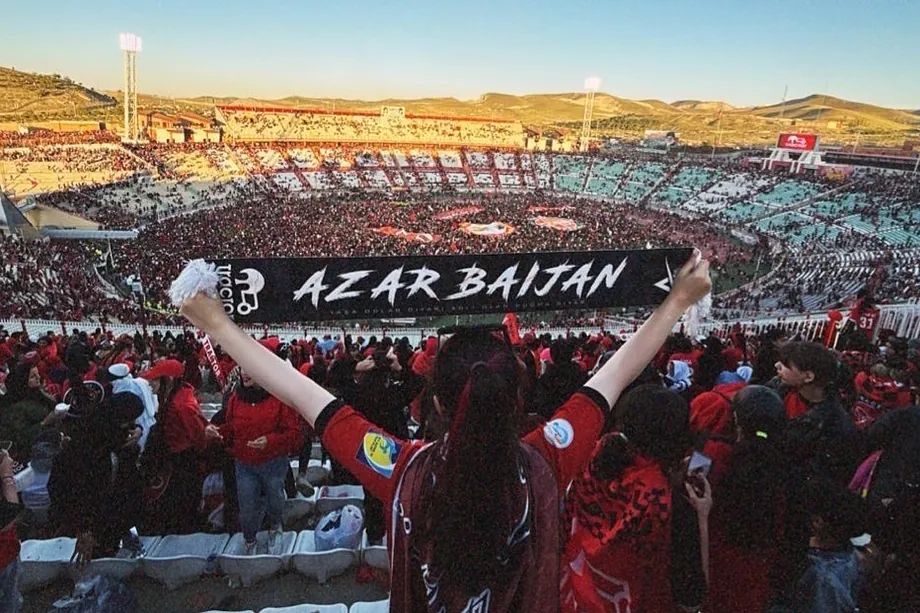
On February 1, Tractor Sazi FC denounced the information blackout with which the ayatollah regime had tried to suppress another wave of protests. "How much pain has been experienced, how many lives have been lost in these 24 days," lamented the current league champion, still perplexed by the "murder" of their former player, Mujtaba Tarshiz, shot dead with his wife. These deaths intensified the outrage in Tabriz, the city of Tractor, in the northwest of the country, close to the border with Azerbaijan and Turkey, the two nations with which their fans truly identify. During the last two home games, expressions of grief were added to the traditional protests at the Sahand stadium.
"Tractor fans do not usually chant direct slogans against the regime, but rather demand education for their children in Turkish and Azerbaijani, the release of political prisoners, or denounce the racism suffered by Turks in Iran," explains sociologist Vahid Qarabagli to EL MUNDO, who has been involved for years in the fight for the civil rights of Iranian Azerbaijanis. "Since their rise in 2009, Tractor has progressively become more than just a football club, seen as a symbol of Azerbaijan and the Turkish-speaking population of Iran," adds the activist.
According to a survey by the Asian Football Confederation (AFC) conducted in January 2021, Tractor is the most popular team on the continent, estimated to have 35 million followers. Most of them are Azerbaijani Turks from Iran and the global Turkish-speaking diaspora. "For them, their team represents a community that has fought for years for the recognition of their language and cultural identity within the Iranian state," reveals Qarabagli, drawing similarities to what FC Barcelona represented during the final years of Franco's regime.
Emil Aslan, a professor of Security Studies at Charles University in Prague, supports this thesis. "Most Tractor fans express their separatist demands, similar to some Catalans. They advocate for becoming part of Turkey or the Republic of Northern Azerbaijan in the Caucasus. However, I would not say that this irredentist agenda poses a major problem for the entire Iranian Azerbaijani community, as many still consider themselves loyal citizens and do not want secession," evaluates Aslan about this Shiite Muslim ethnic group, representing around 30% of the Iranian population.
On February 25, three days before the first Israeli and U.S. bombing of Tehran, Tractor sent a letter to FIFA Secretary General Mattias Grafstrom. In the letter, they strongly criticized their country's federation, accusing it of violating the principle of impartiality, misusing the VAR protocol, and turning a blind eye to the racist chants endured by their goalkeeper, Alireza Beiranvand, a key player in the national team, and their captain Shoja Khalilzadeh, also a fixture in the national team. "We request the intervention of the FIFA Ethics Committee to examine the reasons why the Federation does not address ethnic and racial prejudices, including whether such inaction is due to external pressures or non-sporting considerations," the letter concluded.
This was not a one-time complaint but the latest chapter in a series of historical grievances that had reached its climax in May 2015. At that time, Tractor reported a large-scale scandal during the last league match. With 20 minutes left in their match against Naft Tehran, leading 3-1, the referee very harshly sent off Andranik Seymourian. As a result, their lead dwindled to a final 3-3 draw. Nevertheless, that draw was enough for them to be champions, as Sepahan, their title rival, had only managed a 2-2 draw.
Or so it seemed until the 87th minute when the television, radio, and phones suddenly went silent, leaving everyone in suspense. Confident in their fate, Tractor's players no longer sought a 3-4 victory. After five minutes of celebration, the news that Sepahan had actually won 2-0 came as a bombshell in the locker room. "We were deceived," exclaimed Toni Oliveira, their coach, who had been personally informed of the alleged 2-2 draw by members of the Iranian Federation.
It took exactly a decade, until May 15, for Tractor to overcome that trauma. "Down with Persian racism!", "What joy to be Turkish!", "Tabriz, Baku, Ankara! Persia is far from us!". These chants echoed through the Sahand stadium as over 70,000 fans celebrated their first league title in history. The euphoria among the Red Wolves, as they call themselves, in reference to the totemic animal of the Turkish peoples. "There are not many channels to express the disconnection with the Islamic Republic, so it is done through football, the most popular sport in the country. It is a phenomenon that has intensified since the beginning of the last decade," says Aslan.
55 years had passed since the club's founding, destined to bring joy to the workers of heavy machinery factories in Tabriz. The long-awaited revenge against Esteghlal, the great capital rival, known for its ties to the Shah of Persia and, after the 1979 revolution, to the Islamic government that took control of the club. "During their matches, many derogatory slogans are heard. Tehran fans refer to Tabriz fans as 'Turkish donkeys,' and the Azerbaijanis respond with 'Persian monkeys,'" reveals Aslan.
"We know that the police have become less willing to accept ethnic insults, especially those coming from Iranian Azerbaijanis. They are much more tolerant of insults from Persians but much less tolerant of what is said against them. Therefore, we have indirect evidence that law enforcement has intervened after these matches to locate and punish Iranian Azerbaijani fans," adds the author of the study Football Nationalism Among Iran's Azeris, published in 2015, from Prague.
In January 2010, sports journalist Abdollah Sadoughi was arrested in Tabriz after displaying a poster in support of Traktor, his beloved team. After being detained without charges, he went on a hunger strike. He was placed in solitary confinement and later transferred to a cell with common criminals. A year later, Sadoughi was arrested again for his activities in support of Lake Urmia, turned into a huge salt flat due to government negligence. In 2020, his home was searched again to confiscate materials.
However, the Sahand stands have also witnessed much more hopeful scenes, such as the presence of women. "Over time, the stadium has become a space where fans raise various social and cultural concerns, such as women's rights. In recent years, there have been some changes, and female attendance at certain matches, including Tractor's, is increasingly allowed, where they have shown strong and passionate support for the team," Qarabagli concludes.