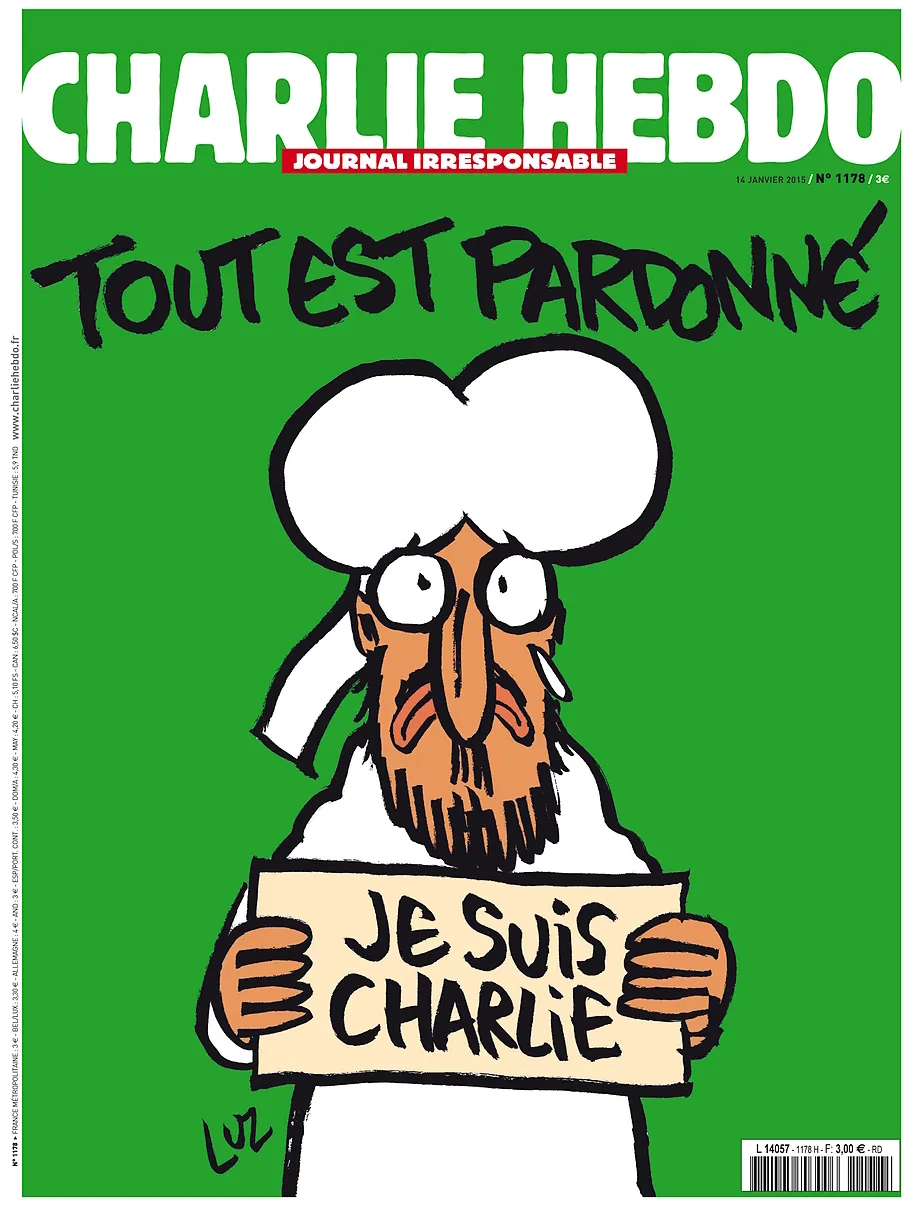
On the morning of January 7, 2015, the cartoonist Luz (Renald Luzier) lingered in bed a little longer. It was his birthday, and he didn't want to rush saying goodbye to his wife before going to work. Additionally, he stopped by a bakery to bring the French equivalent of a King's cake to his Charlie Hebdo colleagues. Those lazy minutes saved his life. Upon arriving at the headquarters of the French magazine, he was horrified to find out that a jihadist attack had taken place. He saw the perpetrators fleeing the building, making their way out just as they had entered: with gunfire. They left 12 dead.
Luz was the author of the iconic cover that was published a week after the massacre, the one with a green background featuring a cartoon of Muhammad with a tear. The one with the sign Je Suis Charlie. The one that moved the entire planet. "I wrote Everything is forgiven and I broke down in tears," the author confessed at the time. Months later, still in shock, the cartoonist expressed his emotions in the album Catharsis. He also bid farewell to the publication where he had spent two and a half decades.
From that young newcomer recently settled in the capital with a desire to tickle current events or use the Eiffel Tower as a toothpick, Luz (Tours, France, 54 years old) now recalls to contextualize his latest graphic novel. Titled Two Naked Women (Reservoir Books), it recounts the incredible tribulations of a painting created in the early 20th century. Indirectly, it also presents his status as a survivor and defender of freedom of expression.
"I had the desire to create a special book for myself. I needed it to become a personal milestone 10 years after the attack," Luz acknowledges via video call. "I thought the best way to tell my experience was precisely through another creator. Specifically, through an artist from the German expressionism, the artistic movement I discovered when I arrived in Paris in the 90s and where I found masters of political satire."
Luz invites us to travel through a century, the deadliest and most violent in history, based on a work practically unknown to the general public. Nothing like those of Grosz, Dix, Beckmann, Kirchner, Marc, or Nolde. In 1919, in a forest on the outskirts of Berlin, the painter of Gypsy origin Otto Mueller began painting Two Naked Women in front of his wife and muse Maschka Meyerhofer. Luz recreates with a dreamlike graphic style fragments of the couple's life, the first owner of the painting, the curator who prevented its destruction, and, in reality, of Germany plunging into its darkest years: Hitler's rise to power, antisemitism turned into state policy, the looting of Jewish families, the labeling of modern art as degenerate by the Nazis (Two Naked Women was included in the traveling exhibition Entartete Kunst), the train journeys to death, the chimneys emitting smoke...
The painting is the silent witness of a world - the one built by the Third Reich - where painters traumatized on the front lines or in the rear of World War I and their creations, recognizable at first glance by the green faces and stumps, are seen as aberrations. With his graphic novel, Luz urges us to remain vigilant against political authoritarianism and cultural demonization.
"Speaking of degenerate art is speaking of stigmatized art, of artists who were first hated and despised and then recognized and celebrated," explains the cartoonist. "I discovered Mueller's piece in a book by Stephanie Barron on degenerate art and saw the photos of the 1937 Munich exhibition. It was hanging crooked, like most of the paintings, because the exhibition was deliberately poorly set up to show the madness of the artists. I wondered if a child could have entered to see it and what they would have thought. Fiction offered me a dead angle from which to talk about myself and current society."
Two Naked Women hit the shelves in France just a few months before the tenth anniversary of the massacre at 10 Rue Nicolas Appert. Last year, it swept all the major awards that any comic aspires to in the neighboring country: the Fauve D'Or (award for the best album at the Angoulême International Festival), the Grand Prix de la Critique ABCD (awarded by specialized critics), the Prix Wolinski (presented by Le Point), the Grand Prix de la BD (awarded by Elle)...
Its merits? A fervent passion for detail. "I spent three weeks reconstructing what a bike ride through interwar Berlin would have been like," specifies the author. A very original choice of perspective: events are observed from the vertical perspective of the canvas, as if it were a TikTok video. "Putting a frame and placing people inside is what we do daily with our mobile phones," he admits. An approach to absolute evil (Hitler, Goebbels, Goering) that does not fall into the grotesque or the explicit. A spoonful of lyricism and even surrealism, noticeable in scenes featuring cockroaches and rats. "I remembered Maus and it seemed natural to invoke the work of Art Spiegelman to show horror through the fantastic," Luz concedes. "Since 2015, there has always been a certain fantastic dimension in my work. I refer to the impact of the unimaginable - the attack - on my reality and that of others, something I cannot help but translate into drawings." And lastly, an allegorical tale that sends shivers down the spine.
"In the image-saturated world we live in, we have to look for something that remains outside the field of vision. Or pursue what is not clearly visible. In Two Naked Women, there are two overlapping stories: the small story, the one we see in front of the painting, and the grand History behind it. It shocked me to see Elon Musk making the Nazi salute when the book had already been published. I thought maybe he wasn't aware of the antisemitism it would provoke. And also that, with all we know in the 21st century about the Holocaust, we have no excuse not to act against the rise of the far right in Europe and the rest of the world."
Luz does not reveal the painting, or rather, his interpretation of Two Naked Women, until the last page. By that time, we already know that it is housed in the Ludwig Museum in Cologne. The research that the cartoonist carried out to trace a work labeled as "immoral" differs little from the investigations of a detective or a journalist. However, he prefers to distance himself from the material that makes up the news.