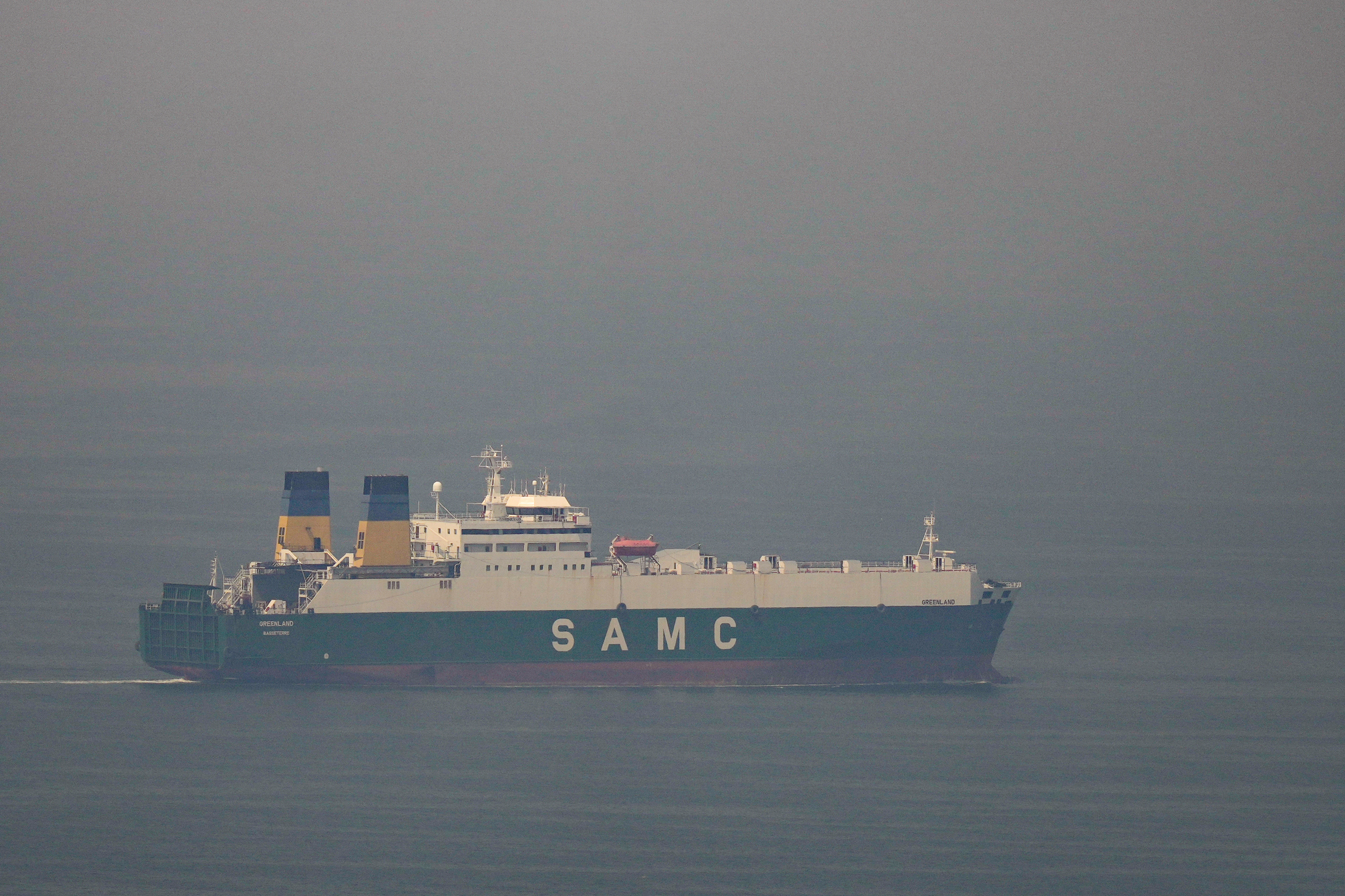
The geopolitical volcano that the Strait of Hormuz has become emits worrying signals. Iran, the owner of the oil passageway, has no intention of letting go. After two weeks of relentless bombings by Israel and the United States, it has suffered huge losses in its army, navy, and air force, but it maintains its capabilities to continue launching ballistic missiles and drones over the Persian Gulf. Although their numbers have decreased since the early days, a logical decision considering that this war may last longer than expected, their projectiles continue to reach Israel, Bahrain, Qatar, Abu Dhabi, Kuwait, Oman, or Dubai daily, with 836 ballistic missiles and 2,568 drones in two weeks.
Tehran has even allowed itself to debut a new device never seen before, the Seji ballistic missile, with a range of 2,000 kilometers, weighing 23 tons, and measuring 20 meters long. They launched it at Israel yesterday.
As the world watches the opening of markets this Monday, in the context of the greatest oil restriction since the 1973 oil crisis, both Washington and other Western countries seek a solution to the forced closure of Hormuz, the leverage that the Iranian regime holds to force its enemies to accept its existence. Currently, out of 150 tankers that crossed that area daily just three weeks ago, it has dropped to less than 100 in the last seven days, most of them linked to China or Iran itself.
To demonstrate its power, Tehran has attacked 16 large merchant ships and has promised to continue doing so with those attempting the crossing without their permission. They can fulfill their threats because they do not need much. The Shahed drones, protagonists of the war in Ukraine, can be launched from anywhere without attracting attention, even from a simple van and hundreds of kilometers away. A swarm of several drones is very difficult to stop, but one is enough to set a tanker on fire.
The United States may have three aircraft carriers in the area with the world's most modern fighters, but they cannot shoot down swarms of dozens or hundreds of those drones or destroy all their launch platforms. Iran has been planning actions like this for a long time and preparing for the new salvo war, but the United States and its allies have been improvising a solution to a complex problem for days. Among the options being considered may be the escort of tanker convoys, as was done in World War II from the US to Great Britain to evade German submarines, but these are not U-boats but 20,000 euro drones operated hundreds of kilometers away by 20-year-old kids.
Another option is the landing on the three islands in the Strait, Abu Musa, Greater Tunb, and Lesser Tunb, belonging to the United Arab Emirates but occupied by Iran since the fall of the Shah. Iran maintains military installations, radars, and missile positions on these islands, allowing them to monitor and threaten maritime traffic. However, any airborne or amphibious mission carries a high risk of casualties and unpopularity.
But even with escorts, it would be impossible to approach the 800 weekly ships, which is the usual passage figure. Iranian ballistic missiles, capable of reaching ships from hundreds of kilometers away, fly at Mach 5 (five times the speed of sound), giving anti-aircraft defenses only a few seconds to shoot them down. Iran is also launching waves of electronic warfare to confuse ship navigation, which could lead to an accident at sea.
Both plans, escort or landing, could take weeks, even months, and their implementation does not guarantee success. According to Professor Robert A. Pape, a conflict specialist at the University of Chicago, "President Donald Trump is escalating the war against Iran with the belief that greater force will lead to victory. History suggests otherwise. When the stronger state that initiated a war continues to escalate the conflict, it often falls into what I call the 'Escalation Trap.' The most dangerous phase of the war is rarely the beginning. It is the middle phase when leaders believe that retreating would signal weakness and escalation becomes easier than stopping."
Two hours by car from the southern end of the Strait of Hormuz, residents in the futuristic emirate of Dubai enjoyed a day without alerts on their phones yesterday, but with a sense that the worst is yet to come. "At first, I said I would stay and no one would take me out of here, but as the days go by, I'm not so sure anymore," says John, a red-haired Irishman who works in real estate. "Our investment has dropped by 30% in a few days and it could still plummet further," he comments fatalistically.
In the sky, the UAE Air Force, almost unknown to the rest of the country a few days ago, is now admired by its citizens for patrolling the sky 24/7 aboard their F16s. The sound of their Apache helicopters flying over the city's luxurious marina can also be heard. The emirate is on alert due to Iran's threats to destroy ports, runways, and facilities they consider related to the US. It is a very unsettling message.
The state, on the other hand, struggles to offer an image of normality that is not real. Currently, Emirates airline is recovering almost 60% of its flights and expects to be at 100% in the coming days, but for those planes not to arrive half-empty, something more must happen: the war must end. The United States is pressuring its European allies to send ships to Hormuz to open the route, but Brussels is furious. The Trump Administration, which frequently disregards the EU and did not consult with any foreign ministry about its joint operation with Netanyahu, and the same one that lifted sanctions on Russian oil at sea against the G6 consensus, is now asking for help from the 27. European Foreign Ministers are meeting today with a naval mission on the agenda. The discussion revolves around a possible expansion of the Aspides naval mission to the Strait.
Meanwhile, Israel, the main promoter of this conflict against its great Iranian enemy, continues with its agenda of fighting Hezbollah in Lebanon but looks indifferently at what is happening in the Gulf, a collateral problem that is not theirs but Donald Trump's. Even the Palestinian militia Hamas, in an unprecedented move, yesterday asked Iran to stop attacking the Gulf emirates, something unthinkable at this stage.
Analyst Shanaka Anslem, an expert in energy markets, states that "the flow of oil through the Strait of Hormuz has plummeted from 19.5 million barrels per day to 0.5 million. The planet's most critical energy chokepoint is not closed by a navy but by a spreadsheet. Seven major insurance companies canceled war risk coverage for the Persian Gulf starting on March 5, and premiums for the remaining travel coverage skyrocketed between 300% and 1,000%. No one buys it because the premium assumes the presence of mines, and the mines are on the seabed. And without insurance, no ship can sail."
Chris Wright, US Secretary of Energy, tried to calm the markets with a reassuring message: "The war come to an end in the next few weeks". But the mention of weeks does not sound too reassuring. No one in that Administration has developed what is called in military science a "theory of victory," that is, a conceptual framework that explains how a war can be won: what conditions must be met, what actions must be taken, and what operations will force the enemy to surrender. Trump has put forward five different objectives.