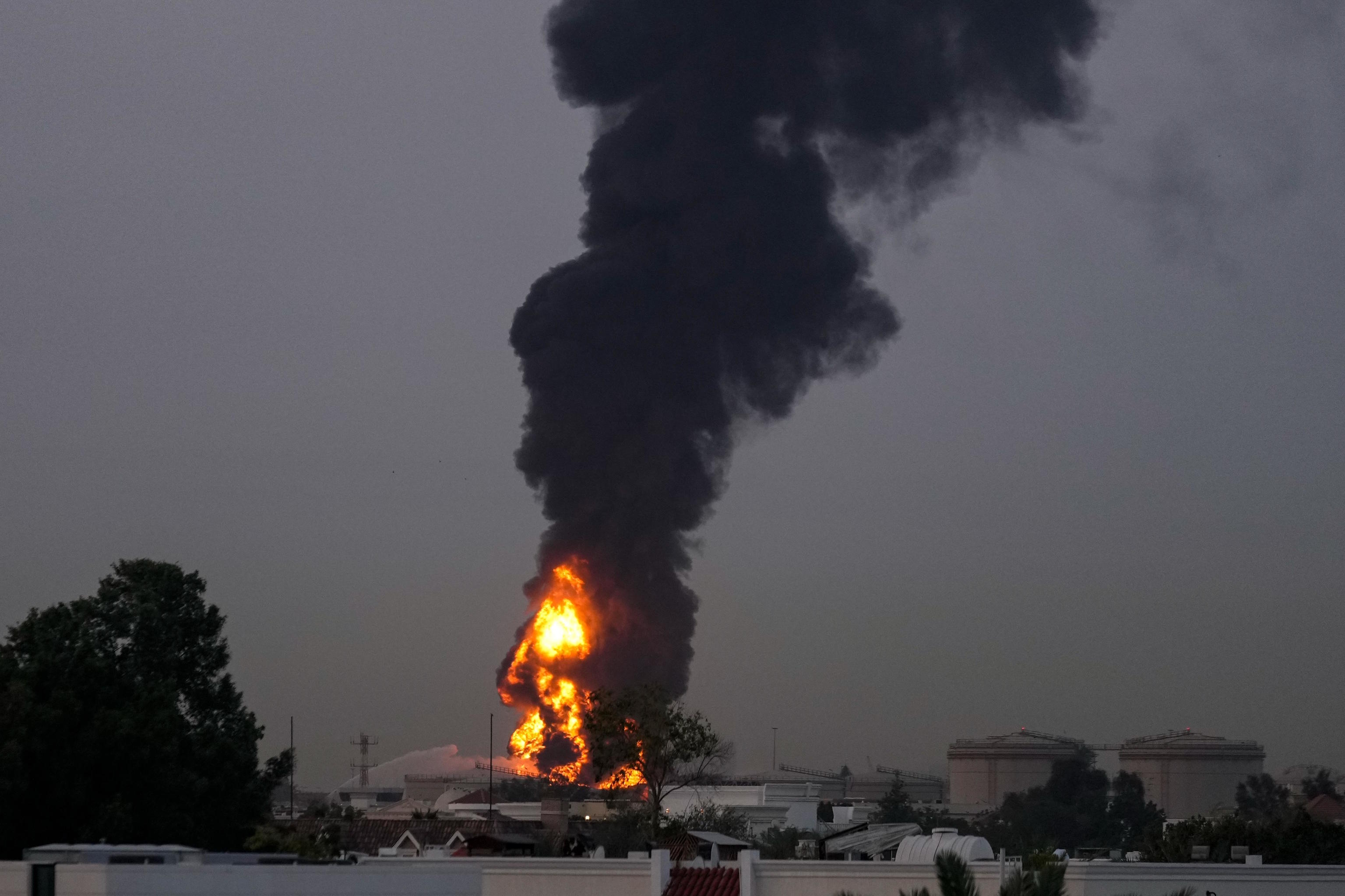
Iran has once again attacked its neighbors in the Gulf this morning, forcing the temporary suspension of air traffic at Dubai airport after a drone caused a fire in a fuel tank near the facility, although no casualties were reported. The interruption of operations was taken "as a precautionary measure," and the first flights began operating early in the morning.
Subsequently, the Saudi Ministry of Defense reported that its defenses intercepted missiles and 61 drones launched by Iran. Additionally, a civilian died in Abu Dhabi due to a missile launched by Iran hitting his vehicle.
Meanwhile, the Israeli army has announced the start of "limited ground operations" against Hezbollah in southern Lebanon and a "broad wave of attacks" against "Iranian terrorist regime infrastructures in Teheran."
Natural gas price rises over 2% and exceeds 52 euros
The price of natural gas for delivery in one month on the TTF market in the Netherlands, a reference in Europe, rose by 2.20% at the opening of this Monday, exceeding 52 euros (52.12 euros) per megawatt-hour (MWh). The price of natural gas continues to rise, in line with crude oil, amid the war between the United States and Israel against Iran.
The focus remains on the Strait of Hormuz, through which 20% of the global maritime flow of oil usually passes, which has been effectively closed by Iran and where traffic has been almost completely interrupted since the start of the war.
At the beginning of the third week of the war, the price of Brent crude, the European reference, rose by 2.51%, to $105.77, as reported by Efe.
Travel agencies request a 400 million package of measures
The Spanish Business Federation of Territorial Associations of Travel Agencies (Fetave) and the National Union of Travel Agencies (UNAV), which represent more than 5,000 points of sale in Spain, are asking the Government for an extraordinary package of measures amounting to 400 million due to the crisis in the Middle East.
They have presented a joint proposal to the Secretary of State for Tourism and the Directorate-General for Economic Policy of the Ministry of Economy, Trade, and Business, which includes eight actions aimed at mitigating the consequences of the current international crisis on their activity.
Among them, the implementation of an extraordinary ICO line of 250 million euros, preferably at a 0% interest rate, to alleviate the cash flow tensions they are experiencing due to cancellations, refunds, and traveler relocations. They also propose the creation of an extraordinary compensation fund of 120 million to partially cover losses from unavoidable cancellations, non-recoverable refunds from suppliers, and extraordinary expenses for traveler assistance. They also request the establishment of an extraordinary ERTE mechanism for agencies significantly affected by this situation, as reported by Efe.
Kallas says Ormuz is outside NATO's scope and discusses options with the UN
The European Union's High Representative for Foreign Affairs and Security, Kaja Kallas, stated on Monday that the Strait of Hormuz is "outside NATO's scope of action," but that options are being discussed with the UN to ensure its navigability.
"We have been in contact with NATO before, but in reality, this falls outside NATO's scope of action (...) There are no NATO countries in the Strait of Hormuz," Kallas said upon arrival at a meeting of EU Foreign Ministers, as reported by Efe.
U.S. President Donald Trump warned on Sunday that NATO faces "a very bad future" if allied countries do not provide assistance to allow ships to pass through the Strait of Hormuz, closed by Iran in response to U.S. attacks.
Kallas stated that the EU maintains the EUNavfor 'Aspides' operation in the area and that "there are Member States willing to contribute, either in the coalition of volunteers or in the operation itself," but made it clear that the area "falls outside NATO territories."
Oil continues to rise, up another 3%
Investors stopped listening to what was being said from the White House a week ago and now only look towards the Middle East, where ground battles continue and where Iran keeps the Strait of Hormuz closed with no expectation of reopening soon, at least not according to market prices.
Brent oil, the European benchmark, climbs another 3% this Monday, above $106 per barrel; while there are also problems at home for Donald Trump's administration as the West Texas barrel, used in the U.S., is about to exceed $100, a reference that has not been reached since 2022, during the peak of the war in Ukraine.
Fire in the Fujairah oil zone (UAE) after a drone attack
A fire broke out on Monday in the important oil industrial zone of Fujairah, on the eastern coast of the United Arab Emirates, after a drone attack. According to the Fujairah government's statement, the fire did not cause any casualties, and emergency teams continue to work to control the flames. The affected facility is crucial for the production and transportation of crude oil in the region, as reported by Reuters.
Israel claims to have destroyed a plane used by the late Supreme Leader Ali Khamenei
The Israeli army reported on Monday that it had destroyed a plane used by the late Supreme Leader of Iran, Ali Khamenei, at Mehrabad airport in Tehran overnight, as reported by Reuters.
According to the army, the aircraft had been used by senior Iranian officials and military figures to travel both domestically and internationally, and to coordinate with allied countries.
Israel announces the start of its ground invasion in southern Lebanon
The Israeli army announced on Monday that it has begun a ground invasion of Lebanon, although it clarified that it is a "limited" operation, according to information released by the Tel Aviv military on social media. "We have launched limited and selective ground operations against key Hezbollah strongholds in southern Lebanon, with the aim of reinforcing the advanced defense zone," read the statement from spokesperson Avichay Adraee.
The Government will meet on Monday with the entire agri-food and fishing sector to analyze the current situation and evaluate possible measures to mitigate the economic impact resulting from the conflict in the Middle East, affecting farmers, ranchers, and fishermen.
In particular, the Minister of Agriculture, Fisheries, and Food, Luis Planas, will start this morning with a round of meetings with representatives of the fishing sector, including the Spanish Confederation of Fishing (Cepesca) and the National Federation of Fishermen's Guilds (FNCP).
The fishing industry has already announced that it will demand urgent compensatory measures from the Government to maintain fishing activity and avoid impacts on fish supply, as they have warned of the risk of activity shutdowns due to the disproportionate increase in production costs, as reported by Europa Press.
For the second time in just three days, Donald Trump directly appealed to China to help Washington unblock the Strait of Hormuz, which has become the epicenter of the global energy crisis. "I think China should also help, as it gets 90% of its oil from the strait," he said on Sunday in an interview with Financial Times. This time, the U.S. president reflected on his upcoming visit to China at the end of the month and his meeting with Chinese leader Xi Jinping, hinting that it could be postponed.
From Beijing, the response has come more from commentators close to state media than official channels. Regular analysts in the Communist Party-controlled press have interpreted Trump's call as an attempt to "further muddy the waters" in the Middle East, emphasizing that the origin of the strait's blockade lies in the U.S.-Israeli military operation against Iran.