t was the year 2001 when the Gaullist right, embodied by Jacques Chirac and his successor Jean Tiberi, left through the back door of the Arc de Triomphe. The Socialist Party of Bertrand Delanoë took over the Mayorship of Paris, inherited 10 years ago by the woman from Cadiz, Anne Hidalgo, who is currently spending her last days in her office with incredible views at the Hôtel de Ville, decorated with nostalgic images of the Olympics.
In front of the impressive municipal mansion stands an urban forest, emblematic of the greening of Paris, next to the river of bicycles that the rue de Rivoli has become and a stone's throw from the pedestrianized and "swimmable" River Seine. Anne Hidalgo has been the driving force behind the greatest urban transformation experienced in decades by the French capital, criticized, however, as "destructive municipal socialism" by her main detractor and eternal rival, Rachida Dati, a living embodiment of the hard right with The Republicans.
"Dati is like Donald Trump, a populist politician, but she will never become mayor because she has many ethical problems in the closet," predicted Anne Hidalgo herself in statements to this newspaper, in the countdown to her farewell. However, the polls have been leaning in favour of the protege of Nicolas Sarkozy, who reaches the finish line of the first round of municipal elections held today throughout France with a 26% voting intention, according to the latest survey by Le Journal du Dimanche, compared to the 31% of the socialist Emmanuel Grégoire, and with great chances of causing an upset in the second and final round on May 22.
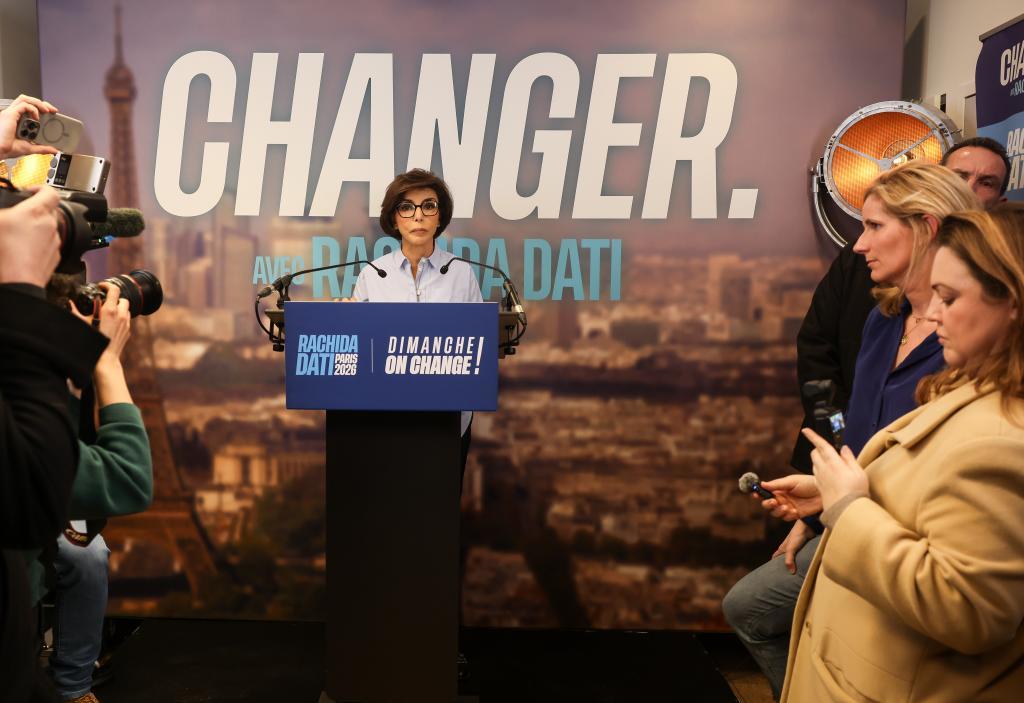
With her posters for Change in Paris and her attack line against the occupant of the Hôtel de Ville for the scandal of her personal expenses, for "the state of neglect of entire neighbourhoods" and for the serious deterioration of security in the capital, Rachida Dati has become the greatest hope of the right to reconquer the Arc de Triomphe after 25 years.
Her flagship proposal, in the name of security, has been the fencing and nighttime closure of the Champ de Mars around the Eiffel Tower, which has initially caused great divisions among Parisians. Dati wants to install 10,000 cameras in the city streets and double the number of municipal police officers to reach 5,000, armed with firearms. As an antagonist of Anne Hidalgo, she aims to evaluate the impact of all measures to restrict private traffic and present a new traffic plan (she once proposed reopening the banks of the Seine to traffic, something unthinkable at this point).
Born 60 years ago in Burgundy, the daughter of a bricklayer and an Algerian mother, Dati boasts of being "the candidate supported by Emmanuel Macron" after her role as Minister of Culture, despite the controversy created by the spectacular Louvre robbery. On September 16, she also has an unavoidable appointment with Justice for alleged corruption and influence peddling due to her links with Carlos Ghosn, former CEO of Renault-Nissan, during her time as a Member of the European Parliament. Not to mention her role as Sarkozy's spokesperson in his controversial presidential campaign in 2007, haunted for years by the shadow of suspicion.
In these local elections, with almost 35,000 municipalities at stake and with an impact that will be felt throughout Europe, Dati has had to face a tough and unexpected rival: Sarah Knafo, from the Reconquista party, the most extreme far-right. Knafo, 32 years old and former girlfriend of Louis Sarkozy, could reach 15% of the vote in the first round and ruin Dati's call for strategic voting and right-wing unity. Her rise in the polls is already an indication of the prevailing winds in a city traditionally leaning towards the left.
The long tentacles of Nicolas Sarkozy reach the other candidate of the far right, Thierry Mariani, former Minister of Transport who defected to the ranks of National Rally (RN). Interestingly, Marine Le Pen and Jordan Bardella, who aspire to conquer Marseille and other major cities, have left their candidate in Paris alone against the populist surge of Dati, and he remains at 5% in the polls.
Meanwhile, the socialist Emmanuel Grégoire arrives at the appointment with the support of the same left-wing coalition (ecologists and communists) as Anne Hidalgo, but at the same time making a calculated distancing. "Hidalgo has done everything possible to sabotage my candidacy", declared the former Deputy Mayor of Paris between 2018 and 2024, exposing internal divisions in the party that has led the reins of the capital for a quarter of a century.
"We are the only left-wing force that can win and can stand up to the far right," has been Grégorie's message during the campaign, spurred on by the former socialist Sophia Chikirou, who is running for La France Insoumise (LFI) of Jean-Luc Mélenchon. "Sophia is not my adversary, but my competitor," Grégorie stated this week, trusting in the unity of the left-wing vote when it matters.
The fifth and final candidate with aspirations for the second round in Paris is the centrist Pierre-Yves Bournazel, from the Horizons party, hovering around 10% and inevitably trapped between the growing polarization of the electorate. "Restoring order in Paris" has been one of his slogans, addressing issues of security and housing, the second major concern of Parisians. However, Bournazel is burdened by the increasing perception that the local elections will be a rehearsal for the 2027 presidential elections, which, everything indicates, will be the end of Macronism.