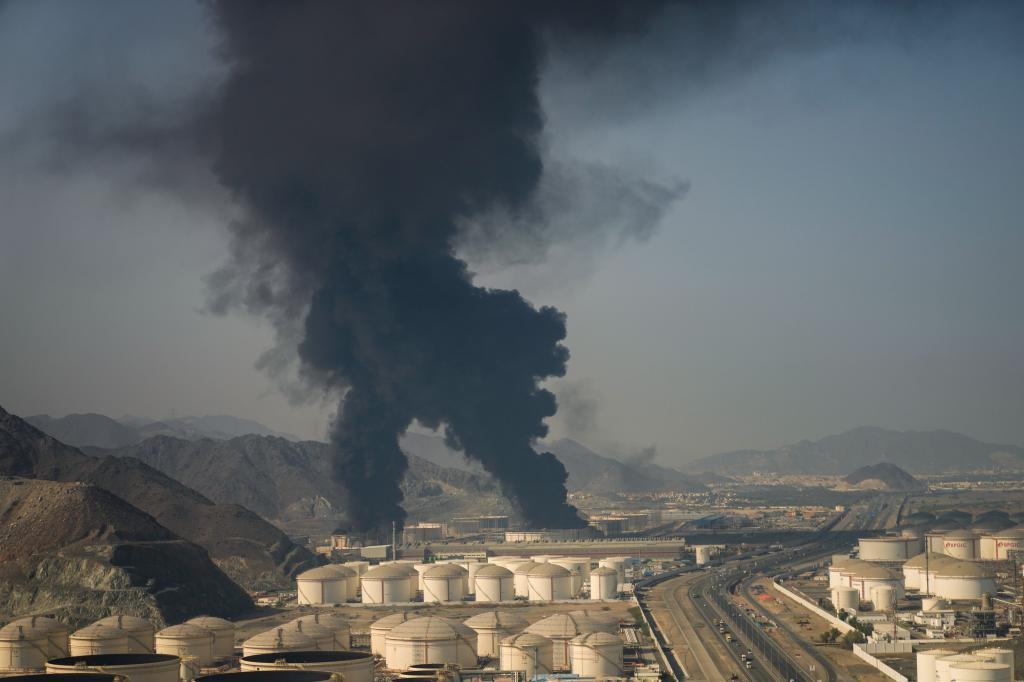
The Middle East conflict, dubbed in Iran as the "Ramadan War," is entering its third week, gradually moving away from what Donald Trump considered "a quick and decisive victory." History shows that starting a conflict is easy, but ending it is always very difficult.
Since the Islamic revolution ousted the Shah of Persia and took over Iran in 1979, no US president had dared to take direct action against its government for fear of Tehran's energy retaliation. Although US General Dan Caine, in charge of the deployment in the Middle East, warned the blond president, he preferred not to listen and move forward with an operation that increasingly resembles a failed bet with an uncertain outcome. These are the most likely scenarios in this conflict for the coming weeks.
US bombings lead to the end of the regime
This possibility is becoming increasingly remote. In the past two weeks, Tehran has experienced terrifying attacks against the country's military, political, and police structures. The United States has burned the equivalent of 10% of all the arsenal delivered to Ukraine in a few days. However, the gains from this offensive are scarce. It has neither brought down the regime nor has the Iranian people risen up in arms against the Ayatollahs, who continue to control the streets with their usual repression.
Furthermore, to add to the humiliation, the US took down Supreme Leader Ali Khamenei on the first day, and now finds that another Khamenei is in charge, his son, although no one knows for certain his physical condition. Many Republicans urge Trump to withdraw from hostilities, declare victory, and try to restore the region to the previous status quo, something difficult to achieve at this stage of destruction.
Iran has also closed the Strait of Hormuz and has attacked all US partners in the region, creating disruption in global oil supply, the worst possible scenario for Gulf countries, but also for Donald Trump himself, now forced to react with a mission to try to control access to the Persian Gulf and perhaps carry out a land landing on its islands, a costly and risky mission that could increase casualties, time, and political cost.
Some strategists propose a possible scenario: that economic, military, or political pressure may severely weaken the Tehran regime. This could lead to a political transition or internal power struggles. However, many experts warn that the fall of the regime does not necessarily guarantee a more moderate government; a more nationalist or chaotic one could emerge, something feared by the Gulf monarchies.
Tehran survives and Trump withdraws without achieving his objectives
Iran has suffered the highest number of casualties, and the US and Israeli air forces have significantly reduced Tehran's military capabilities. Nevertheless, it is not clear that Iran is losing the war because the Tehran regime's goal is to survive its most critical moment. The closure of the Strait of Hormuz has helped condition the US response and now forces them to improvise a military solution in a hornet's nest. Each day without a diplomatic solution will increase pressure on the US.
Gulf countries are fearful as trust in their security is eroding due to a hostile neighbor that has been bombing them daily since Trump and Netanyahu initiated this conflict. No one believes that the United States is deterrent enough to halt the escalation. Many specialists believe that Tehran can prolong the war at will and consider this scenario the most likely. Gulf countries are angry with Trump for involving them in this conflict without consulting them, and now they are not ruling out negotiating a unilateral exit with Tehran, bypassing Washington and accepting its conditions.
Without an easy way out, the Gulf becomes a gray area
The current problem is that peace no longer depends on two parties but on several contenders with different agendas. Israel's interests may not align with those of the US or the Gulf countries. If it is already challenging for Washington to reach any agreement with Tehran, how could it satisfy all parties involved? The current context raises the question: Would Iran give up its influence over the Strait of Hormuz? Would Israel stop attacking Iranian targets? Would Russia cease to support Tehran? Would Tehran be a peaceful and reliable neighbor for Gulf countries following an agreement? It will be difficult for Donald Trump to simply withdraw claiming victory because Iran (perhaps more rightfully) would do the same to maintain the status quo, without toppling the Ayatollahs or ending their capabilities to attack their neighbors. The war could evolve into a scenario of gradual entrenchment.
Gulf countries are dragged in, and Iran activates the Houthis
So far, Gulf countries have been bombed from a distance in their critical structures by Tehran but have refrained from engaging in a long, uncertain war that could destroy their essence as safe havens for foreign investment and energy. However, an escalation could put them in difficulties and entangle them in a nightmare scenario. Only Bahrain allowed the US to use its territory to launch missiles at Iran, but if this continues and Tehran persists with its belligerent attitude, the proud monarchs of the seven Gulf emirates may consider joining the cause. In Dubai, for example, many believe that as long as the Iranian regime remains alive, the threat will not disappear, which harms the emirate's future.
Another actor that has not yet made a move but has declared its intention to do so in favor of Tehran is the Houthi militia in Yemen. Their geographical position gives them a decisive advantage: they control a large part of the Red Sea coast and are very close to the Bab el Mandeb strait, the passage connecting those waters to the Indian Ocean and a key artery for global trade from the Suez Canal.
In other words, Tehran has already closed one important tap and could close the other. The Houthis have shown that they can launch anti-ship missiles, explosive drones, or explosive-laden boats against merchant vessels, even hijack them through boarding. Although the actual number of successful attacks may be limited, the mere risk of attacks would compel many shipping companies to avoid the area.
The Iranian regime is so emboldened that it even dared to threaten the government of Volodymyr Zelensky yesterday with missile attacks on its territory for assisting Gulf countries with their experience in combating Iranian drones, similar to those used by the Russians in Ukraine.