The promotional video of the medical center in Burj Qalaouiyah showcased the modern facilities that served around twenty surrounding villages. They had a dentist, radiology service, cardiology, analysis laboratories, and a pharmacy.
"It served about 15,000 people", stated Mohamed Nurdine, former mayor of the town.
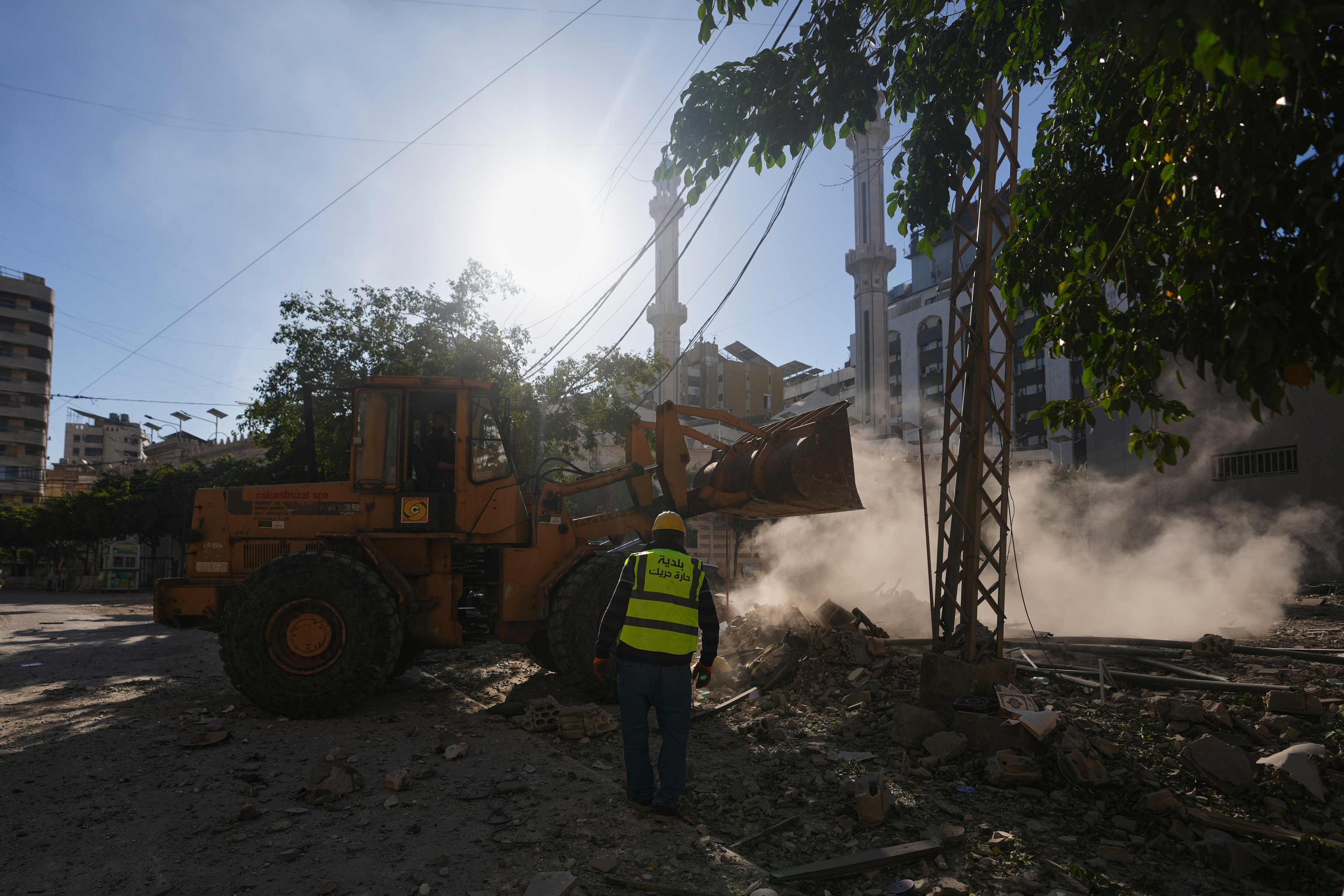
"It had been operating for about 19 years", explained Abdullah Nurdine. The head of the ambulance service at the facility and the former official were standing in front of the ruins of the building. The two floors that once housed all sorts of modern equipment were now a picture of utter devastation.
Rubble mixed with cables, metal and wood pieces, stacked in a structure whose walls were torn down by the explosion. The fire had barely been extinguished. A thick smoke still rose from the remains.
Mohamed Ahmed Mariai, another member of the rescue groups, had been on the phone with two of his colleagues, Assem Sultan and Mohamed Maatu, minutes before the incident occurred.
"They had dinner after breaking the fast -Muslims continue to observe the month of Ramadan- and were resting at the center."
The 43-year-old Lebanese heard the explosion and immediately knew it was in Burj Qalaouiyah. His rescue team arrived when the building was still engulfed in flames.
"There were bodies scattered on the second floor, on the asphalt. Some were crushed by the rubble. It took us four hours to remove them because we had to move the stones by hand," he recounted in front of the charred skeleton of the building.
According to Mariai, several of the deceased were survivors of the bloody attack suffered by a rescue convoy from Taybeh -another southern town- during the last conflict.
On that occasion, on October 2, 2024, the Israelis killed another group of paramedics, whose bodies could not be evacuated until 47 days later, as reported by the victims' colleagues.
This time the toll was even more tragic. Abdallah Nurdine stated that the projectiles that razed the clinic in Burj Qalaouiyah last Friday claimed the lives of 12 rescuers.
"This is not the only attack. The Israelis have killed more than 22 ambulance service rescuers across the country since the war began. They were carrying out their humanitarian duty. The Israelis try to cover up their crime by claiming that these vehicles [ambulances] are used for military purposes. They can check everything they want," Nurdine told the group of journalists gathered in front of the remains of the clinic.
Nurdine pointed out that the incident in Burj Qalaouiyah is far from being an isolated case. The deaths among Lebanese rescuers and healthcare workers during the 2024 war numbered in the tens.
"We had 95 martyrs [deceased] from the Civil Defense and Health Authorities, and around 120 ambulances were destroyed," he specified.
The bloody attack on the Burj Qalaouiyah clinic occurred at 8:42 p.m. on Friday, according to Nurdine. "There was no warning [from the Israelis]", he added. If they had received one, they would have evacuated the place, he emphasized.
The incident is part of the repeated Israeli airstrikes against healthcare facilities and Civil Defense forces in the southern part of the country, as denounced by the Lebanese authorities.
This Monday, Israeli aircraft ended the lives of two more rescuers in Kfarsir, north of Burj Qalaouiyah, by attacking another ambulance. According to the Lebanese Ministry of Health, so far the Israelis have killed 32 paramedics, attacked 18 hospitals and healthcare centers, and damaged or destroyed around thirty ambulances.
An Israeli military spokesperson, Avichay Adraee, acknowledged on Saturday that, for their forces, these assistance vehicles and rescuers are a target, stating that Hezbollah is using them for "military purposes," without offering any evidence to support such an accusation.
Israeli airstrikes against hospitals and rescue services were a constant during the Gaza genocide and also in the war that took place in Lebanon in 2024.
A report released by the Lebanese Ministry of Health in January of last year indicated that during that conflict Israel bombed 68 hospitals or healthcare centers across the country, forcing the closure of eight of them. The repeated Israeli aggressions resulted in the deaths of over 200 rescuers and healthcare workers.
NGOs such as Human Rights Watch and Amnesty International accused the Tel Aviv forces of likely committing war crimes and emphasized that even if some of the paramedics were members of organizations linked to Hezbollah, humanitarian law only considers them legitimate targets if they are engaged in combat, not if they are solely acting as rescuers.
The road to Burj Qalaouiyah ascends from the southern city of Tyre through a string of nearly deserted villages due to the daily harassment they face from Israeli aviation. The closest to Tyre is Aabasiyeh, an enclave that has endured as many wars as deaths since the dispute between Lebanon and Israel began after the creation of the latter state in 1948.
In Deir Qanoun An Nahar -the hometown of Hashem Safieddine, who was supposed to become the new leader of Hezbollah and was killed in October 2024- portraits of dozens of militants from the pro-Iranian group line the vicinity of the cemetery, attesting to the significant punishment the organization has suffered in recent years.
The minimal traffic observed in the villages closest to Tyre disappears completely once Maaroub is crossed. Here, residents have made their affiliation clear by erecting huge photographs of the late Iranian leader Ali Jamenei.
During the journalist's recent journey along this route, ruins were abundant, now turned into vacant lots. Trapped in this endless cycle of violence, the region's residents are already starting to count new destroyed homes, whose remnants multiply as one passes through towns like Srifa -which was partially destroyed in the last war- or Ghandouriyeh.
The almost sole visible individuals along the nearly 30 kilometers of the route are precisely the Civil Protection units' rescuers, stationed in each small village with clearly marked locations by white flags. But the presence of the armed group led by Naim Qassem in the area is as obvious as the two detonations that sounded in Burj Qalaouiyah just as the group of reporters arrived.
"They are outgoing [towards the Israeli positions]. Two mortars," commented one of the reporters.
The paramilitaries' action was met with low-altitude flyovers by Israeli aircraft, thundering through the sky with their jet engines, causing unease among the reporters. Shortly after, while witnesses of the event explained what happened that Friday, the Israeli artillery began firing in the vicinity.
Israeli military officials claim that they have destroyed between 85% and 90% of Hezbollah's rocket arsenal, an estimate that the Israeli newspaper The Jerusalem Post qualified by acknowledging that the irregulars' "true potential" has surprised the army, as they are capable of "launching around 100 rockets or drones daily, including about 200 on March 11."
Despite Israel deploying five divisions to southern Lebanon, their forces have not made significant advances in the border region so far.
Leaks channeled through Israeli and American media have spread the alleged intention of Tel Aviv to launch a broad offensive against the Arab state, which would be the fifth since 1978, aimed at capturing the entire region south of the Litani River.
The aforementioned Avichay Adraee announced on Monday that Israeli forces have initiated "limited and selective ground operations" in the border area "with the aim of reinforcing the advanced defense zone". The Israeli website Ynet indicated that the military had already made progress between seven and nine kilometers in the border area, information refuted by Hezbollah's supporters.
During the visit to Burj Qalaouiyah, organized by the Shia group, one of Hezbollah's spokespersons in the area, Salman Harb, indicated that "after 15 days of fighting, the enemy has not been able to advance towards the heart of southern Lebanon. They have established positions along the front line, but they cannot penetrate further." Lebanese media reported violent clashes in towns such as Jiam, Yaroun, Maroun al Ras, or Al Taybeh, all villages located on the front line of Lebanese territory bordering Israel. This Sunday, during the tour of southern Lebanon, this reporter witnessed the Lebanese army withdrawing half a dozen tanks that had been deployed in that area, perhaps anticipating an escalation of the fighting. Israeli Defense Minister, Israel Katz, stated during the day that the hundreds of thousands of people who have already been displaced by the offensive of their soldiers in the south - "there are already more than a million in the whole country" - will not be able to return to their homes "until the security of the residents of the north of Israel is guaranteed."
The Jerusalem Post quoted Katz himself and said that the military's intention was to replicate the Gaza strategy and turn all the villages in the area into a "wasteland," destroying them as they did in the Palestinian territory. For Mohamed Ahmed Mariai, the attack on the paramedics and the clinic in Burj Qalaouiyah is part of Tel Aviv's military plans, which, according to him, seek to "intimidate" the local population and force them to flee. He acknowledges that, in a way, they have succeeded. "Before the attack, there were 170 families, but now only 60 remain," he commented.
His family is taking refuge in Beirut. But Mariai remembers that this war is part of the many that Lebanon has fought against Israel. "We have been like this since 1948," since Israel was created. "Our grandparents already told us these things, and then our parents. We teach babies that they have to defend this land," he concludes, defiant despite the roar of shells falling nearby.