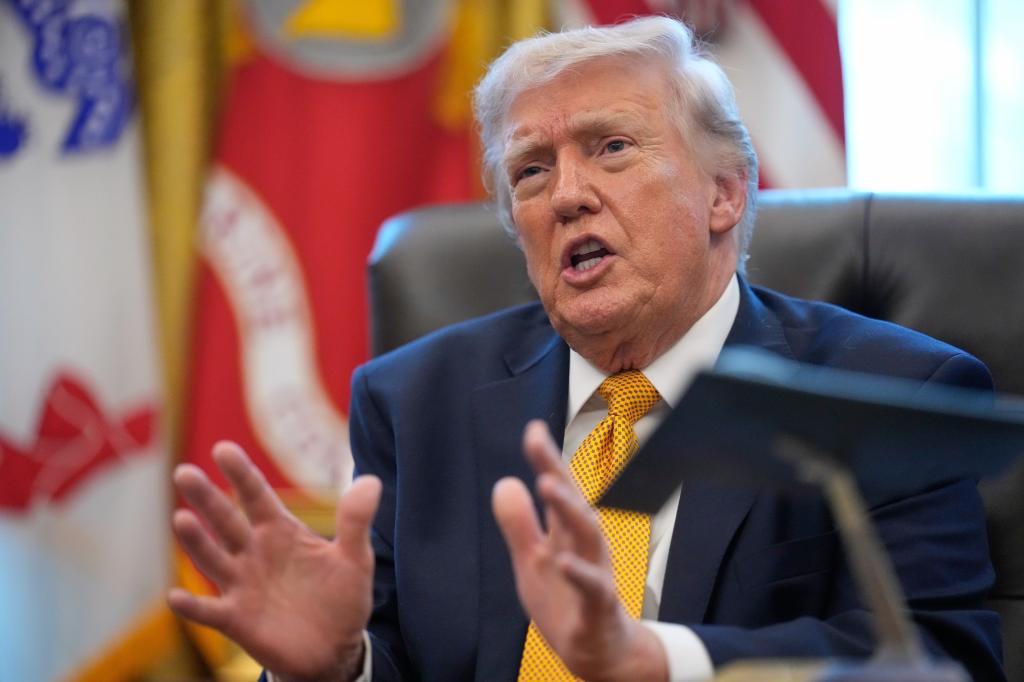
U.S. President, Donald Trump, wants to replicate in Cuba, without the need for military intervention, what has been achieved in Venezuela. The first step for this is for Agustín Díaz-Canel, the Cuban leader, to step down from power. This is stated on Monday by The New York Times, citing four sources involved in the negotiations between the island and the U.S. government.
The situation in Cuba is critical, and the blackout due to the collapse of the electrical system this Monday demonstrates it well. Since the fall of Nicolás Maduro, and the threats to Mexico, Cuba has run out of fuel and barely has enough energy for daily life, with increasingly deep supply cuts. Desperation in the communist government, with more and more protests and demonstrations, is total. To the point of having started negotiations with their eternal enemy in Washington.
The New York newspaper explains that Trump, who talks every day about the situation with satisfaction and who today has once again boasted that he can do as he pleases, wants Díaz-Canel's head, but not the complete downfall of the regime. That is, the same as in Venezuela, where he now maintains "extraordinary relations" with interim president Delcy Rodríguez, as he has reiterated today, praising the links and especially the oil agreements. The visible face of the regime falls and is replaced by someone willing to cooperate with the White House.
This is certainly not what the millions of Cubans abroad are hoping for, especially those who have been living in Cuba for decades waiting for the fall of communism. But it is what best fits this administration's system. "I think I will have the honor of taking over Cuba. It's a great honor. Taking over Cuba in some way. I think I can do whatever I want with it, if you want to know the truth," Trump said today in one of his media appearances.
Díaz-Canel, 65, has been president of Cuba since 2018, and theoretically has two more years in office. He is also the president of the Communist Party. So far, the Trump administration has not said anything about the Castro family. Neither about Raúl nor about Raúl Guillermo Rodríguez Castro, Raúl Castro's grandson, who is one of the main negotiators and who deals with U.S. Secretary of State, Marco Rubio, who in turn is the son of Cuban immigrants who left before the Revolution.
But, according to The New York Times, they believe that Díaz-Canel's departure and his team would be enough to bring about structural changes in the Cuban economy. With the U.S. as a "guide" from a distance, overseeing a transition to capitalism and allowing Americans to benefit from it. Today, Trump praised the "beauty" of the territory and mentioned in passing the tourism potential with its "great climate".
After recently allowing private Cuban companies to buy fuel abroad, the dictatorship has agreed to relax restrictions so that Cubans abroad can own businesses on the island and participate more actively in the economy. "The government is not to blame, the revolution is not to blame, our national electromagnetic system is not to blame," said Díaz-Canel on Friday. "The blame lies in the energy blockade that has been imposed on us," he added while negotiating with those who imposed it.
"Oscar Pérez-Oliva Fraga, vice prime minister of the communist and socialist dictatorship of Cuba, has called on exiles and foreign companies to invest in the island. I want to be clear: the Cuban people are in the streets demanding freedom after more than six decades of repression, blackouts, shortages, and the systematic destruction of their country. The same regime that confiscated properties, expelled families, and forced millions of Cubans into exile now wants those same exiles to return and invest in the system that oppressed them. The solution for Cuba is not doing business with a dictatorship. The solution for Cuba is the end of that murderous communist and socialist regime so that the Cuban people can finally live in freedom and dignity," said U.S. Congressman, born in Cuba, Carlos Giménez, on Monday. Supporting President Trump's measures, calling for the regime to fall, and stating that there can be no agreements without changes in power on the island.