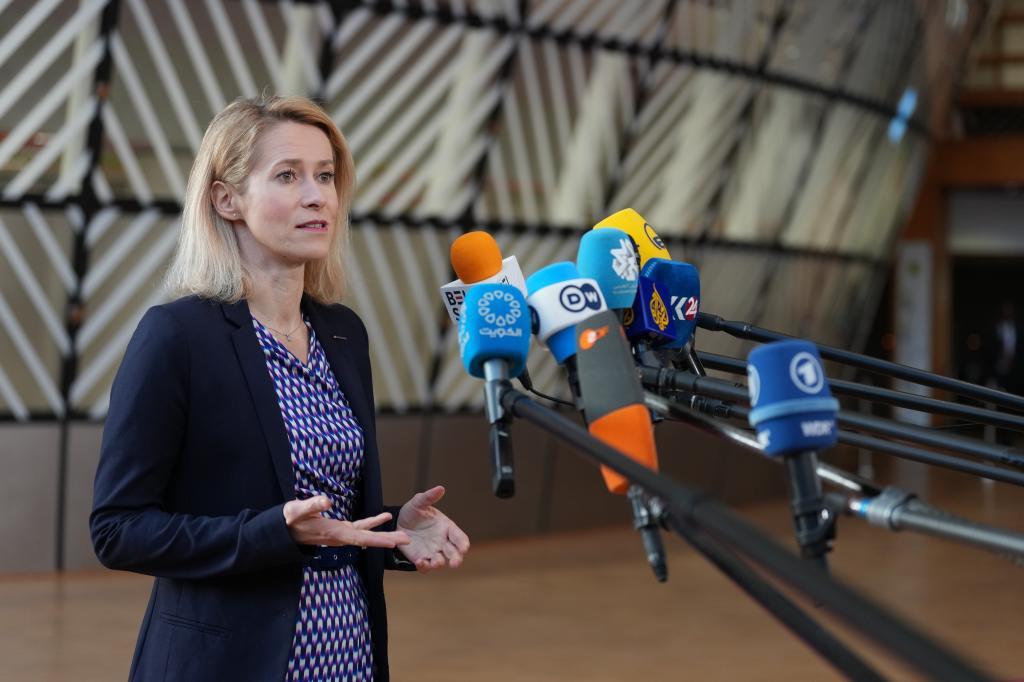
The European Union does not want to get militarily involved in the Strait of Hormuz. "There is no interest on the part of the Member States," explained the High Representative of the Union for Foreign Affairs, Kaja Kallas, after the meeting of the 27 Foreign Ministers on Monday.
"It's not Europe's war," continued the European diplomatic chief, responding very clearly to the pressures from U.S. President Donald Trump, who wants Europe and NATO allies to participate in the conflict and help secure the strait, which is crucial for the global economy.
"Some are very enthusiastic, others are not, and some are countries we have helped for many years. We have protected them from terrible external sources and they are not as enthusiastic. And the level of enthusiasm is important to me," the U.S. official also pointed out from the White House on Monday.
"Why are we protecting countries that do not protect us? I have always considered that to be a weakness of NATO: we were going to protect them, but I always maintained that when the time of need came, they would not protect us. Well, this is that time of need," he added. But the EU's position, at least for now, is very clear. Not only has Kallas expressed it, but also the head of the main economy in the community.
"We do not participate in this war. We said it from day one and that remains the position of the German government," stated German Chancellor Friedrich Merz. "This also means that, as long as the war continues, we will not participate with military means to ensure freedom of navigation in the Strait of Hormuz," he added.
Spain has also shown its rejection of the EU getting involved in the conflict and in the security of the Strait of Hormuz. The Spanish Minister of Foreign Affairs, José Manuel Albares, stated this in the morning upon arriving in the EU capital to participate in the aforementioned meeting, affirming that "Spain's position and Spanish foreign policy are very clear: Europe also has to speak with that voice, and it has to be one of de-escalation, of dialogue and diplomacy, of returning to the negotiating table."
"Purely military solutions never bring democracy, stability, or economic prosperity," added the Spanish government official, rejecting a proposal that Kallas had also mentioned earlier in the morning. After the initial pressures from Trump, which were already known during the early hours, the High Representative hinted at the meeting that one possibility was to modify the EU's naval operation Aspides.
This operation is intended to prevent Houthi attacks on maritime transport in the Red Sea, and the diplomatic chief suggested that the mandate could be modified and transferred to the Strait of Hormuz. However, unanimity would be necessary for this, which seems impossible, not only due to the refusal of the usually rebellious countries. "There is no intention to change the mandate of the operation," Kallas confirmed after the meeting.
France, on the other hand, is willing to get involved in the defense of the Strait of Hormuz. Or at least that's what Trump claims, who also stated that he had spoken with French President Emmanuel Macron, and his response had been "an eight [out of ten], not perfect." "I think it will help," he added. But in Brussels, the message from Paris is that the country would be willing to be part of a sort of volunteer coalition, but only when tensions ease in the area.
And the United Kingdom, a country that according to the magnate would also be willing to help, states that it is working with its allies on "a viable collective plan" to reopen the strait and alleviate the economic impact. But in no case as part of a NATO mission, something that Trump also desires but seems unlikely to happen.
"The Allies have already intensified their efforts to provide additional security in the Mediterranean. We are aware that some individual Allies are talking with the United States and other partners about what more they could do, also in the context of security in the Strait of Hormuz," sources from the Alliance point out. Trump stands alone in this conflict that many in Brussels just want to end as soon as possible.