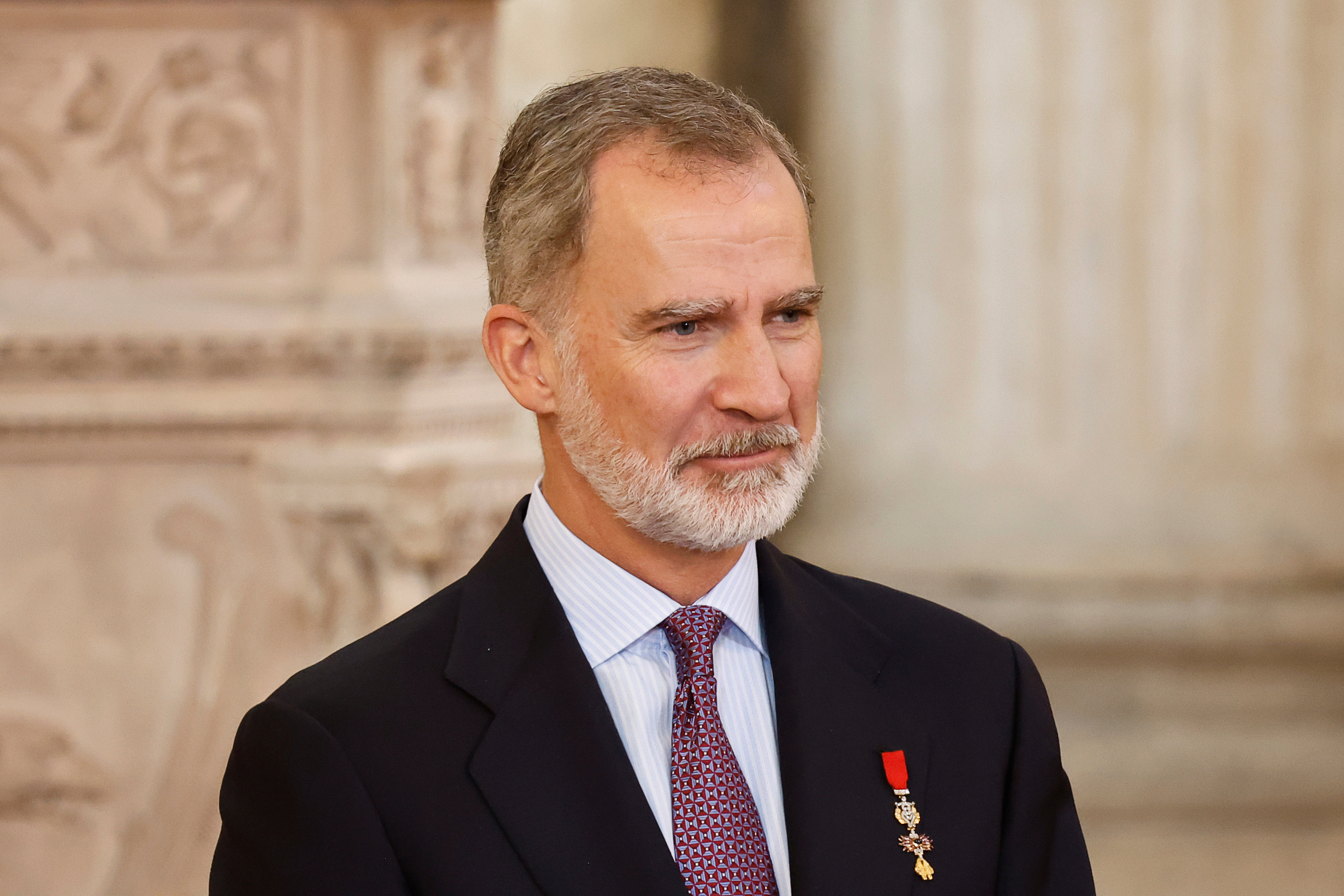
King Felipe VI's commitment to revitalize the Ibero-American Summit, that meeting point of heads of state from both sides of the Atlantic, led him yesterday to take an unexpected step. After a tour last week through Portugal, Chile, and Bolivia, the Head of State wanted to approach Mexico, a country with which diplomatic relations had been at a "standstill" since 2019. The reason was the lack of response from the King to a letter in which Mexican President Andrés Manuel López Obrador demanded apologies from the Crown for the Reconquest. The conflict reached such a level that King Felipe, for the first time, was not invited in 2024 to the inauguration of Claudia Sheinbaum. Six years later, and with no presence from the government, the King sought to take a step towards reconciliation in an event without media coverage.
King Felipe VI made a private visit to the exhibition The Half of the World. Women in Indigenous Mexico. The meeting was not on the agenda, but there, in front of the Mexican ambassador to Spain, King Felipe acknowledged that "there was a lot of abuse" during the colonization of America. "There have also been struggles, let's say, moral and ethical controversies regarding how power is exercised. From the very first day, that is, the Catholic Monarchs with their directives, the laws of the Indies, through the legislative process, there is a desire for protection, which reality later shows is not fulfilled as intended, and there is a lot, a lot of abuse and also, as I said before, valuing the fact that from there, from that knowledge, well, we will appreciate each other more," affirmed the Monarch to Quirino Ordaz, head of the Mexican diplomatic mission.
Don Felipe focused his intervention on the need for "both sides of the Atlantic" to know the common history because "that mestizo culture is what defines us today" since "knowing the past is the way we have to value what happens today." Thus, the King acknowledged that "there are things that when we know them, when we study them, in our current judgment, with our values, well, they cannot make us feel proud, but we must know them, and in their proper context, not with excessive presentism."
At the time of this edition, no member of the Mexican government had publicly reacted to his words. They did cause opinions in some Spanish political sectors. As reported by Europa Press, the Vox MEP Hermann Terstch rejected the King's words: "With all due respect, I remind you that there is 'a lot of abuse' now by a criminal government that plunders the Spanish, has corrupted the entire State administration, steals without pause, and also constantly harasses, marginalizes, and attacks His Majesty's institution," he pointed out. In that sense, he acknowledged that "the possible existing abuses" in any human community are "insignificant" compared to the abuses committed by the inhabitants of those lands and to the colossal and glorious work of Spain.
On the other hand, historians applauded the King's words. "I think it is healthy that the King of Spain picks up on something that is already quite common," noted historian José Carlos Mainer in statements to Europa Press. Meanwhile, Jon Juaristi described these words as "irreproachable," to later warn that he does not see "what they have to do with that formal request for forgiveness" that "so many descendants of anti-Spanish and Indian killers are demanding from the King." For his part, José Luis Corral reiterated that "there is no need to apologize" for what other Spaniards did 500 years ago, although he appreciated that Felipe VI mentioned "presentism."
The King's words sparked mixed opinions among diplomats consulted by this newspaper. While some described the Monarch's speech as "very measured," others lamented that he had "fallen into Albares' trap" to "respond to an absurd demand from Sheinbaum." However, all the diplomats consulted agree in labeling the "neglect" of Albares with Ibero-America as a "scandal": "In November, the Summit will be held in Madrid, he will say it has been a success for Spain as a country, and in reality, it is the diplomats working behind the scenes and King Felipe, who is the one truly known in the region. It is a shame that the minister has not made a major tour of Ibero-America in all the time he has been in office and seven months before the Summit."
During the King's tour last week of three Ibero-American countries, Albares was only scheduled to accompany him in Chile; however, his presence was dropped at the last minute citing the need to follow the conflict in the Middle East from Madrid. King Felipe was accompanied by the Secretary of State for Ibero-America, Susana Sumelzo. In addition to missing the meeting with the new presidents of Portugal, Chile, and Bolivia, the head of diplomacy was not present at the King's meeting with Nobel Peace Prize winner María Corina Machado.
Meanwhile, José Manuel Albares has asked his European partners to lift sanctions for Venezuelan President Delcy Rodríguez. The successor of Nicolás Maduro cannot enter the European Union, and the only way to include her presence in the future Summit would be for the 27 to lift the sanctions.
Yesterday, Albares was also not a witness to how the King tried to bring Spain and Mexico closer again, in a first step to reestablish diplomatic relations and gain more presence at the November summit in Madrid.