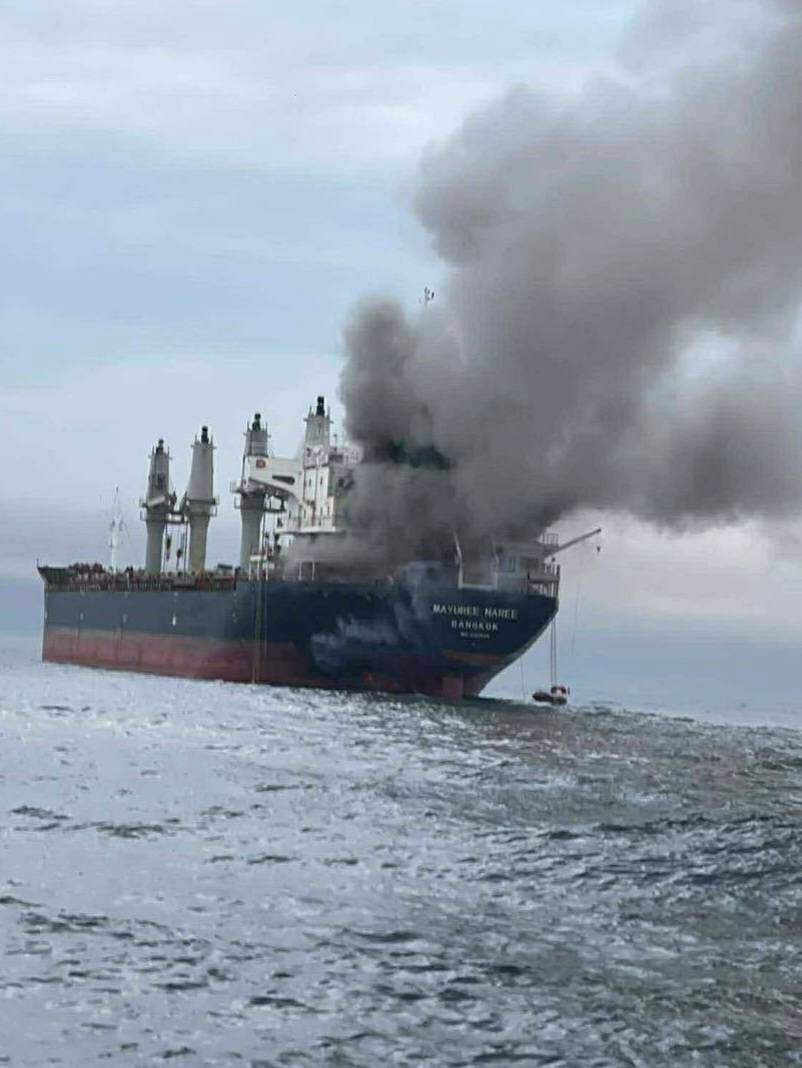
Over the last 48 hours, and for the first time since Iran closed the maritime customs of the Strait of Hormuz with missiles and drones, Tehran is allowing several tankers to leave at once, all of them linked to their own fleet or to China. In this case, it is happening through an unusual route: the authorized vessels to cross do so hugging the southern coast of Qeshm Island, which is shark-shaped, and then enter the channel between Qeshm and Larak Island towards the Gulf of Oman and, finally, to the Arabian Sea.
Why have they changed their route from the center of the Strait to the northern islands? According to several military analysts experts in the region, the answer is clear: Iran has mined the rest of the channel and has cleared the area closest to its coast. The goal is to have fire and radar control over the freighters that try to venture without permission through the strategic Strait between Oman and Iran. This is not an empty threat: 16 tankers have already been hit by Iranian drones since this crisis began.
The entire southern coast of Iran is full of caves, bunkers, and firing positions for hidden drone and missile launchers, which in military terms can be considered a kill box for unauthorized tankers to enter or exit. For example, Qeshm Island hides a missile fortress in its salt caves, which is why in Tehran they call it Iran's "unsinkable aircraft carrier". Unlike an external power, Iran operates literally from its own coast. This allows them to replenish, rotate forces, and sustain operations for a long time. Their bases, depots, and command systems are just a few kilometers from the scene. Additionally, they do not need to attack all the time or everywhere. Just one successful impact per day on a tanker is enough for fear to do the rest of the work. This is the type of warfare Iran has been preparing for.
Over that war zone, where tourists used to sail to see dolphins, powerful Iranian ballistic missiles now fly out of the atmosphere to violently strike their targets. Interceptor missiles depart from the other shore, and the interceptions illuminate the sky over the Persian Gulf.
The United States has weakened Iran's navy, air force, and army, greatly limiting their capabilities, but has not ended the main goal, closing the Strait of Hormuz. The successful decapitation of Nicolás Maduro and absolute confidence in their technological capabilities to decapitate regimes like the Iranian one drove an operation that now presents worrying flaws. According to Robert A. Pape, a military analyst at the University of Chicago, "most analysts wonder if the United States is winning, but that is the wrong question. Iran has already gained influence by disrupting the Strait of Hormuz and imposing costs on the global economy. The danger now is that an attempt by the United States to reopen it could escalate the situation. That is the escalation trap".
The Iranian coast facing the Strait of Hormuz is a natural and military stronghold because it combines favorable geography with a doctrine designed to exploit that advantage. That is why the United States has had to recalculate the route: from a quick victory, announced 11 times by Donald Trump in recent days, they have moved to having to call in the marines. In other words, a complete amphibious group of 2,500 marines for some type of landing on land, either on the islands or on the coast, in addition to trying to diversify the mission's cost by convening an international fleet with its allies. But Trump, after having belittled them, imposed tariffs, and threatened to invade some of their territories, is not getting much enthusiasm to join his plans.
The US already devised a plan to take the Strait of Hormuz in the 1980s. The commanders of the Near East Force made their calculations 40 years ago and estimated that 6,000 marines would be needed spread across several islands. The plan was to first take Larak, Ormuz, and Qeshem. Then, small landing groups would take the rest of the islets. Today, that plan, with current drone technology, would be suicidal.
For further humiliation, Iran is sending a double message: if you are a friend of Trump, your economy will sink; if you are an enemy of Trump, your economy will be saved. Tehran demands that, as a condition to exit the Strait, those tankers make their transactions in yuan, not in dollars. Iran wanting to be paid in yuan for the oil passing through the Strait of Hormuz essentially means trying to remove that trade from the dollar-dominated financial system and US sanctions. It also introduces a geopolitical element: each transaction in yuan weakens the petrodollar monopoly and reinforces the creation of parallel energy circuits between sanctioned countries or those aligned with China.
In the US, high-level voices opposing intervention are emerging, such as Joe Kent, director of the US National Counterterrorism Center, who announced his resignation: "I cannot support the war being waged in Iran. Iran posed no imminent threat to our nation, and it is clear that we started this war due to pressure from Israel and its powerful American lobby".
Meanwhile, missiles and drones arrive punctually at the Gulf capitals, as well as at their oil infrastructures. A large column of smoke was visible throughout Dubai on Tuesday due to the bombing of its airport fuel depots, while a large explosion shook the city's financial center. The same happened in neighboring Abu Dhabi. A missile was intercepted, and the debris killed a Pakistani citizen upon impact.
The Trump Administration seems to have approached the conflict with Iran based on two assumptions. The first, that they could redefine their objectives as the war progressed, adapting them to what they believed possible to achieve in each phase. However, entering a war without a clear theory of victory is always a mistake. The second, that the joint military superiority of the United States and Israel would allow them to fully control the pace, intensity, scenarios, consequences, and ultimately, the outcome of the conflict, deciding when and how to end it. Now Trump could withdraw and claim victory again, but leaving control of the Strait to the ayatollahs could be a geopolitical error of enormous magnitude.
British military analyst Nicholas Drummond Trump states that "Trump is playing a high-risk poker game. The price of failure could be too high for European nations to allow the defeat of the US. Even without this possibility, the need to avoid long-term economic suffering could mean that we will be involved, whether we want to or not".