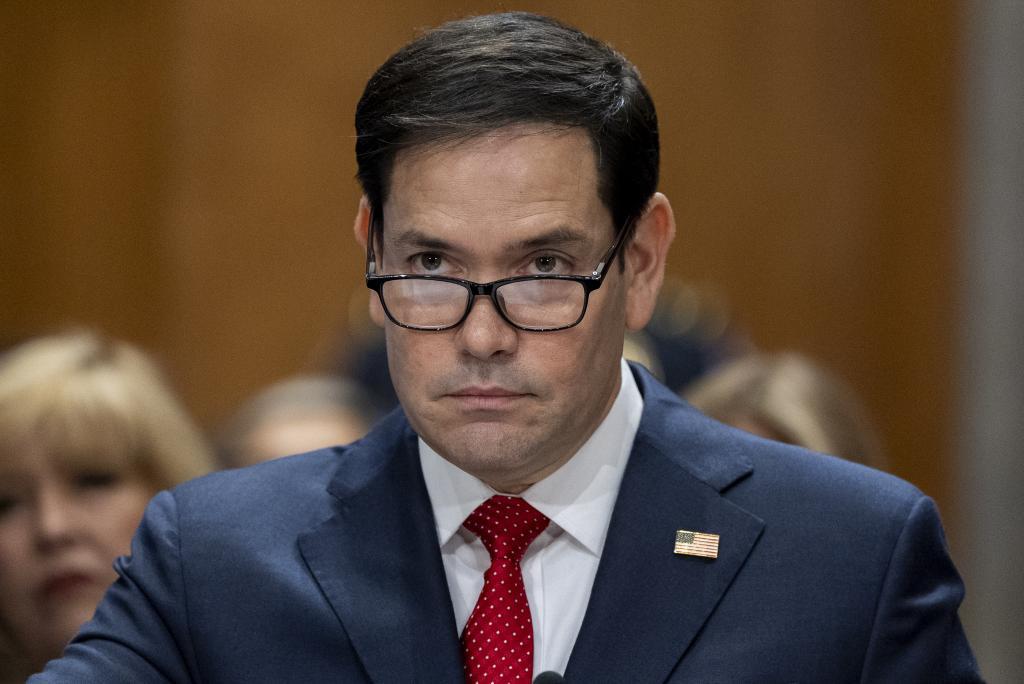
Economic reforms in Cuba are a necessary condition, but not sufficient. For the United States to lift the embargo, allow the arrival of Venezuelan fuel, and reach an agreement that provides immediate relief, there must be political changes. And, above all, a change among Cuban officials. This was stated on Tuesday by the U.S. Secretary of State, Marco Rubio, during a joint appearance with President Donald Trump alongside Irish Prime Minister Micheál Martin.
He did so encouraged by Trump to explain Washington's view on the events in the Caribbean, after a general power outage on Monday and after Vice Prime Minister and Minister of Foreign Trade and Investment, Óscar Pérez-Oliva Fraga - great-nephew of Fidel and Raúl Castro - announced that Cuban exiles are welcome to invest in the islands. Not only by owning companies and businesses, but also by investing in infrastructure projects or opening accounts in state banks. This adds to the permission granted a few weeks ago for private Cuban companies to purchase oil abroad.
"Cuba has an economy that does not work within a political and governmental system that is incapable of fixing it. Therefore, they must make drastic changes. What they announced yesterday is not drastic enough; it will not solve the problem. So, they have to make some important decisions there," Rubio concluded.
When specifically asked about the possibility of the U.S. Congress accepting a relaxation of the commercial embargo on Cuba, Rubio said he would not go into details about what they are currently negotiating, but that the embargo "is conditioned on political changes on the island. The law - the embargo has been legally codified - is clear. "Their economy does not work, it is dysfunctional. It is an economy that has managed to survive for 40 years since the Revolution - if it can be called a Revolution - thanks to subsidies from the Soviet Union and later from Venezuela; but now they no longer receive those subsidies, so they are in a very complicated situation. Those in charge do not know how to solve the problem; therefore, it is necessary for new people to take the lead," stated Rubio, himself the son of Cuban immigrants to the United States.
On Monday, The New York Times, confirming news previously reported in Florida media, had published with testimonies from up to four people involved in the negotiation, that the White House demands that Miguel Díaz-Canel step aside. The formal president of the country and the Communist Party, who theoretically has two years left in office, is not directly negotiating with Washington. That role falls to another relative of Raúl Castro, his grandson Raulito.
Trump wants for Cuba the same solution he achieved in Venezuela and aspired to in Iran: a change within the same regime that completely alters the relations of the last decades. A leader completely subservient to Trump and the United States. He said this on Monday, stating that he will "have the honor of taking Cuba in some way" and that "he can do whatever he wants with it." He repeated this on Tuesday, once again praising Delcy Rodríguez. "That is the relationship we have maintained with Venezuela. I think it could almost be described as incredible. It has been really good. It has been good for Venezuela and good for us," the president congratulated.