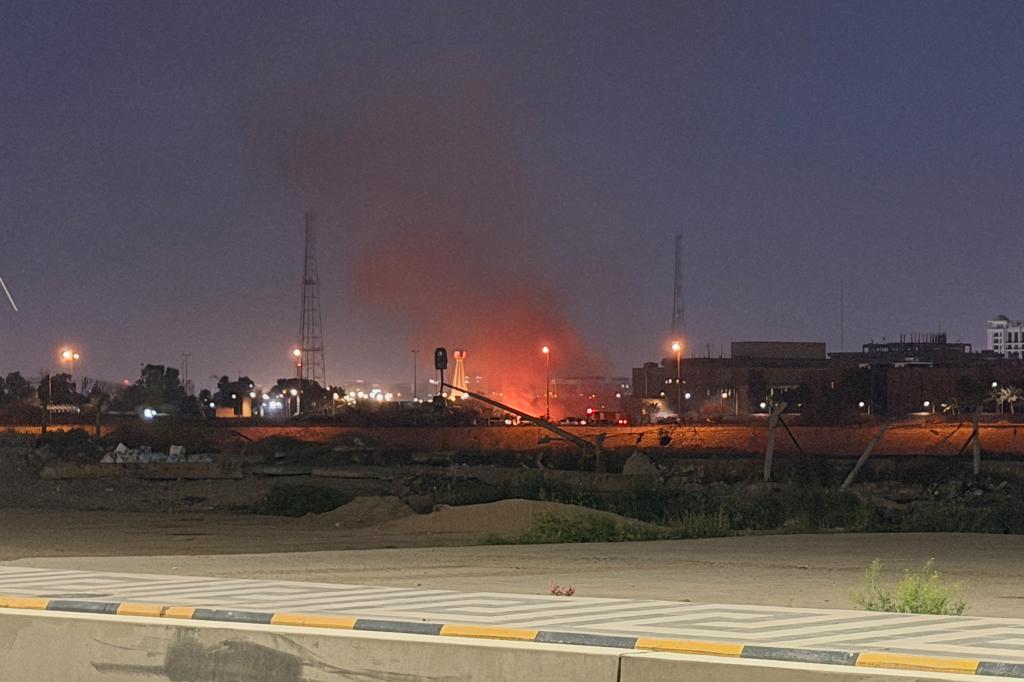
The escalation of violence between the Air Force of the USA and Israel, and the pro-Iranian Iraqi paramilitary groups, has intensified this Tuesday in the Iraqi capital, where at least 4 people have been killed in an airstrike that targeted an installation of armed factions linked to Tehran.
The airstrike occurred hours after an attack with 5 drones -according to Reuters- against the US Embassy in Iraq and the iconic Rashid Hotel, located in the so-called "Green Zone" of Baghdad, which for years -both during the dictatorship of Saddam Hussein and after the 2003 invasion- was the center used by the central power to host its most illustrious visitors.
The AFP agency indicates that two of the four deceased could be "Iranian advisors" of the irregular groups, integrated with others that do not follow Tehran's guidelines in the so-called Popular Mobilization Forces (PMF).
Videos from the Arab country show how the early hours of the Iraqi capital were startled by huge fireballs exploding in the sky -possibly unmanned devices intercepted by the defenses of the American complex-, tracer bullets, and a huge explosion reaching the territory near the delegation.
Several news agencies have confirmed that at least one of the devices hit the compound. Another recording shows the large cloud that emerges from one of the positions hit by the US planes. The diplomatic complex had already experienced a similar incident last Saturday, as acknowledged by outlets like Fox News.
Both the Washington Embassy and the Rashid are located in a walled area of about 10 square kilometers -the aforementioned Green Zone- where the Iraqi power organs are concentrated.
The US has urged all its citizens to leave Iraq with the utmost urgency, as armed groups close to Iran have offered up to 100,000 euros as a "reward" for the capture of military personnel or agents of that country's secret service.
Washington and Tel Aviv have increased their aerial incursions into Iraqi territory, which is increasingly becoming another of the war scenarios generated by the devastating regional war initiated by the USA and Israel on February 28.
Hours before the aforementioned episodes in the capital, PMF spokespeople acknowledged the death of 6 of their followers in the west of the country, near the border with Syria, in yet another "Zionist" airstrike, as they put it.
The Iraqi broadcaster Al Sumuria TV has reported that one of the bases of the aforementioned PMF was also attacked in the southern city of Najaf, in an incident that left at least 3 injured.
On Monday, Abu Hussein Al Hamidawi, the Secretary-General of Kataeb Hezbollah, one of the main groups in that nebula, announced the death of one of their most well-known commanders, Abu Ali Al Askari.
Media close to these groups confirmed Al-Askari's death under the bombs of the US aviation. Another armed group, Badr, also admitted the death of another prominent leader on the same day.
In his last known message, Al Askari had explicitly supported the involvement of Iraqi militias in the broad confrontation taking place in the Middle East, arguing that "the Americans have to understand the magnitude of the crime of assassinating Jamenei."
PMF officials have acknowledged that US and Israeli aircraft have bombed their positions 32 times since the conflict began, resulting in the deaths of 27 uniformed personnel and injuries to 50 others in those attacks.
In turn, the irregular forces have claimed responsibility for more than two dozen armed actions not only in Iraq but "in other parts of the region," a hypothesis that suggests that some of the events in the Gulf countries attributed to Iran may have been carried out by Iraqi militants.
The United States is pressuring the acting Prime Minister, Mohammed Shia al-Sudani, to act against the PMF formations, worsening the precarious situation of the local leader, caught between the two conflicting sides. Washington had already viewed with suspicion when Sudani congratulated Ali Jamenei's successor, Mojtaba Jamenei, upon assuming power in Iran.
Sudani issued a statement on Tuesday trying to maintain a middle ground -something difficult to achieve in this era of polarization- criticizing both the actions against the PMF and against the US Embassy. Both, he believes, aim to "destabilize security and stability in Iraq."
The extension of the conflict is highlighting the fragility of the power system that followed the catastrophe that befell the country after the 2003 invasion, which ended Saddam Hussein's dictatorship but brought about absolute chaos.
The military struggle is deepening the divisions between the central authorities and the Kurdish autonomy established in the northern part of the country, aligned with Washington for years.
Baghdad and Erbil have been engaged in a war of words in recent days with mutual recriminations. The former claims that Iraqi Kurdistan has interrupted the transfer of fuel through a strategic pipeline that crosses its territory and connects with Turkey. The latter says that the Iraqi government is subjecting them to a "suffocating economic embargo" and is not effectively acting to stop the militias, which have continued to launch drones and rockets against Erbil and other cities in the area.
According to the latest official figures, Iraq's oil exports have fallen by 70% compared to those recorded last February, largely due to the closure of the Strait of Hormuz.
The head of that department, Hayan Abdul-Ghani, has indicated that Baghdad has been in contact with Tehran to try to get the Iranian forces to allow tankers carrying fuel from Iraq to pass through that strategic channel, which has been blocked.
As the Iraqi newspaper Al Mada wrote, the "new dispute that has erupted" between Baghdad and Erbil is taking place "amid missile and drone attacks against energy facilities in the Kurdistan region."