To access Ali Wehbe's apartment, you have to walk among pieces of walls, motorcycles crushed by the ruins, and the metal door that closed the building's access, now lying on the asphalt after being torn off by the explosion.
Wehbe and his mother Aida live on the first floor. Just meters away from the Israeli target. At 4:00 in the morning, they were sleeping. They woke up to the shots in the air from the militants residing in the area. It is the unique method they have in this country to warn of an imminent attack.
"The bursts of gunfire alerted us, and we ran out in our pajamas", says the 35-year-old Lebanese man.
The two tenants on the first floor of number 10 on this street in Bashura were early in the morning trying to tidy up the chaos left by the Israeli bombing in the early hours.
As the local newspaper L'Orient Le Jour wrote, Beirut had "experienced another night of hell under Israeli fire." Tel Aviv's aviation and warships attacked several suburbs of the Lebanese capital in an offensive that left at least 12 dead and dozens injured.
Among the deceased was a presenter from the Al Manar network, Hezbollah's propaganda organ, and his wife, murdered in their home. "Their children and grandchildren, including women and children, were also injured," the Shiite movement stated in a release.
The violent onslaught affected neighborhoods like Zokat el Blat, Basta, or the aforementioned Bashura, which is located a few hundred meters from the Lebanese government headquarters and Martyrs' Square, the central axis of the city.
All these suburbs are far from the southern suburbs where Hezbollah has logistical facilities and are recurrently targeted by Israeli planes.
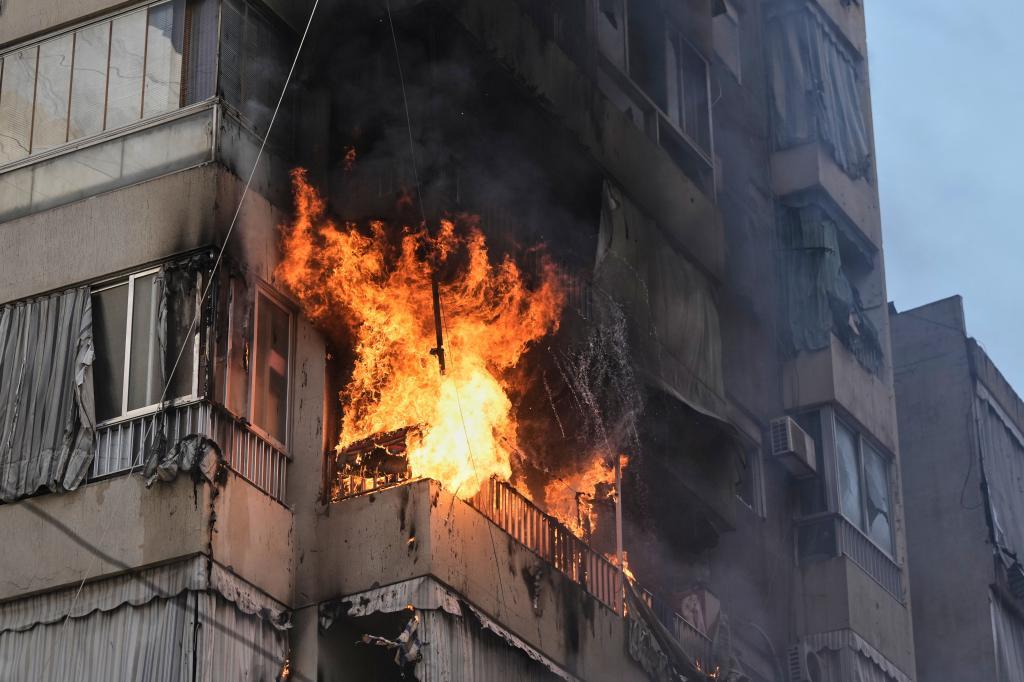
A fireball rises from the site of an Israeli airstrike on a building in the Bashura neighborhood in Beirut.FADEL itaniAfp
The local newspaper An Nahar acknowledged that all of Beirut - regardless of neighborhoods predominantly inhabited by one or another confessional community - "has become an open battlefield" for Tel Aviv's troops.
"They no longer care about anything. They bomb everyone," said Adnan, another young man from Bashura, while observing the absolute devastation left by the event.
Like Ali Wehbe or Adnan, thousands of people were forced to flee during the night in anticipation of the next Israeli bombing.
Residents sat for hours in parking lots or on the streets until a missile struck the building, just after 5 in the morning, generating a huge fireball that engulfed the entire structure.
By 9:30, when the dust and smoke from the subsequent fires had almost completely dissipated, what was once a twelve-story building now lay in a pile of rubble.
A small fire was still burning among the debris of what had been the building's underground parking lot. Rescuers had piled up motorcycles destroyed by shrapnel. Many cars remained covered in a thick layer of dust or with broken windows.
A few meters from the scene, one of the displaced Lebanese - there are thousands in this central area - could be seen sleeping in the driver's seat of his vehicle, unable to stay awake despite the harrowing episode he had just witnessed.
"I finish cleaning up and then I go to work"
Ali Wehbe was another of the many facing the harrowing event with the resignation that defines a nation that continues to suffer war after war with Israel, since the latter state was founded in 1948.
"I have to finish cleaning up, and then I go to work," he stated.
"This is our daily life, unfortunately. I have to work to pay for the repairs to the apartment," he added.
Ali had already had to invest $5,000 in rehabilitating the place in 2024. The demolished building had been attacked on two other occasions. Once in the last war and once last Thursday.
The Lebanese man points to a cracked wall that marked the division with one of the rooms and another that has disappeared, torn off by the blast.
"We built those during the last repairs due to the damage left by the 2024 bombing. This is the third time this building has been bombed. Israel said there was Hezbollah money, but we have never seen anything suspicious, and we have been living here since 2005. Now it was empty, but before, they were civilian homes, like our building," he clarified.
The demolished apartment block was located in the middle of a particularly congested area. An environment of tall residential towers and narrow streets. A few meters away, a school full of displaced people could be seen.
The view from the top floor of another nearby residence, the home of 60-year-old Hamza Hiyasi, was absolutely chilling. The only thing standing amid the rubble was a piece of wall. Around it, excavators and a fire truck were seen in action.
Hamza returned from Australia four years ago. He had been living there since 1988. He had adorned his home with a large painting paying homage to Sydney and the oceanic country. Filled with kangaroos, ostriches, and the famous Opera House of the Australian city.
This was the second time he had to flee his apartment, despite not having fully recovered from hip surgery he underwent a few weeks ago. In fact, he walks leaning on a metal structure.
"Last Thursday, I hurt myself when leaving. I was twisting in pain," he explained.
Hamza is another of those Lebanese who adapt to circumstances. He has experienced many wars. That's why he knew that before leaving the house, he had to leave the windows and doors open. This prevented the blast wave from shattering them. His apartment was one of the few that showed no damage, despite being meters away from the attacked site.
However, the Lebanese man says he was not as lucky with the house he built in his hometown, Blida, not far from the Israeli border. "I spent $1.5 million, and it was razed in 2024," he commented.
"I grabbed the car and went to Sidon"
"It is our destiny to suffer war after war with the Israelis", echoed Adnan. "They attack civilian buildings to pressure civilians. It's pure psychological warfare," he added.
The desolation of Bashura was replicated in other adjacent areas. Several streets in Zikat el-Blat, also a few meters from the administrative heart of the capital, were dominated by dozens of cars crushed by the rubble from the homes devastated by Israeli rockets.
Here, the Israelis destroyed two apartments and another building, which also collapsed under the impact of the ammunition.
In the Basta neighborhood, one of the witnesses to the Israeli bombing was Spanish citizen Ahmad Zahabi, who lives in an apartment next to the one that caught fire.
"We were not warned. We were preparing breakfast. I only saw a big, very powerful red light, and then the explosion. The explosion shattered all the windows and caused chaos. I grabbed the car and went to Sidon," he recounted over the phone hours later.
"It's madness. (The Israelis) are bombing everything, without distinction," he added.
In addition to Beirut, the Israeli army acknowledged that the harassment of its forces extended to many other regions of the country, especially the southern town of Tyre.
The offensive came hours after the message issued on Tuesday night by Hezbollah's Secretary-General, Naim Qassem, who praised the "surprise" caused by the resistance of the paramilitaries in the south of the country against the Israeli invasion attempt.
The words of the Hezbollah commander coincided almost exactly with the launch of a broad salvo of rockets—more than a hundred, according to the Israeli newspaper Yediot Aharonot—against a dozen towns in northern Israel, an action that once again called into question Tel Aviv's claims about the extent of the damage it has inflicted on the group's military capabilities.
Tel Aviv announced that it will begin bombing the bridges that cross the Litani River, whose course it has targeted for a ground invasion that has so far made little progress, given the resistance offered by Hezbollah militants.
The Israeli armed forces "have expressed their concern about a renewed Hezbollah entrenchment" in the southern villages, "which it did not expect," the Israeli newspaper Yediot Aharonot wrote on Wednesday.
For Ali Wehbe, this conflict will drag on. "And it's going to be much more dangerous," he concludes.