Nowhere to hide today. The nervousness felt by investors yesterday after the attack on the largest Iranian gas field has escalated. The early hours have been intense, and the response from the weakened Ayatollah regime was swift. Iran has attacked the Ras Lafan liquefied natural gas complex in Qatar, and Donald Trump has been forced to intervene to ease tensions in his own way. During the three weeks of the conflict, the price of European gas has surged by 112%, rising from 32 euros to 68 euros per megawatt-hour this Thursday.
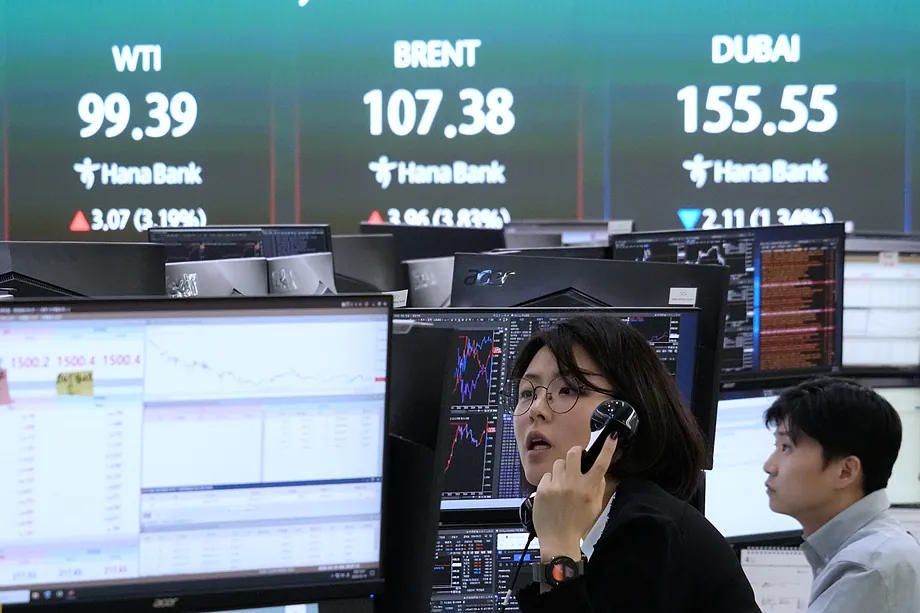
Three weeks after the start of the war in the Middle East, the Brent crude oil, the European benchmark, has risen by over 60% and has surpassed $116 per barrel, with nearly 9% increases this Thursday. In the U.S., the West Texas has increased by another 46% and is close to breaking the $100 mark, reaching four-year highs following the invasion in Ukraine. What has happened in the last 24 hours? Yesterday, European markets closed after the historic U.S. and Israel attack on the South Pars plant, located in the south of the country and considered one of the most important in Iran and internationally. Iran's response was swift, attacking Qatar by setting fire to one of its gas fields. U.S. President Donald Trump, through his social media, pledged that Israel would not "attack the South Pars field" again and immediately threatened Iran with complete destruction of this field if they bombed "an innocent country," referring to the Gulf Emirates.
"The U.S. was completely unaware of this attack, and Qatar was in no way involved or aware of what was going to happen." "Unfortunately, Iran was unaware of this, as well as any other relevant information about the attack on South Pars, and unjustly attacked a part of Qatar's liquefied natural gas plant," the president wrote on his social media. Following this, the White House tenant promised that "Israel will not attack this vital and valuable South Pars gas field again unless Iran, recklessly, decides to attack an innocent country, in this case, Qatar."
The emirate has declared that the three fires that broke out on Wednesday in the industrial zone of the Ras Lafan liquefied natural gas complex, following Iran's missile attack, are "completely" under control. According to QatarEnergy, the state-owned oil company, the attack caused "considerable" damage. The company explained that "several" of its liquefied natural gas facilities were targeted by missile attacks that caused "significant fires" and "additional considerable damage." All this, in addition to the previous attack on the Ras Lafan industrial complex, which had already caused "significant damage."
In this context, European natural gas has surged by 25% in the European market, reaching nearly 68 euros per megawatt-hour, its highest level in the past three years following the attacks on the region's main gas fields and amid fears that the supply cut-off could worsen. The passage through the Strait of Hormuz remains closed, and it has been over three weeks since the war began with the initial U.S. attacks that resulted in the death of Ayatollah Ali Jamenei.
What has the market done? Asian stocks closed with declines - lower than the Black Monday at the beginning of March, but enough to reflect investors' nervousness as the conflict escalates. The Nikkei index in Japan closed with a 3.4% plunge. In China, the Shanghai and Shenzhen main indices suffered losses between 1.4% and 2%.
In Europe, initial losses give way to a selling stampede, with the Ibex 35 dropping over 2% and bidding farewell to the 17,000 points mark. Selling pressure accumulates in Europe, with a 2% drop also seen in the benchmark index, the EuroStoxx 50, led by Frankfurt and Paris falling over 1.5%. Not only are there losses in equities; investors are also fleeing the bond market... and gold, which has already corrected by 10% since the start of the war. Today alone, the price of gold is plummeting by nearly 4%, on the verge of dropping below $4,700 per ounce. The U.S. ten-year debt yield is approaching 4.28%, raising concerns for the Trump administration as it increases the costs of public debt, which stands at around $38 trillion, according to official records, especially after the Federal Reserve's decision yesterday. The institution led by Jerome Powell did not yield to Donald Trump's pressures and in the context of rising prices decided to keep the reference interest rates stable in its economy, condemning the U.S. to live, at least until April 29, with rates at 3.75%. Yesterday, the Fed raised its inflation forecast for this year from 2.4% to the current 2.7% in a war context that has been ongoing for nearly a month and has significantly impacted the American consumer's wallet. Gasoline prices have surged by 44% in the last month, reaching $3.2 per gallon (equivalent to 3.785 liters in Europe). During the Ukraine war, it exceeded $4.
Today is the turn of the European Central Bank (ECB) and the Bank of England. The forecast is similar. Analysts expect the central bank to keep interest rates stable for the sixth consecutive meeting, with Christine Lagarde toughening her stance to prepare the market for possible future rate hikes due to the current situation of rising prices. "Although the market has ruled out the slim probability of European rate cuts in 2026 that existed before the war, now anticipating two rate hikes in the year, it does not make sense to raise rates to combat a supply shock, which could mean repeating past mistakes (Trichet's rate hikes in 2008 and 2011 in response to higher oil prices, which were later cut due to the Great Financial Crisis and the European debt crisis)," according to Renta 4 analysts.