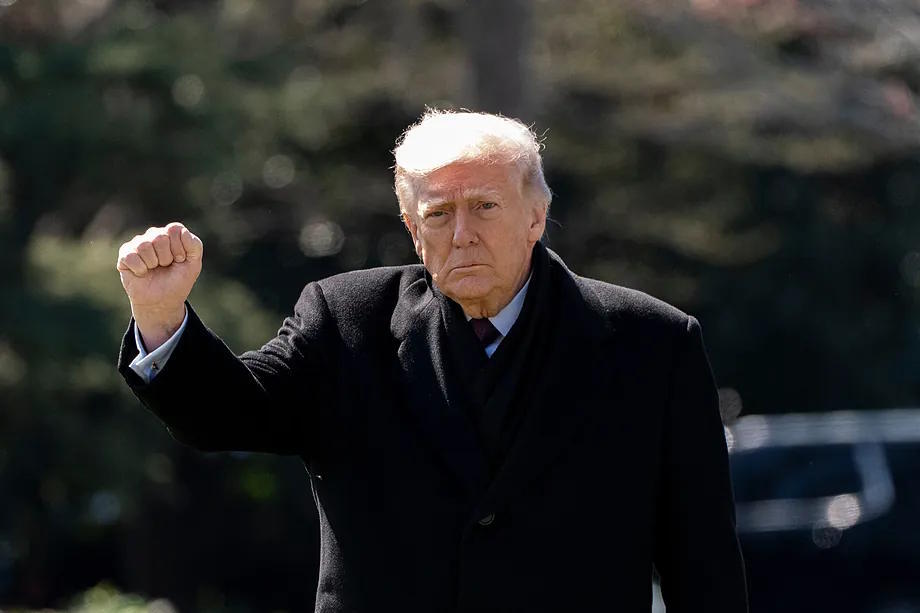
The U.S. President, Donald Trump, is very nervous. The Israeli attack on Wednesday on the Iranian gas fields, the largest in the world, which in turn prompted retaliations on facilities in Saudi Arabia or Qatar, has once again raised oil prices and alarms throughout the region. As the days go by, the situation in the Middle East becomes more complicated, chaos spreads, and the paths to a quick resolution are being blocked.
A good number of U.S. and Israeli media outlets have reported in the last few hours, citing various sources from both administrations and military officials, that the Benjamin Netanyahu Government consulted in advance and received approval from the Trump administration for that operation. It was impossible for it not to be so. But after seeing the consequences, the U.S. President wanted to completely distance himself, stating that his country was not aware. Trump also promised that Israel will not attack the South Pars gas fields again, but at the same time, he threatened Tehran with the total destruction of energy facilities if it continues to attack its allies, especially Qatar.
"Israel, driven by anger over what happened in the Middle East, has violently attacked an important facility known as the South Pars gas field in Iran. A relatively small section of the complex has been hit. The United States had no knowledge of this particular attack, and the country of Qatar was not, in any way or form, involved in it; nor did it have the slightest idea that it was going to happen," the president wrote on Wednesday night (early morning in Spain) on his social media. "Unfortunately, Iran was unaware of this fact —as well as any other relevant information related to the attack on South Pars— and, unjustifiably and unfairly, attacked a part of Qatar's liquefied natural gas (LNG) facilities," he added.
This is not the first Israeli bombing on Iranian oil or gas. The previous one, which filled the capital with crude oil remnants, already received a public reprimand from prominent Republican senators. But tonight, Trump stated that there will be no more, at least not if Iran refrains from the "eye for an eye" response he hinted at today.
"ISRAEL WILL NOT CARRY OUT FURTHER ATTACKS in relation to this South Pars field, of great importance and value, unless Iran commits the imprudence of attacking a completely innocent actor —in this case, Qatar—; in which case, the United States of America, with or without Israel's help or consent, will proceed to massively destroy the entire South Pars gas field, deploying a force and power that Iran has never seen or witnessed before. I do not wish to authorize this level of violence and destruction due to the long-term repercussions it would have for Iran's future; however, if Qatar's LNG facilities are attacked again, I will not hesitate to do so," he added in his message.
According to The Wall Street Journal, citing U.S. officials, Trump "approved the attack to pressure Iran to unblock the Strait of Hormuz. These officials pointed out that Trump believes Tehran has understood the message and wishes to refrain from further attacks on Iranian energy infrastructure. However, they warned that if Tehran continues to obstruct the free passage of oil tankers through that strategic waterway, Trump could once again support attacks on Iran's oil and gas interests."
Chaos also extends within the U.S. administration. On Tuesday, the director of the National Counterterrorism Center resigned dramatically, denouncing that the war in Iran was a mistake, that it was unnecessary because the ayatollah regime did not pose "an imminent threat," and blaming Israel for deceiving the president to drag him into it. This led to the FBI opening an investigation into Joe Kent, after the administration accused him of being a "leaker" to discredit him.
On Wednesday, it was the turn of Kent's boss, Tulsi Gabbard, the Director of National Intelligence, the agency that should coordinate all spies, who appeared before the Senate. There, in a long session, she made it clear that her main goal was to keep her position, even at the risk of appearing incompetent at times. But she also made it clear that President Trump is the one making the decisions, that his judgment is what matters. And that, in a way, he is the main intelligence officer of the U.S., not his subordinates.
The central thesis is that "only President Trump can decide if there is an imminent threat". Not the tens of thousands of experts, the CIA, the NSA, the Pentagon. The president is the one who decides, according to his judgment, his intuition. Gabbard's testimony will go down in history. Pressed by Senator Jon Ossoff, a Democrat from Georgia, on whether there really was an "imminent nuclear threat posed by the Iranian regime," as the Government has argued (among other theories) in recent weeks, Gabbard evaded a direct answer. When Ossoff demanded a yes or no response, the Director of Intelligence replied: "It is not the responsibility of the intelligence community to determine what constitutes an imminent threat."
In a highly discussed article yesterday in Washington, published in The Atlantic, essayist Anne Applebaum, based on what has been seen in the last two weeks, the many changing reasons offered by the Government for the attack, summarized the president's behavior as follows: "Donald Trump does not think strategically. Nor does he think historically, geographically, or even rationally. He does not link the actions he takes one day with the events that occur weeks later. He does not reflect on how his behavior in one place will modify the behavior of other people in other places. He does not consider the broader implications of his decisions. He does not take responsibility when these decisions fail. Instead, he acts on whim and impulse, and when he changes his mind —when he experiences new whims and impulses—, he simply lies about what he said or did before."