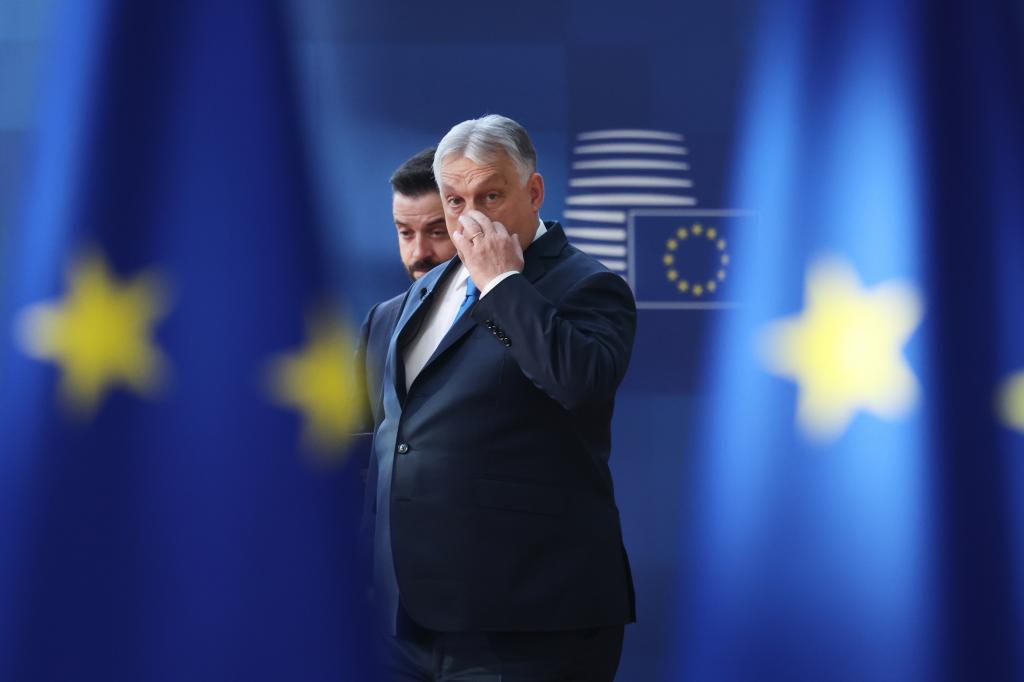
"The expectations are very low". "I cannot predict what the outcome will be but it seems very unlikely to happen". "I don't think the credit will be unblocked". Three diplomatic sources from three different countries confirm what was increasingly hinted at in Brussels in recent days: Viktor Orban is not willing to lift his veto on the EU's 90 billion euro loan to Ukraine, there will be no progress at this Thursday's European Council, and Kiev will reach April without receiving funds from this tool.
Reaching the fourth month of the year in this situation is far from irrelevant. When the European Commission presented this aid, initially focused on frozen Russian assets in Russia, it stated that the goal was for Ukraine to start receiving funds at the beginning of the second quarter of the year. That is, in April. At that point, Kiev would be close to running out of funds. And that is the current situation.
The phone call between the Hungarian Prime Minister and the President of the European Council last Wednesday did not lead to any progress. António Costa pressured Orban, telling him he expected him to fulfill the commitment he made in December not to block the credit and reminded him that Volodymyr Zelensky has already stated that he will repair the Druzhba oil pipeline.
This infrastructure, which passes through Ukraine and is essential for the supply of Russian oil to Hungary, was severely damaged by Russia and rendered unusable. Despite this, Orban has demanded that Ukraine repair it, and to increase pressure, he has blocked the approved 90 billion credit. Specifically, what he has vetoed is the use of the EU budget as collateral for the credit, which requires unanimity. The diplomatic sources consulted indicate that this is the stance he will maintain, regardless of Zelensky's statements or the fact that the EU itself will financially assist Ukraine in carrying out the repair. European public money for a Russian infrastructure.
In Brussels, attention is now turning to the elections scheduled for April 12 in Hungary. Many, if not all, of Orban's maneuvers in the EU are aimed at gaining electoral advantages domestically. One of his common speeches is that Brussels and Kiev have plotted a joint strategy to politically harm him, including the failure to repair the pipeline to raise energy prices before the elections.
The desperation in the discourse and attitude of the Hungarian Prime Minister is due, among other things, to the possibility that his 16-year term may end in less than a month. And that is precisely what is expected in the EU capital: that Peter Magyar wins the elections. The current leader of the opposition is aligned with the popular family and is pro-European. His victory would substantially change negotiation processes in the EU, make everything much simpler, and, of course, allow the 90 billion in aid to Ukraine to be released.
A clear sign that many in Brussels are hoping for this sequence of events is that the Commission stated a few days ago that Kiev has funds to last beyond the elections. Diplomatic circles add that there is no specific breaking point, a day when funds are expected to run out. They also mention that if the situation remains deadlocked in the coming weeks, the EU may seek a temporary solution to help Kiev.