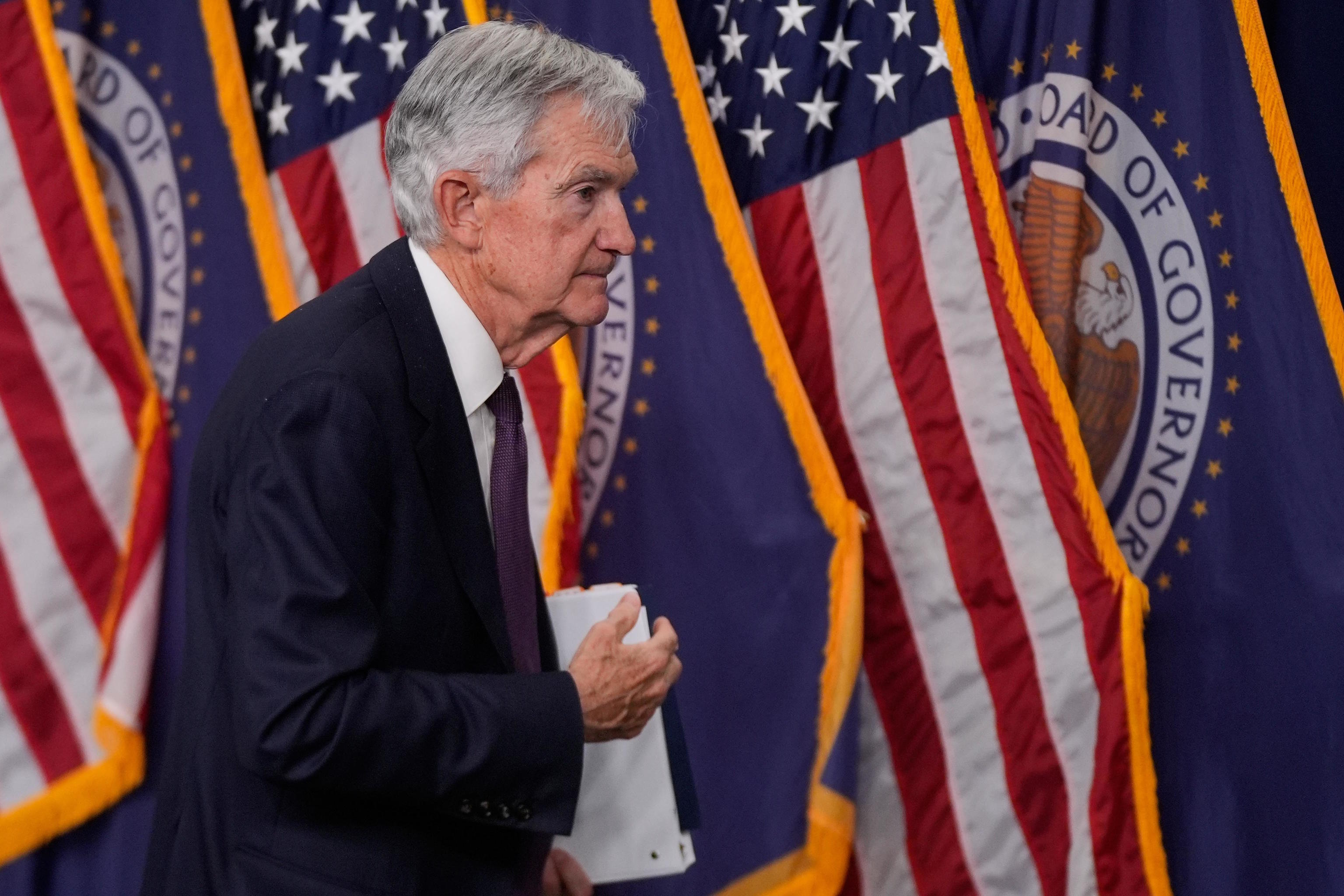
The U.S. Federal Reserve has decided to keep interest rates in the range of 3.50-3.75% this Wednesday. This is the second time this year, after three consecutive cuts in the last third of 2025, and as a result of deep doubts about the performance of the economy in the coming months, especially due to the War in Iran. "The Committee seeks to achieve maximum employment and inflation of 2% in the long term. Uncertainty about economic prospects remains high. The implications of events in the Middle East for the U.S. economy are uncertain. The Committee remains attentive to risks for both aspects of its dual mandate," the statement released this noon in Washington says.
It was what the entire market expected in the penultimate meeting led by Jerome Powell, before his term ends. In January, the Board of Governors emphasized that while economic activity had been expanding at a solid pace, job creation was low, and inflation remained somewhat high. Looking ahead, economists stated that "uncertainty about economic prospects remains high." Now, they maintain that diagnosis point by point, but the war unleashed by the United States and Israel in the Middle East has shattered any hope of predictability, stability, and control of the situation.
Today, the price of a barrel has surged above $110 again after the Israeli bombing in the Iranian part of the world's largest natural gas deposit. In February, Americans were paying around $2.90 per gallon of gasoline, and now the price exceeds $3.70. Wholesale inflation has reached 3.4%, its highest level in a year, as reported by the Department of Labor on Wednesday morning. An indicator that the Fed closely monitors.
The Central Bank has once again found itself between a rock and a hard place. Except now, the edge is much sharper, and the wall is full of holes. According to projections made public today, the Fed sees it much more challenging for inflation to return to 2%... in the coming years. For example, they estimate that "core inflation, which does not take into account food and energy prices because they are more volatile, would reach at most 2.7% this year, two tenths higher than what they thought in December. The board does believe that unemployment will remain at 4.4% and slightly revises upward its growth forecasts to 2.4%, but everything could change soon depending on what happens in the war, with energy and international trade, and tourism.
Nevertheless, a majority of the Board still believes that the Fed will cut rates at least once this year, by a quarter percentage point. However, seven of the 19 policymakers believe there will be no reductions, and five aim for at least a half-point reduction in total.
Today's decision, once again, was not unanimous. Since summer, decisions have always had dissent, but it has increased, showing a deeply divided board in clearly political terms. This time only Stephen Miran, Trump's economic advisor who is expected to return to the White House shortly, has called for a rate cut, in his fifth consecutive dissent. But the focus was on two of his colleagues, also appointed by the president.
Donald Trump has led an unprecedented pressure campaign on the Fed to lower interest rates. With reproaches, shouts, insults, and lawsuits. He has initiated investigations into two members, including Chairman Powell, threatening with criminal consequences to correct the course. Today, Trump has once again used his social media to urge the "always late Powell," as he has dubbed him, to consider rate cuts. Just as he did last week, even demanding an extraordinary Fed meeting that would undoubtedly have further disrupted the markets.
Although there was almost absolute consensus that there would be no changes in monetary policy, betting houses doubted whether the three Fed members appointed by Trump would form a bloc, deepening the division. In January, two called for rate cuts, and there have not been three dissenting votes since 1988.
Miran's thesis is that oil prices (even though the U.S. is a producer and the consumer does not pass through the Strait of Hormuz) usually lead to a drop in consumption, slower growth, and therefore a higher risk of recession. If contraction is added to high inflation, the dreaded stagflation is obtained, one of the most dangerous words on Wall Street.
Another member, Christopher Waller, had warned that he would lean towards more cuts if the labor market continued to show poor data. January was a positive month, but in February, 92,000 jobs were lost, and the unemployment rate rose to 4.4 percent. The problem is that at the same time, inflation will inevitably rise. So, it is necessary to choose between the two evils.
If confirmed by the Senate, Warsh will inherit a deeply fractured Fed. Trump understood that it was essential to replace Chairman Powell, whom he himself appointed in 2017, and replace him with someone more aligned and, above all, more in favor of rate cuts. But he also understood that this is not enough and that he needs more pawns. That is why he is pushing as much as possible to replace those in place and make others feel the consequences of making independent decisions.
The Fed sets interest rates through a committee of 12 members, seven governors appointed by the president, and five of the 12 presidents of the regional banks of the Federal Reserve system, who are not politically appointed and rotate. The 19 members participate in monetary policy debates, but only those 12 mentioned have voting rights at each meeting. Central Banks always desperately seek consensus and unanimity to send messages to the market. And the message that is now coming through is increasingly clear.