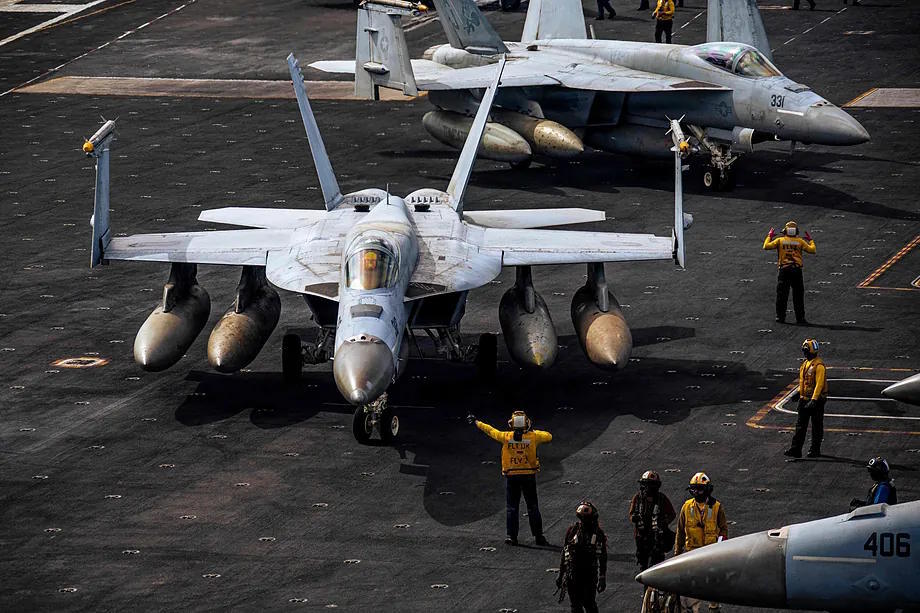
The US Secretary of War, Pete Hegseth, stated on Thursday that the US military has completely destroyed Iran's submarine fleet and significantly damaged the military ports of the Islamic Republic as part of the war being waged alongside Israel against Tehran.
On the other hand, the US Fifth Fleet in the Middle East was targeted on Thursday by a "precise" missile attack by Iran, as well as energy targets in Israel, reported the Iranian Revolutionary Guard (IRGC) in a statement.
The note, disseminated by the Fars agency, specifies that this 64th wave of the Iranian military response - initiated in retaliation for the US and Israeli attack on February 28 - also targeted objectives in Israeli territory, such as Ben Gurion Airport, refineries in Haifa, and Rishon LeZion.
The Trump Administration States that the US and Israel Have "Different" Objectives in the War in Iran
The US Director of National Intelligence, Tulsi Gabbard, stated on Thursday that the objectives of her country and Israel in the war in Iran are "different." She made this statement during a hearing where she also denied any involvement of Washington in the Israeli attack on the largest gas reserve in the Islamic Republic.
"The Israeli government has focused on neutralizing the Iranian leadership and eliminating several of its members, starting obviously with the ayatollah, the Supreme Leader (Ali Khamenei), and they continue to focus on that goal," Gabbard declared during a hearing before a House committee.
In contrast, the declared objectives of US President Donald Trump are "to destroy Iran's ability to launch ballistic missiles, its missile production capacity, its Navy, the Islamic Revolutionary Guard Navy, and its ability to lay mines," Gabbard added.
The US intelligence director stated that she is unaware of the position of Israeli Prime Minister Benjamin Netanyahu's government regarding the possibility of reaching some kind of agreement with Tehran.
The Israeli Military Attacks Iranian Naval Targets in the Caspian Sea
Lieutenant Colonel Nadav Shoshani, spokesperson for the Israeli military, declared on Thursday that the Air Force carried out attacks for the first time against Iranian naval targets in the Caspian Sea, stating to the press that Israel neutralized Tehran's naval capacity in the area. He did not specify when the attacks took place.
More than 1,000 Dead in Lebanon from Israeli Attacks Since Early March
Israeli attacks on Lebanon have resulted in the deaths of 1,001 people, including 118 children, since the start of the war between Israel and the pro-Iranian group Hezbollah on March 2, according to the Ministry of Health on Thursday. The previous official death toll was 968. Among the deceased are also 79 women and 40 healthcare workers, according to the ministry, which also reports 2,584 injured.
The War Against Iran is a "Tremendous Blessing," Says an Israeli Minister
An Israeli minister declared on Thursday that "every day of the Israeli-American bombing campaign that has been ongoing in Iran for almost three weeks is 'a tremendous blessing for Israel' and an opportunity to 'aggravate the damage inflicted' on the Islamic Republic.
"The debate should not focus on when it will end (the war), but on how we will prolong and aggravate the damage inflicted," stated Zeev Elkin, a member of Likud, the right-wing party of Prime Minister Benjamin Netanyahu. "Every day of the campaign is a tremendous blessing for the State of Israel," declared the minister responsible for the Reconstruction of the North and South, and a member of the security cabinet, a small governmental body authorized to make urgent diplomatic and strategic decisions, especially in times of war.
Zeev Elkin, in statements to the army radio, also praised the "unique cooperation with the United States, something we do not know when it will happen again."
Iran's Foreign Minister Threatens to Respond "Without Restrictions" if the Country's Infrastructure is Attacked
"Our response to the Israeli attack on our infrastructure used only a fraction of our power. The only reason for moderation was respect for the de-escalation request. Zero restrictions if our infrastructure is attacked again. Any solution to this war must address the damage caused to our civilian facilities," shared Iranian Foreign Minister Seyed Abbas Araghchi on the social network X, referring to the responses launched by his country after Israel and the US attacked the South Pars gas facilities.
The WTO States that the War "Threatens Global Food Security"
The war in the Middle East poses a serious threat to global food security, warned the Director-General of the World Trade Organization, and called for global food supply chains to remain open.
The conflict in the Middle East "threatens global food security, as disruptions in transportation and rising energy costs reduce supply and raise fertilizer prices," said Ngozi Okonjo Iweala to journalists in Geneva. "A prolonged disruption in supply could spread through food systems, leading farmers to reduce fertilizer use and grow fewer input-intensive crops," she added.
The ECB Warns of a "Significant Impact" of the War in the Middle East on Europeans' Pockets: Foresees More Inflation and Less Growth
In a war context, the central bank keeps interest rates stable, but does not "commit to a specific path" in the coming months due to "much more uncertain prospects." The central bank raises its inflation forecast by 7 tenths, to 2.6% for 2026 due to the contagion of the rise in gas and oil.
Six Countries Affirm They Are Willing to Contribute to the Security of the Strait of Hormuz
Germany, the United Kingdom, France, Italy, Japan, and the Netherlands condemned on Thursday the recent Iranian retaliations against energy infrastructure in the Gulf and stated that they are "willing to contribute" to the security of the Strait of Hormuz, de facto closed by Tehran.
"We call for an immediate and general moratorium on attacks on civilian infrastructure, particularly oil and gas facilities," the six countries said in a joint statement. "We declare ourselves willing to contribute to the necessary efforts to ensure the security of passage through the strait," these countries added. In normal times, 20% of the world's consumed oil and liquefied natural gas flows through that strait.
Iran Arrests 138 Suspects with Links to the US and Israel
Iranian security services announced on Thursday the detention of 138 more people for planning violent actions, having links with the US and Israel, or contacts with "hostile" media, in operations in several provinces that increase the wave of arrests.
The Iranian Ministry of Intelligence reports that a nationwide anti-espionage operation led to the arrest of 69 individuals "trained" for street disturbances and violent acts, under the direction of the US and Israel, according to a statement released by the Fars agency. It adds that during these interventions, 45 firearms, ammunition, and bladed weapons were seized.
It indicates that in the province of Sistan-Baluchistan (south), 13 members of a "spy network backed by Israel" were caught in simultaneous actions, with the seizure of firearms, five Starlink terminals, and surveillance equipment. On the other hand, the head of internal security in Alborz (north), General Hamid Hedavand, confirms the capture of 41 "enemy spies" for sending videos about police positions to "hostile foreign channels." Among the seized items are Starlink servers and telecommunication devices.
The Attack on the South Pars Gas Facilities in Iran Was Coordinated with the US, Israeli Officials Claim
The Israeli attack on the South Pars gas facilities in Iran, carried out on Wednesday, was coordinated with the United States, but it is unlikely to be repeated, three Israeli officials declared on Thursday. Trump stated on social media that Washington "knew nothing about this particular attack," which has prompted numerous Iranian attacks in response on energy facilities in the Gulf.