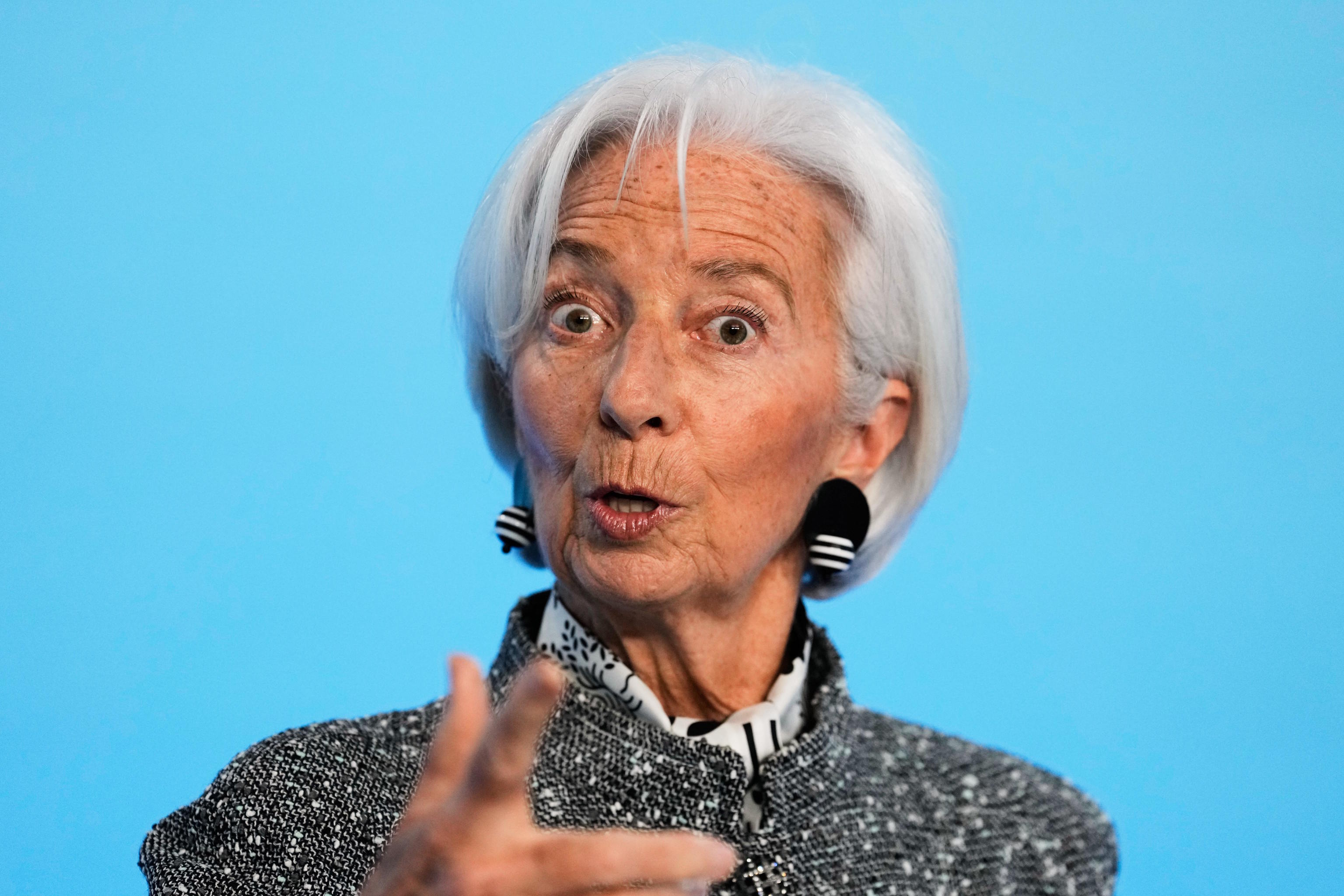
The European Central Bank (ECB) has decided to keep official interest rates in the eurozone stable, affecting both citizens' savings returns and the cost of their loans and mortgages, although it already warns of "upside risks to inflation" and "much more uncertain prospects" due to the war in the Middle East. For now, the banking regulator follows the script, and all eyes are on the words Christine Lagarde will use in her press conference this Thursday. The ECB President is facing, probably, the most challenging scenario since last spring when the U.S. disrupted global trade relations with new tariffs. Analysts will not only focus on the content of her speech but also on the tone, which will be crucial in guiding investors smoothly towards a new, more restrictive monetary policy if that is the expected scenario.
The ECB Governing Council, meeting in Frankfurt since yesterday, has therefore agreed to keep the three official reference rates at the same levels for the sixth consecutive meeting. Since June 2025, when the central bank made its last interest rate cut in the Eurozone, official rates have remained at 2% for the deposit facility; around 2.15% for the main refinancing rate (which is the reference for setting loan costs), and at 2.4% for the marginal lending facility.
However, the ECB makes it clear that it "is determined to ensure that inflation stabilizes at the 2% target in the medium term," which implies a tough stance to prevent price hikes and to prepare investors for what is to come. "The war in the Middle East has created upside risks for inflation and downside risks for economic growth, making the outlook much more uncertain," the ECB stated in its communication on Thursday, considering that "the war will have a significant impact" on prices in the short term "due to the rise in energy prices."
In line with these statements, and having included "exceptionally" data up to March 11 to make its forecasts, the institution has revised upwards its inflation outlook and downwards the economic growth prospects for the eurozone. Thus, the ECB raises the inflation forecast for this year from the previous 1.9% to 2.6%, which takes the biggest hit; with more moderate increases of 1 tenth for 2027, to 2%; and also for 2028, when it is expected that the general CPI will be around 2.1%, still above the central bank's target. For Lagarde, beyond the numbers, it is a matter of consumer and business confidence, as she states that they could start tightening their spending and investments, ultimately impacting economic growth.
"Experts predict that economic growth will average 0.9% in 2026, 1.3% in 2027, and 1.4% in 2028, implying a downward revision, especially for 2026, due to the effects of the war on commodity markets, real incomes, and confidence worldwide," the ECB stated. Previous forecasts from December pointed to Eurozone GDP growth of 1.2% for this year, 1.4% in 2027, and 1.4% in 2028. In any case, during the press conference, Lagarde warned national governments that any fiscal measures they may take to mitigate the effects of this energy crisis must be "temporary and tailored" to current circumstances. Precisely, this Friday, the Government has called an extraordinary cabinet meeting to approve measures aimed at helping farmers and ranchers cope with the recent rise in fuel and fertilizer prices, among others.
The central bank's decision comes amid a dark session for European stock markets, with declines exceeding 2% in major exchanges and soaring energy prices. European gas, TTF, which is used as a reference for price setting, is today up by 25%, exceeding 68 MGW/h. In just over three weeks of war in the Middle East, the price of gas has more than doubled (up by 112%), following the escalation of the conflict in the region, with attacks on major gas fields in Iran and in countries like Qatar, in addition to relentless bombings on oil plants, compounded by the closure of the Strait of Hormuz, through which 20% of the world's oil and gas supply flows.
The market has been pricing in a change in the roadmap of the European Central Bank for several weeks, which was expected to have a calm 2026 without changes in official rates. It seems that might not be the case, although some analysis firms consider it premature to talk about rate hikes in the eurozone just three weeks into the conflict, possibly attributing it to a temporary supply tension. "We see no reason to raise rates to combat a supply shock, which could mean repeating past mistakes like Trichet's rate hikes in 2008 and 2011 in response to higher oil prices, which were later reversed due to the Great Financial Crisis and the European debt crisis," stated Renta 4.
However, the reality is that European citizens may already be facing a higher costof living, both in the shopping basket with more expensive food and in car usage due to the rise in gasoline and diesel prices, coupled with upward revisions in mortgages. The Euribor, which is the indicator used to set housing loan prices, is trading today at around 2.52% for the twelve-month reference (implying that loans are expected to become more expensive next year), and the provisional monthly average is above 2.407%. These levels are similar to a year ago during a period of interest rate cuts.
"The main risk factor comes from the dual energy impact facing Europe. On one hand, the rise in oil prices quickly translates into higher fuel prices at gas stations. On the other hand, the increase in natural gas prices will take longer to impact: suppliers usually take between six and nine months to adjust their rates, implying a delayed impact on energy bills for households and businesses," stated Benedicte Kukla, Director of Strategy at the private bank Indosuez Wealth Management.
"As a net energy importer, the impact of oil seriously threatens eurozone inflation. Although the ECB may overlook a pure energy shock in the overall rate, it will not tolerate inflation expectations diverging if higher costs are passed on to core inflation through wage increases and service prices," highlighted TwentyFour Asset Management, a Vontobel boutique. With the February data, inflation remains under control according to the central bank's criteria, at levels of 1.9%, two tenths higher than at the beginning of the year. Nevertheless, various members of the ECB Governing Council have been echoing the official discourse for weeks about Frankfurt's ability to do "whatever it takes" to keep prices under control and avoid a scenario similar to that experienced between 2021 and 2022 following the pandemic and the subsequent Ukraine war. This is currently seen as unlikely.
"We do not see a likely economic and market scenario similar to that of 2022: the eurozone does not suffer from energy shortages, imports very little through the Strait of Hormuz, and we do not foresee supply disruptions," stated Neuberger Berman, a New York-based asset manager.