China has found in energy geopolitics an additional lever to advance one of its most sensitive strategic objectives: "reunification" with Taiwan. The current energy crisis triggered by the war in the Middle East has offered Beijing an opportunity to reformulate its discourse towards the island: less emphasis on shared national identity rhetoric and more pragmatism regarding supply security.
The seemingly technical offer is deeply political: prosperity and stability in exchange for sovereignty under the known "one country, two systems" model. In this equation, Taiwan would gain guaranteed access to stable, cheaper, and, according to Beijing, cleaner energy resources. It is a proposal that seeks to exploit a structural vulnerability. The island imports around 96% of the energy it consumes, mostly by sea and largely from the Middle East.
The model China continues to put on the table is not new. For decades, Beijing has proposed that territories with different economic and political systems can coexist under a single sovereignty. Hong Kong and Macao were the laboratories for that formula. In theory, the integrated regions would retain their institutions, currency, and significant autonomy, while the Communist Party would assume key competencies such as defense and foreign policy.
But in Taiwan, where a democracy with political alternation and an increasingly differentiated identity from the mainland has been consolidated, that promise sounds hollow. The evolution of Hong Kong, where the Chinese regime has swept away political freedoms with a national security law, has severely undermined the credibility of that scheme. For many Taiwanese, accepting the offer would not mean preserving their system but initiating a gradual absorption process.
Beijing's latest strategy to convince the Taiwanese involves using the energy hook. "We are willing to provide our compatriots with energy security and stable, reliable resources so they can live better," said Chen Binhua, spokesperson for the Taiwan Affairs Office, the main Chinese government agency responsible for managing everything related to the island.
Chen made these statements in relation to the risks of disruptions in oil and gas supply due to the current effective blockade of the Strait of Hormuz. "After peaceful reunification, full connectivity across the strait would be achieved, which would address the shortage of electricity, natural gas, and crude oil in Taiwan," Chen continued, pointing out that Beijing "will also ensure that Taiwan residents enjoy a more affordable, clean, and stable energy supply."
On one hand, China presents itself as an alternative supplier. On the other hand, it suggests that this vulnerability in maritime transport could worsen in a prolonged tension scenario. The promise of "full connectivity across the strait" points to integrated energy infrastructures - cables, gas pipelines, electrical grids - that would reduce Taiwan's exposure to external shocks.
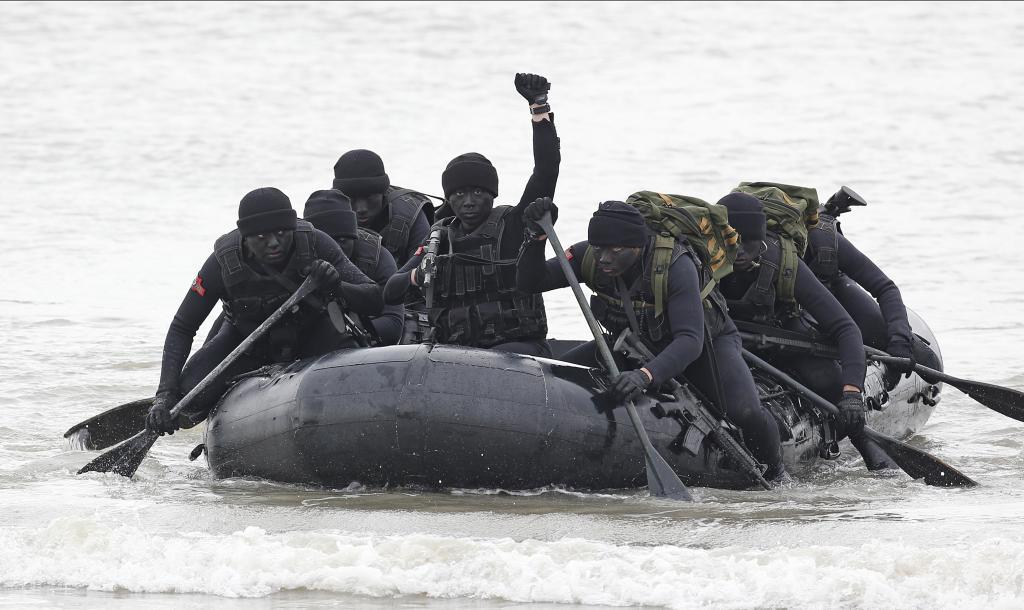
But this energy offer does not replace Beijing's classic repertoire of pressure tactics. The government of Xi Jinping has never hidden that, if necessary, it would resort to the use of force. Since late 2020, Chinese military incursions near the island have shifted from sporadic episodes to a calibrated routine. Taipei calls it "harassment in the gray zone." Combat aircraft crossing the strait's median line, naval encirclement maneuvers, and blockade drills are part of a strategy designed to wear down without triggering an open conflict.
This pattern intensified after the August 2022 visit of then Speaker of the US House of Representatives, Nancy Pelosi, who crossed a red line marked by Beijing. The Chinese military began daily deployments of a greater number of combat aircraft and executed dangerous large-scale blockade drills.
The Taiwanese military has become accustomed to the daily task of tracking and publicly notifying Chinese aircraft flying near the self-governing island. Some days there are a few; other days, many more. But their presence is usually constant.
Last year, the Pentagon projected that Beijing would be ready to invade the autonomous island in 2027. However, this assertion has been retracted this week by a new US intelligence report. "China is likely to continue seeking to create conditions for eventual unification with Taiwan without resorting to conflict," states the 34-page document published annually on the global risks facing the US. "China does not have a fixed timeline to achieve unification," it adds.
The nuance is relevant. It suggests that China's strategy is not based on an inevitable countdown but on a progressive accumulation of military, economic, and diplomatic advantages that reduce the cost of invasion. In this scenario, energy now emerges as a silent but effective pressure tool.
This report was published on Tuesday, after President Donald Trump announced that, due to the war with Iran, he would postpone his planned trip to China for the end of March by "approximately a month." For Beijing, every distraction the US faces on other war fronts opens up room to continue presenting itself as the stable and responsible superpower.