The United States Department of Defense is seeking around 200 billion dollars in additional funds for the war with Iran. A massive figure, exceeding all the aid authorized by Congress to help Ukraine since 2022 and almost 25% of the annual Defense budget after less than a month of bombings. "Money is needed to kill the bad guys," Secretary Pete Hegseth said on Thursday in a briefing from the Pentagon. "We will return to Congress and our representatives to ensure we have the appropriate funding," he explained with his characteristic enthusiasm, acknowledging that the figure "could vary."
The figure is extraordinarily high, especially considering that the Department of Defense or War already received a significant injection last year thanks to Donald Trump's Big Beautiful Bill. The Pentagon Budget is over 800 billion dollars for the current fiscal year, in addition to around 150 billion dollars that Congress allocated to the Department of Defense in last year's law.
The war costs the U.S. a fortune daily directly, not even considering the resulting consequences. In the first week, it was at least 11.3 billion dollars, according to Pentagon estimates sent to Congress. This figure does not even take into account the monumental cost of mass troop transportation to the Middle East. Since then, analyses speak of over 1 billion dollars daily. According to Congressional studies, the U.S. spent nearly 815 billion dollars on direct costs for the war in Iraq, but over 13 years. So, a figure of 200,000 inevitably makes congressmen and senators think that the campaign would turn into something of much longer duration and involvement.
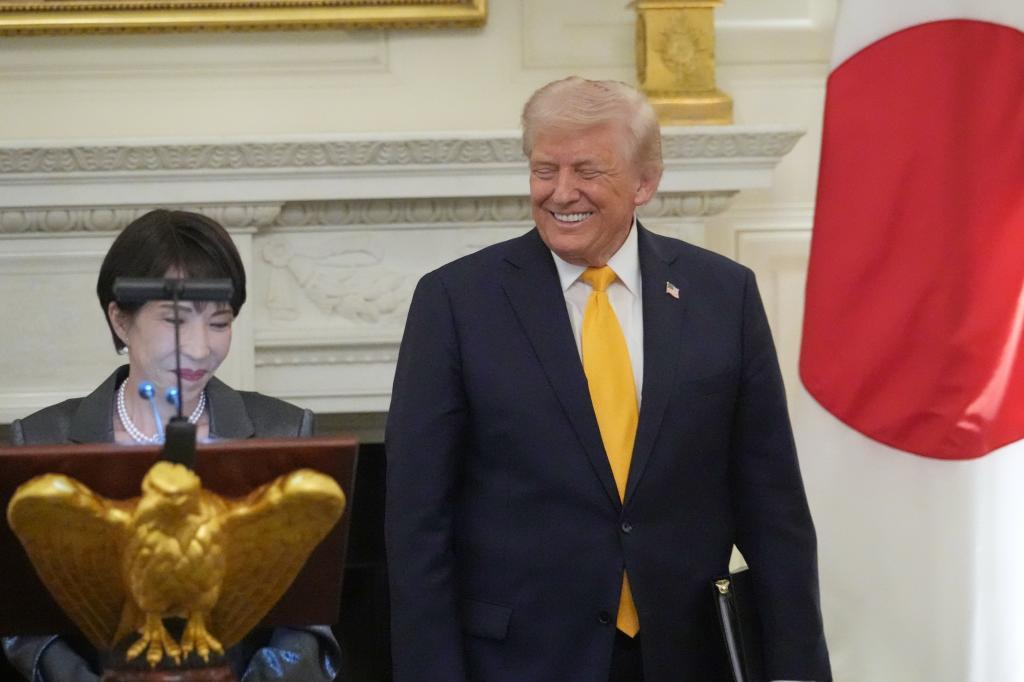
But all of this is "a small price" for President Trump. He has repeated it several times, in different contexts, these weeks and reiterated it today in the Oval Office, in a briefing with the Prime Minister of Japan.
"We have the most powerful army in the world... The other night, they launched 114 rockets at a specific location, high-tech rockets... each and every one of them was intercepted with our equipment. [That funding request] is a small price to pay to ensure we stay on top," he affirmed, downplaying both the financial chaos and the nerves among his allies, who are experiencing profound impacts on their energy facilities.
In his appearance, Trump appeared more relaxed than in the past week. Last night, for example, he wrote a visibly concerned message about the escalation when Iran responded with missiles against Saudi Arabia and Qatar's gas fields in response to an Israeli bombing of theirs. He has also toned down his rhetoric with his allies, including Japan. He continues to demand that they join an international initiative to unlock the Strait of Hormuz, but has not used the same expressions as earlier in the week. "In the case of NATO, they don't want to help us defend the strait, and they are the ones who need it, but now they are becoming much kinder, because they are seeing my attitude," he added.
"The economy was excellent. Oil prices were very low. Gasoline was dropping... we had everything in unbeatable conditions. But seeing what was happening in Iran, I said, 'I regret having to undertake this incursion, but we will have to do it.' In reality, I thought the figures would be worse. I thought prices would rise more than they did and once the operation is concluded, we will have a much safer world (...) Iran poses a serious threat to the world; to the Middle East and to the entire world. And everyone agrees with me. Therefore, I wanted to put out that fire. And I said, 'You know, if we do this, oil prices will rise. The economy will slow down a bit,' but I thought it would be worse; much worse. In fact, I thought there was a possibility that the situation could become much more serious. It hasn't been so bad, and everything will be resolved very soon," he assured.
On her part, Prime Minister Sanae Takaichi praised Trump hours after signing a statement with other countries committing to work for the opening of the Strait of Hormuz, but without directly mentioning the use of their navy. "I firmly believe that only you, Donald, can achieve peace worldwide. We are willing to contact many of the partners in the international community to achieve our goal together, and today I have come here to the White House to convey this message directly," she said.
When a Japanese journalist asked the American why he did not inform the allies before attacking Iran, Trump used dark humor. "We wanted it to be a surprise. Who knows more about surprises than Japan? Why didn't you tell us about Pearl Harbor? You believe much more in surprises than we do," he replied.