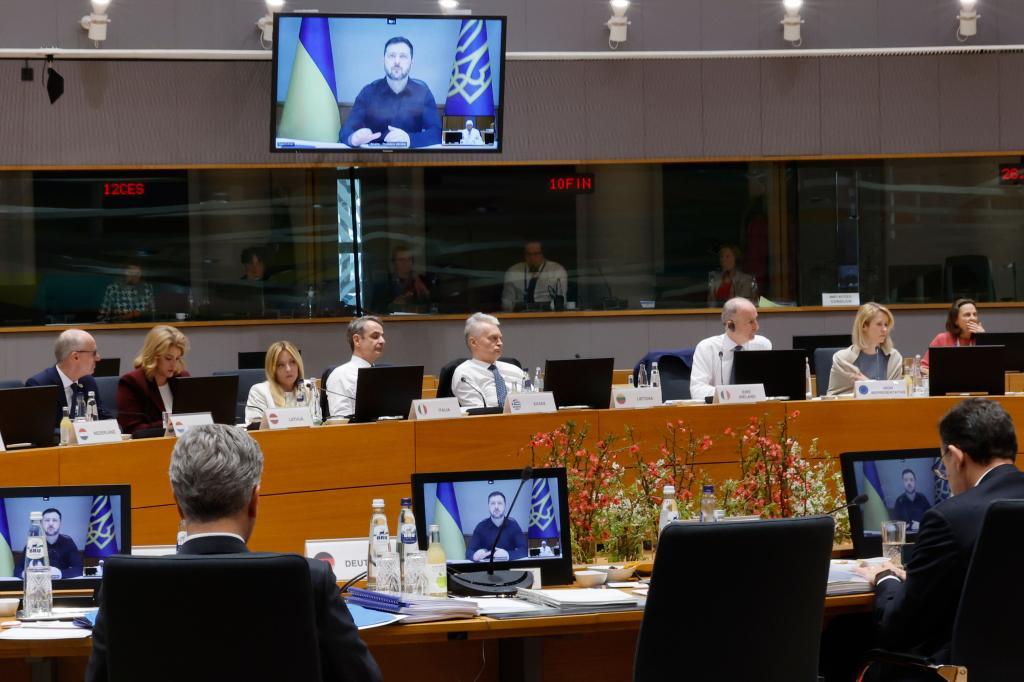
The European Union calls for "full respect for international law by all parties, including the principles of the United Nations Charter and international humanitarian law" in the Iran war, not only as a demand to the Iranian regime but also as a warning to the United States and Israel. However, in the conclusions of the European Council held in Brussels on Thursday, signed by the 27 EU countries, there is no reference to these two countries. None.
"The evolution of the situation in Iran and the region in general threatens regional and global security. The European Council calls for de-escalation and maximum restraint, the protection of civilians and civilian infrastructure," the text points out. It also calls for a "moratorium" on attacks "against energy and water facilities," and "regrets the loss of civilian lives and closely monitors the broad impact of hostilities, also on economic stability."
Within the dynamics and texts of the EU, this absence of a direct reference to the United States and Israel was expected. What would have been truly surprising is the opposite, a direct reference because it would mean a direct attack signed by, for example, the German Chancellor, Friedrich Merz, or the Italian Prime Minister, Giorgia Meloni. But even so, it is very significant that there is no mention.
There is a direct criticism, of course, of the Iranian regime. "The European Council strongly condemns Iran's indiscriminate military attacks against countries in the region and expresses solidarity with the affected countries. It urges Iran and its allies to immediately cease these attacks and respect the sovereignty and territorial integrity of the countries in the region," the document states. "The European Council reiterates that Iran should never be allowed to acquire a nuclear weapon and must fulfill its legally binding obligations regarding nuclear safeguards under the Non-Proliferation Treaty," it further elaborates.
The leaders also express "firm and unambiguous support" for countries near the war zone. "They welcome the support provided by the Member States in this regard, particularly through the deployment of military assets in the Eastern Mediterranean and in support of Cyprus," the text explains.
Regarding the Strait of Hormuz, the leaders condemn "any act that threatens navigation or prevents ships from entering and exiting the strait" and make a relevant reference that was not included in the last draft. It was added after the discussion among presidents and prime ministers. "They also welcome the increased efforts announced by the Member States, also through enhanced coordination with partners in the region, to ensure freedom of navigation in the Strait of Hormuz once conditions are met," the text states.
In essence, there is a willingness to work towards and promote security in the Strait of Hormuz, with a subtle nod to US President Donald Trump. It is a nuanced message regarding "this is not Europe's war," as European foreign policy chief Kaja Kallas pointed out earlier this Monday after meeting with Foreign Ministers.