Josyane Boulos understood the meaning of war that night she spent hidden in a military hospital in Beirut, during the fratricidal conflict that her country was facing with opposing Christian factions. Along with her mother, they were the only civilians in the medical center. When she recalls it, despite the passing of years, she still inhales deeply and pauses in the narrative. These are memories that are hard for her to retrieve. "The soldiers came in torn apart. I understood what a bloodbath was. There was a nun who spent the whole night cleaning the floor, but it was always bathed in blood," she recounts while seated in the small café of the Monnot Theater in the Lebanese capital.
The director of Monnot speculated on the number of spectators who could attend the performance last Wednesday. "We have 50 reservations [the venue has a capacity for 250 spectators]. But that was before the bombing," she explains. The headquarters of the representation center is located a few hundred meters from the neighborhoods that were attacked during the night by the Israeli aviation. An airstrike that left at least 12 dead and dozens injured. For Boulos and the rest of the company performing White Lie since the 11th, in the emblematic artistic venue of Beirut, each performance day is pure uncertainty.
"We have already had to cancel four times. When the bombings get close to Martyrs' Square (the central axis of Beirut), we think it doesn't make sense to open. No one will come. The problem is not the safety in the theater but the displacements. That's what's dangerous. Getting here," she argues. The effort of the dozen actors involved in White Lie reflects the unique spirit of a country plagued by wars with the neighboring country, Israel, since its creation in 1948.
Boulos calls it "cultural resistance," a behavior that was already present during the 15 years of their fratricidal confrontation, when artistic activities were only interrupted at intervals. Boulos herself wrote a text in one of the country's cultural pages acknowledging that "theater in wartime is a perfectly absurd activity." "We put on makeup, set up the lights, discuss whether to use this sofa or the other... meanwhile, the world is falling apart," she emphasized in the text. And the Lebanese added: "And yet, when the audience enters the theater, something strange happens. The phones go silent. Shoulders relax. People breathe in unison. The tension dissipates. For one or two hours, the war stays outside."
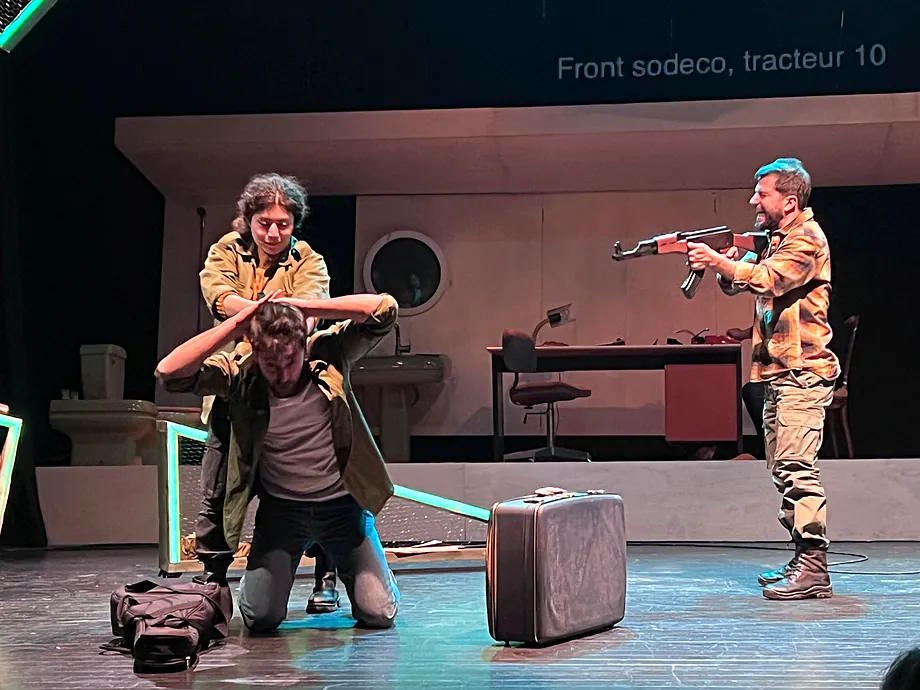
"I think it's a form of therapy. For the audience and for ourselves," Josyane explains during this conversation. White Lie tells the story of a young Lebanese man, Gino, who wanted to be a singer and whose parents insisted on sending him to study engineering in Scotland, to get him out of a country plagued by the Civil War. The boy deceives them, tells them he is in the European region, but decides to enlist in one of the militias fighting in those years on one of the most active fronts in Beirut, Sodeco, very close to where the Monnot Theater is located.
"It's a true story even though the character told his family he had spent seven years in Romania. In fact, to document ourselves, we interviewed many former militiamen," Josyane explains. A former local television presenter, she is also part of the cast: she plays Gino's communist aunt, who joins an ultra-right-wing faction. "It's a comedy but with a very dark underlying story", she points out.
The actors have not been able to escape the collateral effects of the conflict. The protagonist, Gino -portrayed by Anthony Touma-, has been separated from his family, now stranded in Dubai, also affected by the regional war initiated by Israel and the United States. The French-Lebanese actress, Joanna Khalaf, who plays a nurse of the same nationality who ends up falling in love with the young Gino, had to evacuate her three-year-old son, with whom she had come to Beirut before the conflict erupted. "I came with him in February and when the bombings started, they canceled the flights. My husband had to come to repatriate him, I decided to stay. It's the only way I can fight [against the war]," Khalaf explains.
"The play was supposed to premiere in 2024 but then the war started. Then the ceasefire came and we resumed the idea. We started rehearsals in February. And then, the war returned," Josyane explains, shrugging.
Touma did not experience his country's conflict as he was born after it ended, in 1994, but he also decided to stay in Beirut and continue to be part of the performance. "It's very strange to do a play about war when the war is outside, but I think it's a tribute to all the Lebanese who have suffered it," he said before taking the stage.
For another artist, Ali Farhad, 40, the consequences of violence are a recurring theme. A resident of the southern neighborhood of Dahiyeh, repeatedly devastated by the Israeli aviation in each war, he finds himself once again -it has happened to him six times since the 90s- among the displaced. Since March 1, he has been living in a school with his family. It is not the first time he combines being a victim of a conflict and being an actor in a play based on war. "We are used to enduring war after war, and to continue being actors during those wars," he insists.
The history of theater in the Middle East is particularly associated with Lebanon as it is considered that the playwright Maroun Naccahe, in the 19th century, was the driving force behind this art throughout the region. Like the entire cultural scene of the country, theater had its golden age in the 60s and the first half of the 70s. The Civil War that began in 1975 did not interrupt the performances, but restricted them to certain locations north of the capital like Junieh. It was in the post-conflict period when the Monnot Theater, founded in 1997, became one of the main cultural references in the Lebanese capital. Josyane Boulos took over the management in 2022 with the idea of opening an "inclusive" space.
"Here we do not make distinctions based on religions or races [something unusual in a country fractured along the confessions of its citizens]," this woman, daughter of Jean Claude Boulos, known locally as the father of Lebanese television, emphasizes. Linked to the artistic scene for more than two decades, the actress has participated in dozens of performances, including one dedicated to her particular story with Julio Iglesias, whom she met in Lebanon during a concert at the Casino du Liban in July 1980, taking advantage of one of the periods of precarious calm. Boulos's autobiographical work was called The Girl Who Loved Julio. "I had been in love with Julio for years and when I found out he was going to sing, I managed to get close to where he was and kissed him, without asking. I didn't brush my teeth for two days. In this case, I was the one who harassed him. Three days after his concert, the Christian militias committed another massacre, killing each other," she details.
White Lie concludes with an emotional reconciliation between Gino and his father, who urges him to leave Lebanon. "Choose life and not barricades, do not choose death!" he shouts. The boy has decided to leave for France with his girlfriend and asks his father to accompany him. But his father sums up in one last sentence the philosophy that inspires the resolute ones like Josyane Boulos who have decided to defy their nation's tragic fate. "No, son, I stay to rebuild the company. In Lebanon, we are doomed to always start from scratch." The same ideology that has inspired Boulos and her colleagues to keep the curtain up. "We cannot close the theaters, we cannot stay silent. That's what these warlords want," she concludes.