There are war zones where the conflict is visible everywhere. Others, however, do not offer tangible signs; nevertheless, the presence of war conditions everything. The agent at the border checkpoint, with a white dishdasha and turban, looks at the Spanish passport and asks puzzled: "Are you a tourist? I think you might be the only one visiting us today. Enjoy the Musandam Peninsula."
An hour earlier, we left the futuristic utopia of Dubai, with its skyscrapers, luxury hotels, Russian women in miniskirts, and sports cars, and the landscape changed. Cement and glass gave way to golden dunes, a solitary camel, and cities of ochre. At the entrance to this strategic enclave of the Sultanate of Oman, the horizon changed again. The sand gave way to rock. Mosques, shops, and herds of goats lined the walk to the dividing line. Almost a journey to the past.
Once inside Oman, the coastal road skirts an imposing gray limestone cliff. The Persian Gulf takes on various shades of blue as it approaches the coast. On the completely empty beaches, turquoise color dominates. The route to the western end of the Strait skirts several coves and begins to ascend to a high, rocky, and arid point that serves as a viewpoint over the channel. At this point, one can glimpse the Iranian coast 30 kilometers away, especially the island of Qeshm, which is shaped like a shark and where the ayatollahs have set up a veritable military fortress.
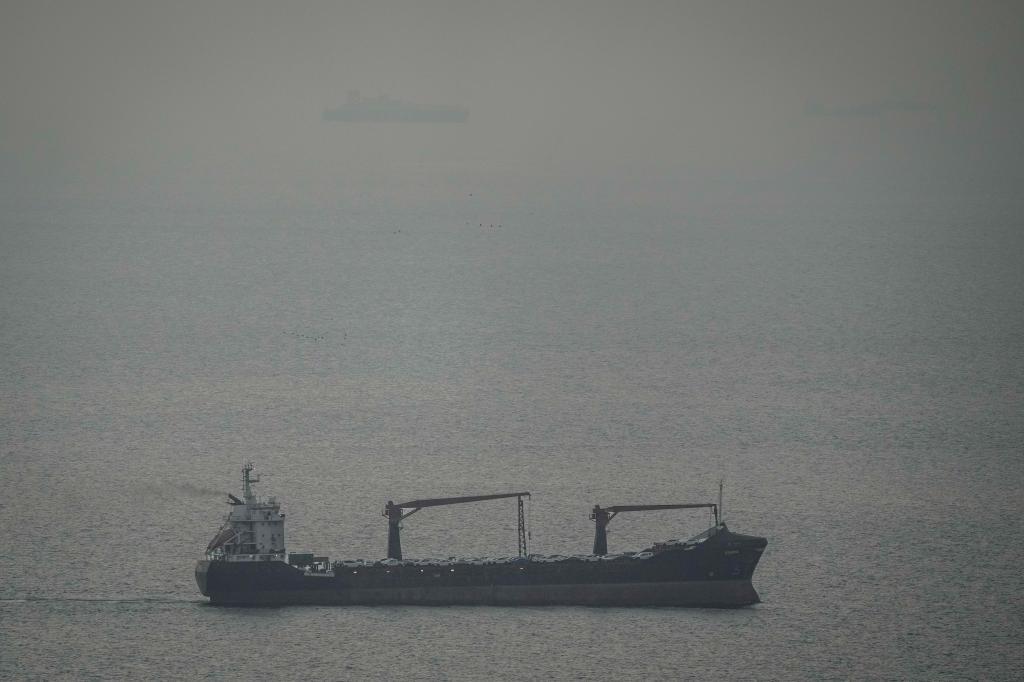
Several stone forts built in the Middle Ages attest to the importance of surveillance on this coast. From that privileged vantage point, we do not see a single ship crossing the Strait at that point. Later, we will verify the number of oil tankers that Iran has allowed to pass without opening fire that day: zero. The place is called Harf Ghabi and is completely empty, although the landscape is conducive to scorpions, snakes, and falcons. From the border, and along 40 kilometers of road, we have not encountered anyone yet.
We decide to continue our journey to the port of Khasab, framed in a fjord of living rock. Along the way, we see several solitary beaches, with perfect weather to enjoy them but no tourists to do so. The beach bars are also closed due to the war. In one of the fjords, we see a sunken boat leaning on one of its sides, and another larger one stranded on the seabed in the middle of the sea. The first person we see in the sultanate is a sailor with a sleepy face coming out of one of the doors to dry his clothes. No one would say that the boat he lives on can sail again.
Until a few weeks ago, this enclave had some tourist interest: the Strait is a common passage for dolphins and whales, and some local fishermen - the main industry in the area - made trips to the channel to see them up close. In addition, it was common to take mountain routes in its rugged landscape or go diving in its crystalline waters. Today, all of that seems like a long time ago, as wooden boats rot stranded in the port of Khasab, the largest town in the Musandam Peninsula.
View of the Strait of Hormuz from the heights of the Harf Ghabi viewpoint, the easternmost part of the peninsula.A.R.
"At night, it is easy to see the Iranian missiles flying towards the United Arab Emirates. They look like shooting stars at first, but then they descend rapidly as if a large meteorite had entered the atmosphere," says Ahmed, a local fisherman who takes advantage of the break to sand down the entire hull of his boat. "From here, you can smell the war and feel it all around. This is a tragedy for us. We are a people who live off the sea, and it is that sea that we cannot go out to now."
- Why can't you sail through the Strait?
- We know that the United States has bombed the fast boats that the Iranians have used to mine the Strait. We don't want to be mistaken for them and get shot at as well.
The reality is that many of these fishermen led a double life. During the day, they cast their nets, and at night, they made other types of trips. Before the current escalation, this Strait was not only an artery of global trade; it also functioned as a gray area of smuggling tolerated in practice by all actors. It was not marginal: it was part of the daily landscape of the Gulf. The main business was fuel smuggling. Iran, with heavily subsidized gasoline, illegally exported huge quantities to the United Arab Emirates and Oman in small fast boats. There, it was resold at market prices.
It was an almost industrial system: thousands of boats, fixed routes, and well-organized networks moving millions of liters daily. The boats returned to Iran with consumer goods to evade sanctions: electronics, industrial parts, cars, and huge amounts of alcohol, a highly prohibited product in Iran. It was also not uncommon to see police seizures on the beaches of Oman when things got out of hand. Many of these products entered from Gulf ports in semi-informal circuits, often with the tacit approval of local authorities. But the war has put an end to all that traffic, legal and illegal.
"Now we are limited to fishing among our own islands," says another fisherman who has just arrived with his boat, but whose nets come back empty. In the streets of the town, paralysis is total. It is true that we are on the last day of Ramadan and that activity drops significantly, but the hotels for tourists are not open and will not open, just like the restaurants, just like the shops. Businesses have closed due to the war.
The port of Khasab, with all the tourist boats moored due to the total absence of visitors.A.R.
The muezzin calls to prayer, and several parishioners spread their prayer mats under a palm tree facing Mecca. "Praise be to Allah," the reverberation of the prayer is heard among the mountains. The feeling here is of time standing still.
"This situation cannot last. This Strait feeds many people on both sides. Everyone is losing money, and if this continues, we will have to find other work," says Ahmed. Everyone here knows that the next move in the global geopolitical chess game will be played in the waters where they have bathed since childhood. Many were also involved in supplying fuel to tankers, supplying ships with food from the coast, crew changes, or evacuating the sick and quick repairs. In a world where 150 large cargo ships crossed from one side to the other every day, there was work for everyone. Today, some are sitting in the port terminal watching life go by.
Yesterday, Iran again attacked several merchant ships in the Gulf, and immediately after, 22 countries announced that they will join efforts to unblock Hormuz. Among them are Bahrain and the United Arab Emirates, perhaps along with Qatar, the country most affected by the aggression against these Gulf monarchies.
Before the war strained everything, the landscape was an almost surreal layering of scales: at dawn, a supertanker would slowly advance, laden with millions of barrels, while just a few meters away a fiberglass boat would speed toward the shore with drums of gasoline; further on, a wooden vessel would silently unload cargo, as it had for centuries, and on the horizon, tugboats and supply ships orbited around it like satellites of a larger system. Everything happened at the same time and in the same place: legal, tolerated, and clandestine trade, without clear boundaries between them, in layers of activity that tolerated and respected one another. Hormuz was not just a maritime passage, but a moving market, where every ship—from the largest to the smallest—was part of a shared economy that functioned precisely because no one fully controlled it. It was an ecosystem that is now under threat.
A couple of fishermen talk with a newcomer about the critical situation in the sector.
For centuries, control of the Strait of Hormuz was key to Oman's maritime power. Its sultanate built a veritable commercial empire between the 17th and 19th centuries. After expelling the Portuguese from the region in 1650, the Omanis dominated the routes between the Gulf, India, and the Swahili coast of Africa, establishing bases in Zanzibar and extending their influence as far as Mombasa. From the Musandam Peninsula, which overlooks the southern entrance to the Strait, they controlled the flow of goods, imposed tariffs, and protected their trade networks. Although this power declined with the arrival of European powers in the 19th century, Oman retained its strategic geographic position as guardian of one of the main gateways to world trade, a role it continues to play, albeit more discreetly, today.
The inhabitants of this peninsula are under no illusions. Although Oman has always played a prominent role as a negotiator of agreements, the crisis will affect everyone to some extent, and they too have suffered from Iranian missile attacks. The sultanate has always acted as a silent and reliable intermediary, a kind of discreet channel between actors who cannot speak directly. This position was consolidated under Sultan Qaboos bin Said and has been maintained by his successor, Haitham bin Tariq. His government is also playing this role in the current crisis. Although tensions are rising, relations between the two sides have not completely broken down.
Whatever Trump's final decision, whether it involves armed convoy escorts or a landing operation, the risks of escalation are more than evident.
Ahmed stands up and points to the opposite shore: "We are very worried here, but I'd rather be on this side than that one. The firepower of the United States must be impressive."