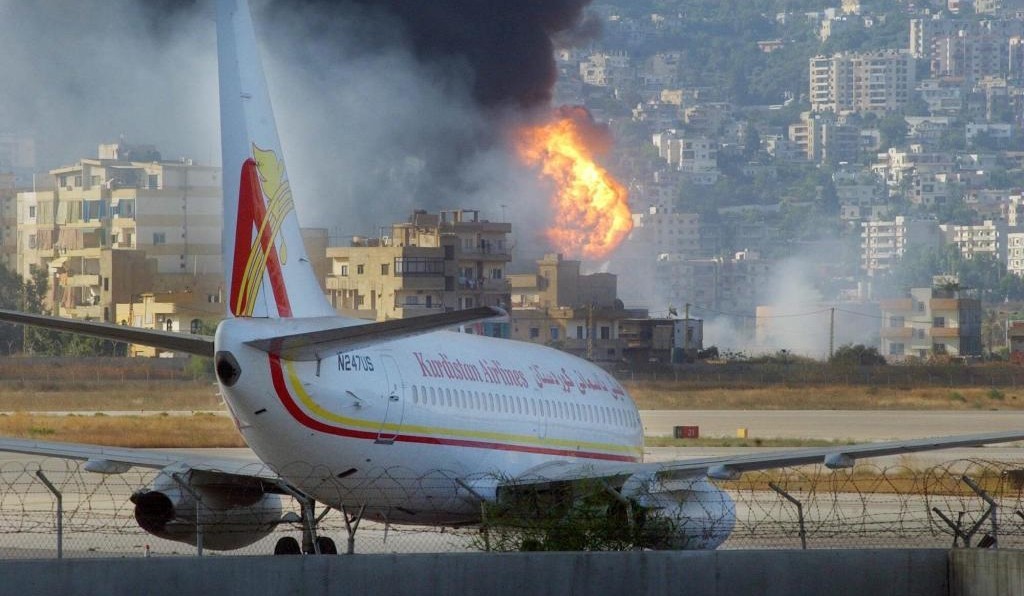
For the Director General of the Lebanese Civil Aviation Authority, Mohammed Aziz, the fact that the Middle East Airlines plane had landed a few kilometers from the huge smoke mushroom marking yet another Israeli air attack did not pose more risks than the "usual" ones.
Aziz, a veteran pilot of the same company, explained this by referring to the map of Beirut airport that adorns the office of his office in those same facilities.
According to his argument, "when you saw the smoke, it was because the bombing had already occurred, and in those circumstances, we use the second runway, further away from Dahiye [the southern neighborhood usually hit by bombs from the neighboring country]."
"It seems close, but the explosions occur five kilometers from the airport. It is a distance we consider safe," he adds.
The determination of Middle East Airlines to maintain the air connection with Beirut both in the 2024 war and in the current one has become one of the few reasons "of pride" - Aziz's expression - to which the population of this country clings, shaken by conflict after conflict.
"Right now, we are flying at 50% of our capacity. Before the war, we had about 60 or 70 flights a day, and now there are 30 or 40. 90% of MEA. It is a decision we make every day. The Americans have assured us that Israel will respect the airport. It is not a business matter. MEA is losing money. It is a patriotic obligation," says the former pilot.
The videos of MEA planes landing or taking off seconds after huge flames and columns of smoke rose from the vicinity of Rafic Hariri airport have gone viral on Lebanese social media. "They are the heroes of the sky," a Lebanese woman said of them in that same virtual space.
Despite Aziz's words, the multiple uncontrollable variables entailed by an armed conflict in the vicinity of an airport have already caused several alarms among the officials of Rafic Hariri airport.
As Transport Minister Fayez Rasammny told NBC on the 6th, air traffic controllers had to make an emergency call for Israeli bombers to stop attacking Beirut and allow the landing of flight ME230, which was about to run out of fuel as it could not land due to the activity of the neighboring country's aviation.
The danger lies not only in the displacement of the airplanes but also in that of the passengers, who have to cross the southern areas of Beirut, punished by the assaults of the Tel Aviv air force.
On the 5th, three people died and five others were injured when two vehicles traveling on the airport road were hit by Israeli drone rockets.
But the troubled memory of the Lebanese always puts the current tragedy into perspective. They equate the situation with the turbulent past they have had to face.
That is why Aziz assures that these turbulent months - those that began with the 2024 war and have continued with the present one - are far from being the most complicated for the pilots of the Lebanese national company.
"Now we know that there is only one responsible for the attacks [Israel] and that they hit a specific target. The worst was during the civil war when you had 30 militias and they launched rockets randomly, not knowing where they would fall," he explains. In those years, just trying to reach the airport was quite an odyssey, as the route was filled with kidnapper groups.
The capital airport had suffered a first assault on December 28, 1968, by Israeli special forces, who blew up a dozen MEA commercial aircraft and two other Lebanese companies as retaliation for an attack by Palestinian militants in Greece. "MEA had a special high-risk insurance that allowed it to stay afloat. The other two companies had to close," Aziz recalls.
The 1968 incident was just the prelude to the fratricidal conflict that began in 1975 and lasted until 1990. During those years, the transport center had to be closed on more than a dozen occasions, including several months in the final phase of the conflict.
In 1976, one of the company's newborn planes traveling to Oman, MEA438, exploded in the air in an attack that was never clarified. 81 people died.
That same year, in June, another plane was hit by indiscriminate militia bombings. Upon realizing the start of the clashes, the airport authorities managed to evacuate the passengers, but the pilot remained on the plane and died in the attack.
Aziz was part of the group of pilots who had to evacuate the MEA fleet to Cyprus in 1982 when Israel invaded Lebanon again. They had to take off avoiding bomb craters.
"MEA is a reflection of Lebanon. We have normalized wars. It is not something positive, but it is our reality," acknowledged Ahmed Karam, who had been waiting for a family member at Rafic Hariri for days.
Despite the persistence of flights by the national company, the connection of most airlines with Beirut has been interrupted or reduced for weeks. The image of the capital airport, almost devoid of passengers, contrasts with how it looked during the last Christmas, when it was crowded.
Similar to what is happening on the other side of the border, at Ben Gurion airport. As Israeli media warn, the only airlines currently using those facilities are four local companies, including the national El Al.
"All flights by foreign companies for March have been canceled," wrote Haaretz on the 19th.
The crisis worsened a day earlier when the airport was hit by Iranian rockets, causing damage to three planes, as authorities admitted.
According to The Times of Israel, the main local company, El Al, "has canceled its scheduled flights until March 27," a measure similar to that taken by two other Israeli firms: Israir and Arkia.
Mark Feldman, head of an Israeli tourism firm, indicated that "Israeli airlines have canceled between 80 and 90% of their regular flights. A minimum number of flights to a minimum number of destinations is operated, with a minimum number of people allowed."
Until the direct attack, Ben Gurion officials had to operate in a somewhat similar warlike environment to that of Rafic Hariri. The account of a group of journalists who visited the facilities this week recalled that after each air raid alarm, the staff had to send out special vehicles nicknamed "carpets" to collect shrapnel remains on the runways.
Unlike Rafic Hariri, the Israeli airport shares its civilian flights with those of the military aviation participating in the current conflict. "It looks like a US military base," one of the reporters who visited the place remarked.
The Iranian regime reported on Saturday that it had attacked the facilities of the complex near Tel Aviv, causing "significant damage" to several fuel depots. The news was not confirmed by the Israelis.
The Tel Aviv airport has not been the only strategic facility in Israel to become a target of the Iranian response in recent days. Despite the strict censorship imposed by the neighboring country's military, Israeli authorities have acknowledged that the main local refinery, Haifa, was hit on the 19th by rockets that caused a violent fire, which was only extinguished with the assistance of 12 fire trucks.
Videos leaked from the scene show the huge smoke rising from the complex. The attack also caused power outages in the country's second-largest city.
Energy Minister Eli Cohen tried to downplay the incident and stated that there were no "significant damages to the infrastructure" of the facility. A statement that was contradicted hours later by the company managing the refinery, the Bazan Group, which admitted that "essential facilities for the operations" of the complex had been affected.