Abdullah Tariaqi holds an almost epic place in the popular legend of Sidon. "He was the great leader of the resistance, even before Hezbollah was known," says Sheikh Husam al Ailani.
On the 16th, the former commander of the Fajr (Dawn) Forces sat in a corner of the Al Ghafran mosque in the main city of southern Lebanon, receiving condolences from hundreds of people. The attendees had filled the nearby streets. Another sign of the great respect that Abdullah commands.
Tel Aviv never forgets. Abdullah is still alive, but his brother Ali's four family members - including Ali himself - had been assassinated by an Israeli missile two days earlier at their residence in the same town. The rocket and subsequent fire destroyed the second-floor home.
The attack on Ali Tariaqi demonstrates that, in Lebanon's troubled history, the past is as significant as the present. The origin of Ali's death dates back many years. To the summer of 1982, when Israel launched its second major invasion of Lebanon to end the resistance of the Palestine Liberation Organization (PLO) led by Yasser Arafat.
Sidon had been captured in June after crushing the Palestinian militants entrenched in the Ain el Hilweh camp. The then Defense Minister, Ariel Sharon, stated that his troops had been received as "liberators" by the Lebanese.
The initial armed actions of the Sunni militants in Sidon against the Israeli occupation, first under Jamal al Habal - who died in 1983 - and then under Abdullah Tariaqi, buried that narrative.
Therefore, figures like the aforementioned Husam al Ailani or the Sidon deputy, Abdu Rahman Bizri - a member of one of the most emblematic families of the city - have no doubts about the reason for the attack on the Tariaqi family. "Revenge", says Ailani.
Retaliation, perhaps, but also the fact that the alliance forged by Abdullah Tariaqi with Hezbollah to confront Tel Aviv's troops has endured over these decades, also questioning the notion that only the Shiite Muslims of the group led by Naim Qassem oppose the Hebrew state.
"We have always fought against Israel and will continue to do so. They have Palestine kidnapped," says Ailani.
The four deaths in the Tariaqi clan add to the nearly two dozen fatalities in Sidon in this new war - the umpteenth - initiated by Israel and the United States in the Middle East. Burials and scenes of burnt cars or collapsed buildings are beginning to multiply in the country's third-largest city.
A broad offensive
The current conflict has revived in Lebanon the specter of a possible massive invasion by the Israeli armed forces, similar to the one the country experienced in 1982.
Several local newspapers like L'Orient Le Jour have indicated in recent days that if Israel decides to launch an offensive as extensive as the one from the last century, their advance would not be limited to the southern regions, as it was not back then either.
According to the aforementioned L'Orient Le Jour, the Israeli assault would aim to occupy both the southern region and the Bekaa Valley, an objective that, according to sources cited by the newspaper, has received the "green light" from the Donald Trump Administration, which also aims - in the newspaper's words - to "avenge" Hezbollah for the hundreds of American soldiers killed in the 1983 attacks.
The hypothesis of such a large-scale assault would require Tel Aviv to deploy tens of thousands of soldiers in Lebanon - emulating the nearly 80,000 used in 1982 - hundreds of tanks - they sent over 1,000 in the initial phase of the 1982 war - and most of their air force, something that has not happened so far.
All Israeli representatives claim that their objective is more limited, but at the same time, they have leaked to the media that they intend to extend the war "for months". The Lebanese also remember history. In 1982, Israel promised that the advance would last a maximum of 72 hours and would not exceed 40 kilometers. Not beyond Sidon. Within a week, they were in Beirut.
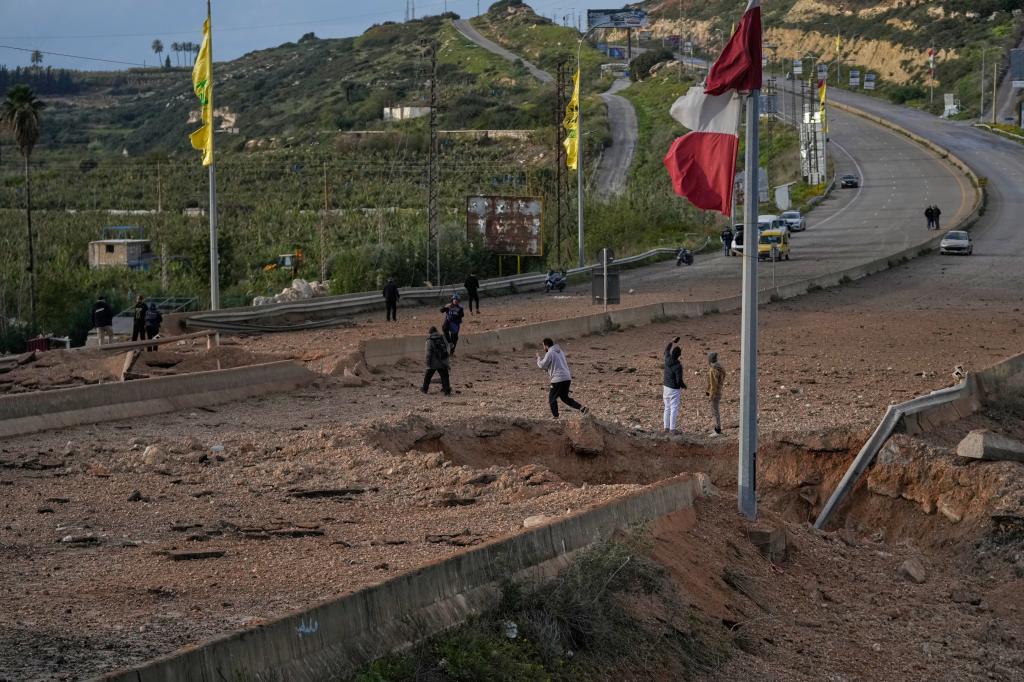
The evacuation orders issued by Israel already affect 15% of the territory and have caused the exodus of over a million people.
In Sidon, for example, there are already close to 50,000 displaced people. Hundreds of them are living precariously on the town's beach, in small tents, or simply sleeping inside their cars. They can be seen parked along the promenade.
Hundreds of Syrians have chosen to settle on the mass grave where hundreds of Lebanese and Palestinian victims of the 1982 Israeli attack were buried. "Cemetery of the Martyrs of Sidon who fell during June 1982 as a result of the treacherous Israeli occupation," reads the plaque installed next to the tarps tied with plastics and fastened to the trees, serving as a roof for homeless families.
Abdel Majed Hariri, 31, has ended up in the exact same corner of the cemetery where he settled in 2024, during the previous confrontation. He lived near Tyre, just 20 kilometers from Israel, and both two years ago and now, he had to flee as soon as the conflict began due to the violent bombings launched by the Tel Aviv air force in that area.
Majed doesn't even know he is now sleeping on the graves of those killed by the last century's occupation. Nor does he know how long he will stay here or how he will feed his three children, all under six years old. "God will decide," he asserts, looking up at the sky.
Emptying of the territory
Many analysts believe that Tel Aviv's real objective is to occupy a strip on the border of several kilometers, repeating once again the experience initiated in 1978 and continued in 1982, with one exception. "They want to occupy that territory but leave it empty," says Bizri. "I don't think the Israelis will try to repeat what happened in 1982. They will lose many soldiers," he adds.
From 1978, Israel maintained control of the region bordering its northern boundary, using local population members as allied militias. Many of them became double agents, intensifying the guerrilla warfare that the occupying army had to face. Tel Aviv ended up losing over 1,200 soldiers and had to withdraw in 2000. For several Israeli generations, that was their particular "Vietnam," as the local media dubbed it.
"Israel wants to establish a 'death zone' [like in Ukraine] in the south, without population," agrees former General Khaled Hamadeh, who was the director of the Strategic Studies Center of the Lebanese Army.
"Israel wants to establish a 'kill zone' [like in Ukraine] in the south, devoid of any population," agrees former General Khaled Hamadeh, who was director of the Lebanese Army's Center for Strategic Studies.
The former military officer believes that the Israeli military intends to unleash a general offensive "to destroy not only Hezbollah's weapons, but its entire socio-economic network," and he has no doubt that they will apply the Gaza Doctrine, based on absolute destruction. Repeated Israeli actions have generated widespread anxiety among the Lebanese population, deepening communal divisions, as already occurred during the civil war, in which the Israeli military played a very active role.
Bizri is currently downplaying the "minor clashes" that have already occurred between religious groups and displaced Shiites, who are beginning to be perceived as a threat.
Following the Israeli airstrike on two hotels—one located in a predominantly Christian neighborhood and the other in a predominantly Sunni area—many establishments have turned to the country's security services to identify their potential guests.
Tel Aviv continues to stoke this fear and obsession among a large segment of the Lebanese population. An Israeli military spokesperson who speaks Arabic, Ella Waweya, claimed on social media that "there are fighters from the Iranian Islamic Revolutionary Guard Corps with forged documents hidden among civilians" in "five-star hotels in Beirut," without providing the slightest evidence.
Sectarian tension is becoming increasingly visible throughout Lebanon. "We only live with people we know. We don't trust strangers. I have a house in the mountains [in the Druze area]. The mayor called me the other day and told me that if I wanted to rent it out, I would have to provide him with the tenants' ID cards, and that they would have to be investigated before being allowed in," explains Ahmad Zahabi, a Spaniard living in Sidon.
On the 15th, Israeli aircraft dropped thousands of leaflets over the streets of Beirut, drawing a parallel between the devastation suffered by Gaza and that of Israel, urging the population to spy for them and "disarm" Hezbollah, resorting to a tactic already used in the Palestinian territory and in Israel itself during the civil war.
A professor at Tel Aviv University, Eliav Lieblich, quoted by the Haaretz newspaper, noted that "spreading fear among the population is absolutely prohibited [under international law]. These kinds of messages are very close to crossing that line, if they haven't already crossed it completely."
However, Hezbollah's paramilitaries face not only rejection from a significant segment of the Lebanese population, but also opposition from the country's new leadership, whose president, the Christian Joseph Aoun, accused them of seeking the "collapse" of the state "for the sake of the Iranian regime's calculations."
Both Washington and Tel Aviv are pressuring Beirut at all levels to have its army attempt to disarm Hezbollah, a task that even Israeli soldiers have been unable to accomplish. The ironic circumstance in this case is that the Lebanese army has been subject to a de facto embargo since the end of the civil war, preventing it from acquiring sophisticated weapons from the West, despite Israel's opposition.
"Yes, Israel imposes restrictions on the weapons we can have," admits former General Hamadeh.
"The Lebanese army doesn't have the capacity to confront Hezbollah. They have nothing. In the 19 years I spent in Lebanon, they were never provided with what they need, except for a few vehicles and a small boat. They have no aircraft. Only a few helicopters. They can't disarm Hezbollah by force," asserts Andrea Tenenti, former spokesperson for the UN peacekeepers deployed in southern Lebanon.
With nearly two decades of experience in the Arab nation, Tenenti warns that any attempt to use Lebanese troops to pressure Hezbollah could also revive another ghost from the past: the division suffered by the nation's Armed Forces during the civil war, when they fractured along sectarian lines. "Yes, there is a danger that the army will split," Tenenti emphasizes.
Existential Battle for Hezbollah
For Hezbollah, the current conflict is a struggle that will define its future. "It's an existential battle, not something limited," Naim Qassem stated on the 15th. The secretary general of the so-called Party of God said they have "learned from their mistakes," which would explain the fierce resistance Israeli tanks are encountering along the border.
"Both sides are showing inflexibility. It's a war that will last a long time," General Hammadeh emphasized.
On August 8, 1982, then-Israeli Prime Minister Menachem Begin delivered a historic speech at the National Defense College in which he acknowledged that—as was the case today—Israel had initiated the wars of 1956 and 1967, as well as the invasion of Lebanon. He added that these were "wars without alternative."
At the time of his speech, Tel Aviv's forces had already surrounded Yasser Arafat in western Beirut and were on the verge of forcing him to leave the Lebanese capital. The "new era" in the Middle East promised by his Defense Minister, Ariel Sharon, seemed within reach.
"We can now look beyond the fighting. I know we will have a long period of peace," he proclaimed.
It was then that Abdullah Tariaqi appeared. And, shortly after, Hezbollah.