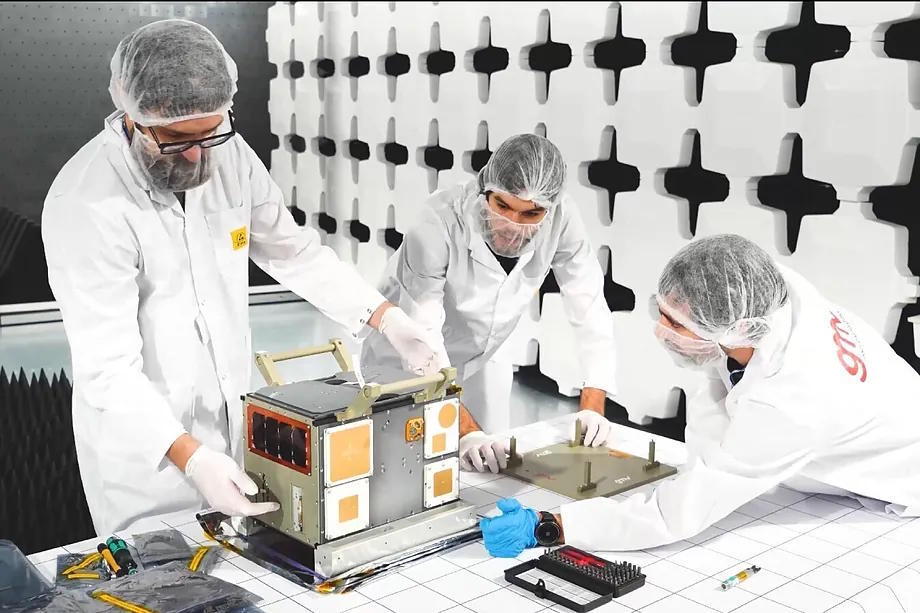
Satellite navigation has become a crucial technology on which we are increasingly dependent. This week, the European Space Agency (ESA) will launch the first two spacecraft of a new demonstration constellation named Celeste, aiming to enhance the geopositioning capabilities of our continent in the future.
The first phase of this long-term vision program was approved in 2022 and consists of 11 satellites (plus one spare) that will fly close to Earth. "With Celeste, we aim to increase the resilience of navigation systems to make them more robust and secure, and also to offer new services that are more challenging to provide from a medium orbit," explains Roberto Prieto Cerdeira, head of the Celeste Program at ESA, during a video conference press briefing.
These satellites will operate in low Earth orbit (LEO) to test cutting-edge technologies and add frequency bands for Galileo satellite navigation, which is Europe's Global Navigation Satellite System, in other words, the European GPS, operating in medium Earth orbit (MEO) at around 23,222 kilometers altitude. "Society depends on these navigation systems, and in Europe, we have Galileo, which has been successful and is the most accurate system in the world. Why do we need something more? Because these systems are vulnerable to natural environmental effects, such as solar radiation or solar storms, or hacking attempts," says Prieto.
With Celeste, he explains, "the aim is to reduce dependence on other foreign systems. The goal is to demonstrate how a layer of lower satellites can complement the current system, not so much in precision but to ensure that it works and is available all the time for all users."
If there are no delays, its first two satellites, named Celeste IOD-1 and IOD-2, will launch from the Mhia base in New Zealand on March 24 aboard the Electron rocket from Rocket Lab. "We cannot launch all 11 satellites at once because they will operate in different orbits. The first two had to launch before May, and we chose to do it from New Zealand since the available European launchers were limited, and Rocket Lab guaranteed us the ability to launch when needed," explains Prieto.
In the future, he states, they will try to use European rockets to launch the program's satellites, "as in addition to the existing ones, Ariane and Vega, there are other launchers in development, including PLD Space's.
The first two satellites of the constellation are large Cubesats (Celeste IOD-1 weighs 20 kilograms and IOD-2, 30 kg) and will operate at an altitude of about 510 kilometers. The following satellites will launch throughout 2027 and early 2028 and will be larger in size.
According to Prieto, the goal is for the future satellites of the constellation to orbit higher, at around 1,000 or 1,200 kilometers from Earth. "We have to develop systems that are useful to society but in a responsible manner, not launching just for the sake of launching. We try to minimize the number of satellites to reduce the risk of collision with other existing constellations, something that is taken into account when seeking optimal orbits for their operation," he points out regarding the issue of space debris accumulation.
The fleet is being developed through two parallel contracts, led respectively by GMV (Spain) with OHB (Germany) as the main partner, and by Thales Alenia Space (France) as the main contractor and Thales Alenia Space (Italy) responsible for the space segment. The two consortia include more than fifty entities from 14 countries.
"For us, this is a special project, not only because of the challenges posed by a program of this kind, which are many, but also because it demonstrates what the European industry, and particularly the Spanish industry, is capable of when working together towards common goals," states Eduardo Fernández Matamala, deputy director of the Celeste program at GMV. "In less than two years, we have been able to design, build, and validate the IOD-1 satellite, as well as a ground segment that will operate and monitor it," he notes.
The first phase of Celeste has a funding of 200 million euros. During the ESA Ministerial Council held in November in Germany, member countries supported the implementation of the next phase, which will have around 500 million euros. Additionally, Celeste contributes to the ESA initiative called Resilient Europe from Space (ERS), which aims to address the critical security and resilience needs of member states and lay the groundwork for the continent's future strategic space capabilities.
According to Roberto Prieto, "resilience is a fundamental aspect," and with Celeste, the aim is to reduce "the possibility of energy system failures and communication network breakdowns that rely on positioning." Transportation is another sector that will benefit from this constellation, both in terms of aircraft navigation services and autonomous vehicle navigation. He anticipates that it will have governmental and defense uses, as well as more commercial applications aimed at the general population, although they are not the priority. "One of the particularities of Celeste compared to existing systems is that it seeks to provide specific solutions for each user," he emphasizes.